
Close Menu
    Facebook X (Twitter) Instagram
    SciTechDaily
    • Biology
    • Chemistry
    • Earth
    • Health
    • Physics
    • Science
    • Space
    • Technology
    Facebook X (Twitter) Pinterest YouTube RSS
    SciTechDaily
    Home»Space»Cassini Views Water Jets from Enceladus
    Space

    Cassini Views Water Jets from Enceladus

    By SciTechDailyNovember 30, 20151 Comment2 Mins Read
    Facebook Twitter Pinterest Telegram LinkedIn WhatsApp Email Reddit
    Share
    Facebook Twitter LinkedIn Pinterest Telegram Email Reddit
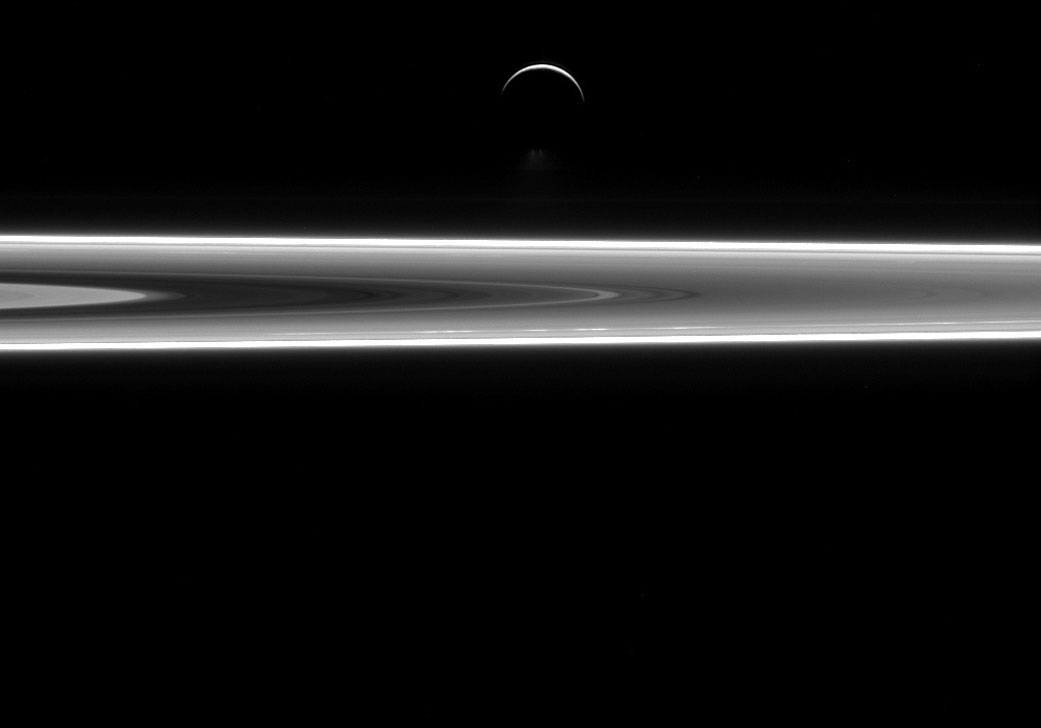
    New Cassini Image of Enceladus
    Water jets shooting from the southern region of Saturn’s moon Enceladus. Credit: NASA/JPL-Caltech/Space Science Institute

    This image from the Cassini Spacecraft shows water jets shooting from the southern region of Saturn’s moon Enceladus. Also visible are the rings of Saturn.

    Although Enceladus and Saturn’s rings are largely made up of water ice, they show very different characteristics. The small ring particles are too tiny to retain internal heat and have no way to get warm, so they are frozen and geologically dead. Enceladus, on the other hand, is subject to forces that heat its interior to this very day. This results in its famous south polar water jets, which are just visible above the moon’s dark, southern limb, along with a sub-surface ocean.

    Recent work by Cassini scientists suggests that Enceladus (313 miles or 504 kilometers across) has a global ocean of liquid water under its surface. This discovery increases scientists’ interest in Enceladus and the quest to understand the role of water in the development of life in the solar system. (For more on the sub-surface ocean, see this story.

    This view looks toward the unilluminated side of the rings from about 0.3 degrees below the ring plane. The image was taken in visible light with the Cassini spacecraft narrow-angle camera on July 29, 2015.

    The view was acquired at a distance of approximately 630,000 miles (1.0 million kilometers) from Enceladus and at a Sun-Enceladus spacecraft, or phase angle of 155 degrees. The image scale is 4 miles (6 kilometers) per pixel.

    Never miss a breakthrough: Join the SciTechDaily newsletter.
    Follow us on Google and Google News.

    Astronomy Cassini-Huygens Mission Enceladus Planetary Science Popular Saturn
    Share. Facebook Twitter Pinterest LinkedIn Email Reddit

    Related Articles

    Listen to the Sound of Plasma Waves Moving Between Saturn and Enceladus

    Newly Released Cassini Image – The Dew Drop of Saturn

    Cassini Spacecraft to Begin Flyby of Saturn’s Moon Enceladus

    Cassini Reveals Global Ocean in Saturn’s Moon Enceladus

    Activity on Enceladus Could Be ‘Curtain Eruptions’

    Saturn’s Moon Enceladus Exhibits Signs of Hydrothermal Activity

    Scientists Pinpoint the Position of Saturn

    NASA Detects Ocean Inside Saturn’s Moon Enceladus

    Storm Spawns the Largest Tropospheric Vortex Ever Seen on Saturn

    1 Comment

    1. Madanagopal.V.C. on November 30, 2015 8:07 am

      The feeble southern glow of Saturn’s moon Enceladus is a fantastic sight. We know that all the comets contain ice and stones and water itself is a cosmic making extra-planetary. Water should have been splashed on any planet by the innumerous comets encircling any star in the galaxy. Mostly planetary water would be found on its poles only since they are not exposed to sun very much during its spinning. Here too the polar regions of Enceladus contain water not in ice form but in water form itself , because it is exposed to its second sun the Saturn which is itself a failed star.Hot geysers would be spitting out the water so that they are visible to Cassini the surveyor. Thank You.

      Reply
    Leave A Reply Cancel Reply

    • Facebook
    • Twitter
    • Pinterest
    • YouTube

    Don't Miss a Discovery

    Subscribe for the Latest in Science & Tech!

    Trending News

    Artificial Sweeteners May Harm Future Generations, Study Suggests

    Splashdown! NASA Artemis II Returns From Record-Breaking Moon Mission

    What If Consciousness Exists Beyond Your Brain

    Scientists Finally Crack the 100-Million-Year Evolutionary Mystery of Squid and Cuttlefish

    Beyond “Safe Levels”: Study Challenges What We Know About Pesticides and Cancer

    Researchers Have Found a Dietary Compound That Increases Longevity

    Scientists Baffled by Bizarre “Living Fossil” From 275 Million Years Ago

    Your IQ at 23 Could Predict Your Wealth at 27, Study Finds

    Follow SciTechDaily
    • Facebook
    • Twitter
    • YouTube
    • Pinterest
    • Newsletter
    • RSS
    SciTech News
    • Biology News
    • Chemistry News
    • Earth News
    • Health News
    • Physics News
    • Science News
    • Space News
    • Technology News
    Recent Posts
    • What if Dark Matter Has Two Forms? Bold New Hypothesis Could Explain a Cosmic Mystery
    • Researchers Expose Hidden Chemistry of “Ore-Forming” Elements in Biology
    • Geologists Reveal the Americas Collided Earlier Than We Thought
    • 20x Difference: Study Reveals True Source of Airborne Microplastics
    • Scientists Uncover Hidden Force Powering Yellowstone’s Supervolcano
    Copyright © 1998 - 2026 SciTechDaily. All Rights Reserved.
    • Science News
    • About
    • Contact
    • Editorial Board
    • Privacy Policy
    • Terms of Use

    Type above and press Enter to search. Press Esc to cancel.