
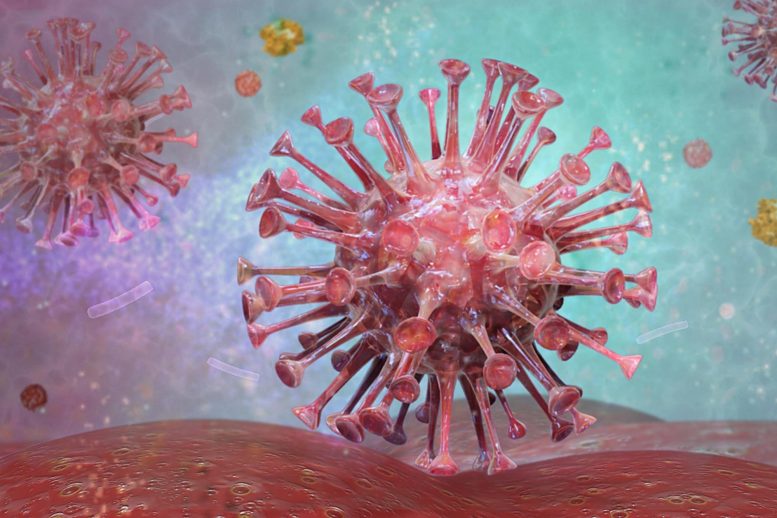
New research unveils initial insights into the mechanisms by which stem cell transplantation can eliminate the virus responsible for AIDS.
New findings from Oregon Health & Science University help explain how at least five individuals have been cured of HIV following stem cell transplants. This research paves the way toward the potential development of a widespread remedy for the virus that results in AIDS, currently affecting approximately 38 million people globally.
The study, which was published in the journal Immunity, sheds light on how two nonhuman primates were successfully treated for the monkey form of HIV through stem cell transplants. It further reveals that a cure can only be achieved when two specific conditions coincide and present the sequential process in which HIV is eradicated from the body. These findings provide valuable insights that can guide efforts to extend this curative strategy to a larger population.
“Five patients have already demonstrated that HIV can be cured,” said the study’s lead researcher, Jonah Sacha, Ph.D., a professor at OHSU’s Oregon National Primate Research Center and Vaccine and Gene Therapy Institute.
“This study is helping us home in on the mechanisms involved in making that cure happen,” Sacha continued. “We hope our discoveries will help to make this cure work for anyone, and ideally through a single injection instead of a stem cell transplant.”
The first known case of HIV being cured through a stem cell transplant was reported in 2009. A man who was living with HIV was also diagnosed with acute myeloid leukemia, a type of cancer, and underwent a stem cell transplant in Berlin, Germany. Stem cell transplants, which are also called bone marrow transplants, are used to treat some forms of cancer. Known as the Berlin patient, he received donated stem cells from someone with a mutated CCR5 gene, which normally codes for a receptor on the surface of white blood cells that HIV uses to infect new cells. A CCR5 mutation makes it difficult for the virus to infect cells and can make people resistant to HIV. Since the Berlin patient, four more people have been similarly cured.
This study was conducted with a species of nonhuman primate known as Mauritian cynomolgus macaques, which the research team previously demonstrated can successfully receive stem cell transplants. While all of the study’s eight subjects had HIV, four of them underwent a transplant with stem cells from HIV-negative donors, and the other half served as the study’s controls and went without transplants.
Of the four that received transplants, two were cured of HIV after successfully being treated for graft-versus-host disease, which is commonly associated with stem cell transplants.
Other researchers have tried to cure nonhuman primates of HIV using similar methods, but this study marks the first time that HIV-cured research animals have survived long-term. Both remain alive and HIV-free today, about four years after transplantation. Sacha attributes their survival to exceptional care from Oregon National Primate Research Center veterinarians and the support of two study coauthors, OHSU clinicians who care for people who undergo stem cell transplants: Richard T. Maziarz, M.D., and Gabrielle Meyers, M.D.
“These results highlight the power of linking human clinical studies with pre-clinical macaque experiments to answer questions that would be almost impossible to do otherwise, as well as demonstrate a path forward to curing human disease,” said Maziarz, a professor of medicine in the OHSU School of Medicine and medical director of the adult blood and marrow stem cell transplant and cellular therapy programs in the OHSU Knight Cancer Institute.
The How Behind the Cure
Although Sacha said it was gratifying to confirm stem cell transplantation cured the nonhuman primates, he and his fellow scientists also wanted to understand how it worked. While evaluating samples from the subjects, the scientists determined there were two different, but equally important, ways they beat HIV.
First, the transplanted donor stem cells helped kill the recipients’ HIV-infected cells by recognizing them as foreign invaders and attacking them, similar to the process of graft-versus-leukemia that can cure people of cancer.
Second, in the two subjects that were not cured, the virus managed to jump into the transplanted donor cells. A subsequent experiment verified that HIV was able to infect the donor cells while they were attacking HIV. This led the researchers to determine that stopping HIV from using the CCR5 receptor to infect donor cells is also needed for a cure to occur.
The researchers also discovered that HIV was cleared from the subjects’ bodies in a series of steps. First, the scientists saw that HIV was no longer detectable in the blood circulating in their arms and legs. Next, they couldn’t find HIV in lymph nodes, or lumps of immune tissue that contain white blood cells and fight infection. Lymph nodes in the limbs were the first to be HIV-free, followed by lymph nodes in the abdomen.
The step-wise fashion by which the scientists observed HIV being cleared could help physicians as they evaluate the effectiveness of potential HIV cures. For example, clinicians could focus on analyzing blood collected from both peripheral veins and lymph nodes. This knowledge may also help explain why some patients who have received transplants initially have appeared to be cured, but HIV was later detected. Sacha hypothesizes that those patients may have had a small reservoir of HIV in their abdominal lymph nodes that enabled the virus to persist and spread again throughout the body.
Sacha and colleagues continue to study the two nonhuman primates cured of HIV. Next, they plan to dig deeper into their immune responses, including identifying all of the specific immune cells involved and which specific cells or molecules were targeted by the immune system.
Reference: “Allogeneic immunity clears latent virus following allogeneic stem cell transplantation in SIV-infected ART-suppressed macaques” by Helen L. Wu, Kathleen Busman-Sahay, Whitney C. Weber, Courtney M. Waytashek, Carla D. Boyle, Katherine B. Bateman, Jason S. Reed, Joseph M. Hwang, Christine Shriver-Munsch, Tonya Swanson, Mina Northrup, Kimberly Armantrout, Heidi Price, Mitch Robertson-LeVay, Samantha Uttke, Mithra R. Kumar, Emily J. Fray, Sol Taylor-Brill, Stephen Bondoc, Rebecca Agnor, Stephanie L. Junell, Alfred W. Legasse, Cassandra Moats, Rachele M. Bochart, Joseph Sciurba, Benjamin N. Bimber, Michelle N. Sullivan, Brandy Dozier, Rhonda P. MacAllister, Theodore R. Hobbs, Lauren D. Martin, Angela Panoskaltsis-Mortari, Lois M.A. Colgin, Robert F. Siliciano, Janet D. Siliciano, Jacob D. Estes, Jeremy V. Smedley, Michael K. Axthelm, Gabrielle Meyers, Richard T. Maziarz, Benjamin J. Burwitz, Jeffrey J. Stanton and Jonah B. Sacha, 25 May 2023, Immunity.
DOI: 10.1016/j.immuni.2023.04.019
The study was funded by the National Institutes of Health, the Foundation for AIDS Research, and the Foundation for AIDS Immune Research.
Never miss a breakthrough: Join the SciTechDaily newsletter.
Follow us on Google and Google News.