
Close Menu
    Facebook X (Twitter) Instagram
    SciTechDaily
    • Biology
    • Chemistry
    • Earth
    • Health
    • Physics
    • Science
    • Space
    • Technology
    Facebook X (Twitter) Pinterest YouTube RSS
    SciTechDaily
    Home»Space»Hubble Views Turbulent Birthing Ground Orion B Molecular Cloud Complex
    Space

    Hubble Views Turbulent Birthing Ground Orion B Molecular Cloud Complex

    By Ray Villard, Space Telescope Science InstituteDecember 17, 20151 Comment4 Mins Read
    Facebook Twitter Pinterest Telegram LinkedIn WhatsApp Email Reddit
    Share
    Facebook Twitter LinkedIn Pinterest Telegram Email Reddit
    Hubble Sees the Force Awakening in a Newborn Star
    This celestial lightsaber does not lie in a galaxy far, far away, but rather inside our home galaxy, the Milky Way. It’s inside a turbulent birthing ground for new stars known as the Orion B molecular cloud complex, located 1,350 light-years away. Credit: NASA/ESA

    NASA’s Hubble Space Telescope views a newborn star shooting twin jets out into space as a sort of birth announcement to the universe.

    Just in time for the release of the movie “Star Wars Episode VII: The Force Awakens,” NASA’s Hubble Space Telescope has photographed what looks like a cosmic, double-bladed lightsaber.

    “Science fiction has been an inspiration to generations of scientists and engineers, and the film series Star Wars is no exception,” said John Grunsfeld, astronaut and associate administrator for the NASA Science Mission directorate. “There is no stronger case for the motivational power of real science than the discoveries that come from the Hubble Space Telescope as it unravels the mysteries of the universe.”

    This celestial lightsaber does not lie in a galaxy far, far away, but rather inside our home galaxy, the Milky Way. It’s inside a turbulent birthing ground for new stars known as the Orion B molecular cloud complex, located 1,350 light-years away.


    This sequence combines a two-dimensional zoom and a three-dimensional flight to explore the Hubble Space Telescope’s striking image of the Herbig-Haro object known as HH 24. Credit: NASA, ESA, and F. Summers, G. Bacon, Z. Levay, and L. Frattare (Viz 3D Team, STScI)

    When stars form within giant clouds of cool molecular hydrogen, some of the surrounding material collapses under gravity to form a rotating, flattened disk encircling the newborn star.

    Though planets will later congeal in the disk, at this early stage the protostar is feeding on the disk with a Jabba-like appetite. Gas from the disk rains down onto the protostar and engorges it. Superheated material spills away and is shot outward from the star in opposite directions along an uncluttered escape route — the star’s rotation axis.

    Shock fronts develop along the jets and heat the surrounding gas to thousands of degrees Fahrenheit. The jets collide with the surrounding gas and dust and clear vast spaces, like a stream of water plowing into a hill of sand. The shock fronts form tangled, knotted clumps of nebulosity and are collectively known as Herbig-Haro (HH) objects. The prominent HH object shown in this image is HH 24.

    Just to the right of the cloaked star, a couple of bright points are young stars peeking through and showing off their own faint lightsabers — including one that has bored a tunnel through the cloud towards the upper-right side of the picture.
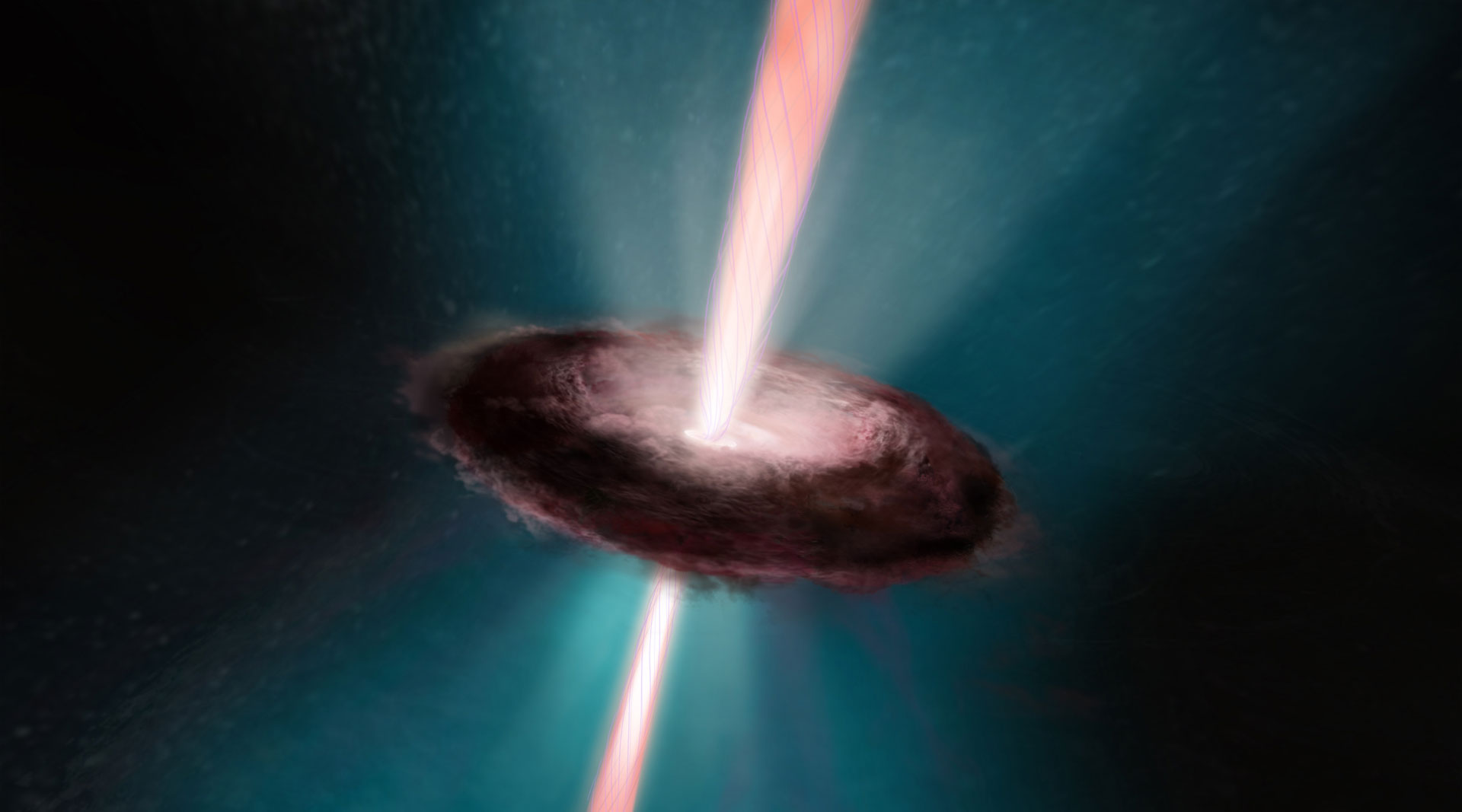
    Hubble Views a Turbulent Birthing Ground for New Stars
    This is an artist’s concept of the fireworks that accompany the birth of a star. The young stellar object is encircled by a pancake-shaped disk of dust and gas left over from the collapse of the nebula that formed the star. Gas falls onto the newly forming star and is heated to the point that some of it escapes along the star’s spin axis. Intertwined by magnetic fields, the bipolar jets blast into space at over 100,000 miles (160,000 kilometers) per hour. As seen from far away, they resemble a double-bladed lightsaber from the Star Wars film series. Credit: NASA, ESA, and A. Feild (STScI)

    Overall, just a handful of HH jets have been spotted in this region in visible light, and about the same number in the infrared. Hubble’s observations for this image were performed in infrared light, which enabled the telescope to peer through the gas and dust cocooning the newly forming stars and capture a clear view of the HH objects.

    These young stellar jets are ideal targets for NASA’s upcoming James Webb Space Telescope, which will have even greater infrared wavelength vision to see deeper into the dust surrounding newly forming stars.

    Never miss a breakthrough: Join the SciTechDaily newsletter.
    Follow us on Google and Google News.

    Astronomy Astrophysics Cosmology Hubble Space Telescope NASA Star Formation
    Share. Facebook Twitter Pinterest LinkedIn Email Reddit

    Related Articles

    Hubble Detects ‘Exocomets’ Plunging Into Young Star HD 172555

    Astronomers Discover a 17 Billion Solar-Mass Black Hole in an Unlikely Place

    Astronomers Measure the Farthest Galaxy Ever Seen in the Universe

    Hubble Image of the Week: Quadruple Star System DI Cha

    ESO and Hubble Reveal Fast-Moving, Wave-Like Features in the Debris Disk Around AU Microscopii

    New Phoenix Cluster Observations Provide A Fresh Perspective

    Evidence of Galaxy Star Birth Regulated by Black Holes

    The Bolshoi Simulation: Boxing the Universe

    Hubble Observes Rare Blue Stars in Andromeda’s Core

    1 Comment

    1. harold wisdom on January 27, 2018 2:24 pm

      earth too may have one of these energy spews and much alike an fresh water clam and or muscle life form uses such as jet propulsion and the world size version having the thrust ability of an atmospheric meteorite would be able to be at least six times beyond the speed of sound quickly and with the radio active bacteria and heavy split atoms scattered about in chernobyl and japan the air borne off spring will assist the metamorphic process along with an invisible version yet it alike the space shuttles propulsion can be shut down in an emergency situation in the near future by draining it of its energy and or its fuel supply and or its electrical energy supply to help chernobyl with such will require an micro biology specialist to control their over population and clean up of its made heavy split atoms via an very cautious process they and earth science specialist should be very good at.

      Reply
    Leave A Reply Cancel Reply

    • Facebook
    • Twitter
    • Pinterest
    • YouTube

    Don't Miss a Discovery

    Subscribe for the Latest in Science & Tech!

    Trending News

    The Universe Is Expanding Too Fast and Scientists Can’t Explain Why

    “Like Liquid Metal”: Scientists Create Strange Shape-Shifting Material

    Early Warning Signals of Esophageal Cancer May Be Hiding in Plain Sight

    Common Blood Pressure Drug Shows Surprising Power Against Deadly Antibiotic-Resistant Superbug

    Scientists Uncover Dangerous Connection Between Serotonin and Heart Valve Disease

    Scientists Discover a “Protector” Protein That Could Help Reverse Hair Loss

    Bone-Strengthening Discovery Could Reverse Osteoporosis

    Scientists Uncover Hidden Trigger Behind Stem Cell Aging

    Follow SciTechDaily
    • Facebook
    • Twitter
    • YouTube
    • Pinterest
    • Newsletter
    • RSS
    SciTech News
    • Biology News
    • Chemistry News
    • Earth News
    • Health News
    • Physics News
    • Science News
    • Space News
    • Technology News
    Recent Posts
    • A Common Diabetes Drug May Hold the Key to Stopping HIV From Coming Back
    • Ancient “Syphilis-Like” Disease in Vietnam Challenges Key Scientific Assumptions
    • Drinking Alcohol To Cope in Your 20s Could Damage Your Brain for Life
    • Scientists Crack Alfalfa’s Chromosome Mystery After Decades of Debate
    • Ancient Ant-Plant Alliance Collapses As Predatory Wasps Move In
    Copyright © 1998 - 2026 SciTechDaily. All Rights Reserved.
    • Science News
    • About
    • Contact
    • Editorial Board
    • Privacy Policy
    • Terms of Use

    Type above and press Enter to search. Press Esc to cancel.