
New imagery from NASA’s Hubble Space Telescope is revealing details never before seen on Jupiter. High-resolution maps and spinning globes (rendered in the 4k Ultra HD format) are the first products to come from a program to study the solar system’s outer planets each year using Hubble. The observations are designed to capture a broad range of features, including winds, clouds, storms and atmospheric chemistry. These annual studies will help current and future scientists see how such giant worlds change over time.
Using the Hubble Space Telescope, astronomers have produced new maps of Jupiter – the first in a series of annual portraits of the solar system’s outer planets.
Collecting these yearly images – essentially the planetary version of annual school picture days for children – will help current and future scientists see how these giant worlds change over time. The observations are designed to capture a broad range of features, including winds, clouds, storms, and atmospheric chemistry.
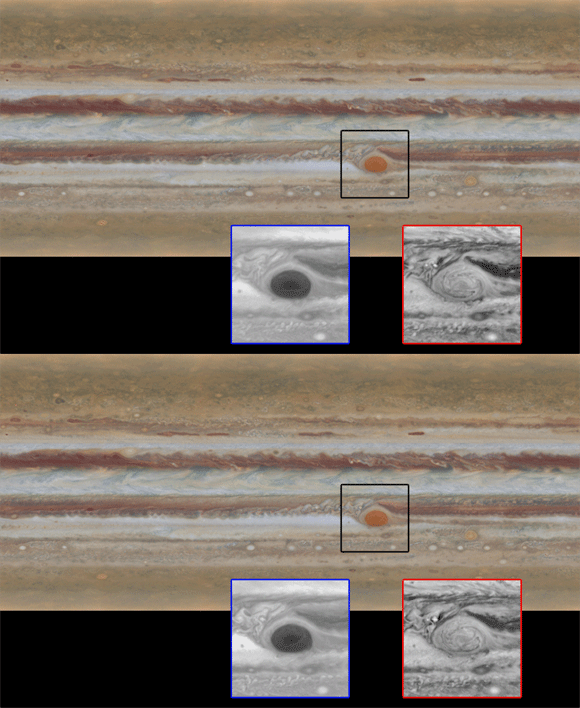
Already, the Jupiter images have revealed a rare wave just north of the planet’s equator and a unique filamentary feature in the core of the Great Red Spot not seen previously.
“Every time we look at Jupiter, we get tantalizing hints that something really exciting is going on,” said Amy Simon, a planetary scientist at NASA’s Goddard Space Flight Center in Greenbelt, Maryland. “This time is no exception.”
Simon and her colleagues produced two global maps of Jupiter from observations made using Hubble’s high-performance Wide Field Camera 3. The two maps represent nearly back-to-back rotations of the planet, making it possible to determine the speeds of Jupiter’s winds. The findings are described in an Astrophysical Journal paper.
The new images confirm that the Great Red Spot continues to shrink and become more circular, as it has been doing for years. The long axis of this characteristic storm is about 150 miles (240 kilometers) shorter now than it was in 2014. Recently, the storm had been shrinking at a faster-than-usual rate, but the latest change is consistent with the long-term trend.
The Great Red Spot remains more orange than red these days, and its core, which typically has more intense color, is less distinct than it used to be. An unusual wispy filament is seen, spanning almost the entire width of the vortex. This filamentary streamer rotates and twists throughout the 10-hour span of the Great Red Spot image sequence, getting distorted by winds blowing at 330 miles per hour (150 meters per second) or even greater speeds.
In Jupiter’s North Equatorial Belt, the researchers found an elusive wave that had been spotted on the planet only once before, decades earlier, by Voyager 2. In those images, the wave is barely visible, and nothing like it was seen again, until the current wave was found traveling at about 16 degrees north latitude, in a region dotted with cyclones and anticyclones. Similar waves – called baroclinic waves – sometimes appear in Earth’s atmosphere where cyclones are forming.
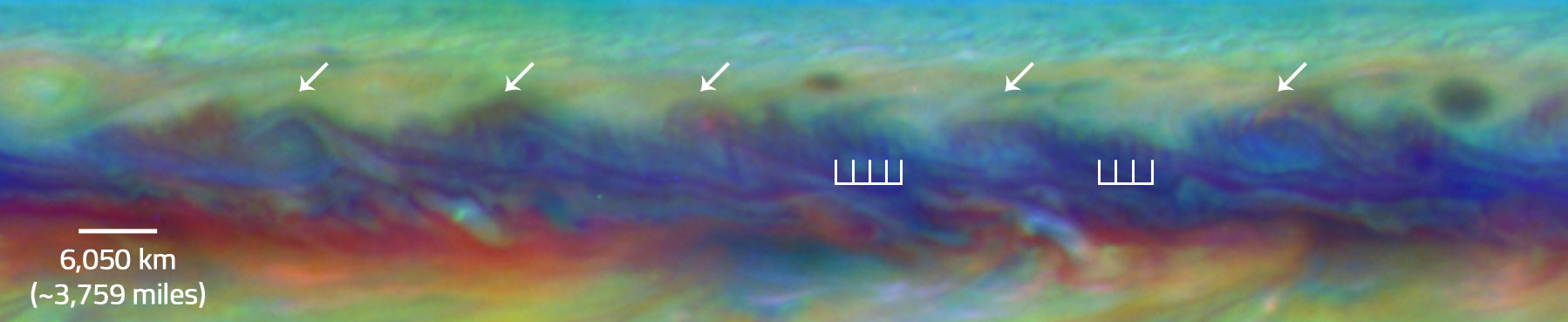
“Until now, we thought the wave seen by Voyager 2 might have been a fluke,” said co-author Glenn Orton of NASA’s Jet Propulsion Laboratory in Pasadena, California. “As it turns out, it’s just rare!”
The wave may originate in a clear layer beneath the clouds, only becoming visible when it propagates up into the cloud deck, according to the researchers. That idea is supported by the spacing between the wave crests.
In addition to Jupiter, the researchers have observed Neptune and Uranus, and maps of those planets also will be placed in the public archive. Saturn will be added to the series later. Hubble will dedicate time each year to this special set of observations, called the Outer Planet Atmospheres Legacy program.
“The long-term value of the Outer Planet Atmospheres Legacy program is really exciting,” said co-author Michael H. Wong of the University of California, Berkeley. “The collection of maps that we will build up over time will not only help scientists understand the atmospheres of our giant planets, but also the atmospheres of planets being discovered around other stars, and Earth’s atmosphere and oceans, too.”
Reference: “First Results from the Hubble OPAL Program: Jupiter in 2015” by Amy A. Simon, Michael H. Wong and Glenn S. Orton, 7 October 2015, The Astrophysical Journal.
DOI: 10.1088/0004-637X/812/1/55
Never miss a breakthrough: Join the SciTechDaily newsletter.
Follow us on Google and Google News.