
A new study reveals that COVID-19-positive humans often transmit the virus to their pets, particularly cats.
New research presented at the European Congress of Clinical Microbiology & Infectious Diseases (ECCMID), held online this year, suggests that people with COVID-19 frequently pass it on to their pets. Cats that sleep on their owner’s bed seem to be at particular risk of infection.
Previous studies have shown that cats and dogs can catch COVID-19 from their owners but it wasn’t clear how susceptible they were and what, if anything, increased their odds of becoming infected. Answering these questions is important from both a public health and animal health point of view.
To find out more, Dorothee Bienzle, a professor of veterinary pathology at the University of Guelph, Ontario, Canada, and colleagues studied cats and dogs of people who had had COVID-19.
The animals, 48 cats and 54 dogs from 77 households, were tested for antibodies to COVID-19 — a sign of past infection. Their owners were surveyed about how they interacted with their pets, including whether they petted them, kissed them, and allowed them to sit on their lap or sleep in their bed. They were also asked if they allowed their pet to kiss them or lick them on the face and how long they spent with their pet each day.
Other questions included whether their pet had become ill around the time they had COVID-19 and what sort of symptoms the animal had.
75 dogs and cats living in an animal shelter and 75 stray cats that had been seen at a low-cost veterinary clinic were also tested for antibodies.
67% (32/48) of the owned cats and 43% (23/54) of the owned dogs tested positive for antibodies, showing they had had COVID-19. This compares to just 9% (7/75) of dogs and cats from the animal shelter and 3% (2/75) of the stray cats.
Symptom Patterns in Infected Cats and Dogs
20% (11/54) of the dogs had symptoms, mainly lack of energy and loss of appetite. Some animals had a cough or diarrhea; however, all symptoms were mild and quickly cleared up.
27% (13/48) of the cats had symptoms, with a runny nose and difficulty breathing the most common signs of COVID-19. Although most cases were mild, three were severe.
The amount of time an owner spent with their dog and the type of contact they had with them did not affect the animal’s chance of getting infected.
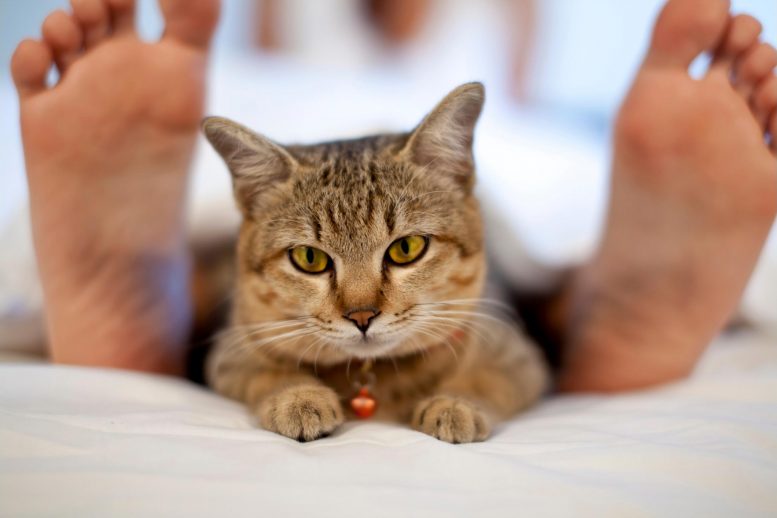
Cats that spent more time with their owners, however, seemed to be at higher risk of infection. And cats that slept on their owner’s bed were more likely to have COVID-19.
Cats’ Higher Susceptibility Explained by Biology and Behavior
The study’s authors say that cats’ biology, including their viral receptors, the “locks” the virus unpicks to enter cells, make them more susceptible to COVID-19 than dogs. Cats are also more likely to sleep near their owner’s face than dogs, increasing their exposure to any infection.
They add that the higher rate of infection in animals with owners than in those from the shelter and the strays, coupled with results of previous genetic studies, means that the most likely route of transmission is from human to pet, rather than the other way round.
Professor Bienzle concludes: “If someone has COVID-19 there is a surprisingly high chance they will pass it on to their pet. Cats, especially those that sleep on their owner’s bed, seem to be particularly vulnerable. So, if you have COVID-19, I’d advise that you keep your distance from your pet — and keep it out of your bedroom.
“I’d also recommend that you keep your pet away from other people and pets. While the evidence that pets can pass the virus on to other pets is limited, it can’t be excluded. Similarly, although pets have not been shown to pass the virus back to people, the possibility can’t be completely ruled out.”
Never miss a breakthrough: Join the SciTechDaily newsletter.
Follow us on Google and Google News.