
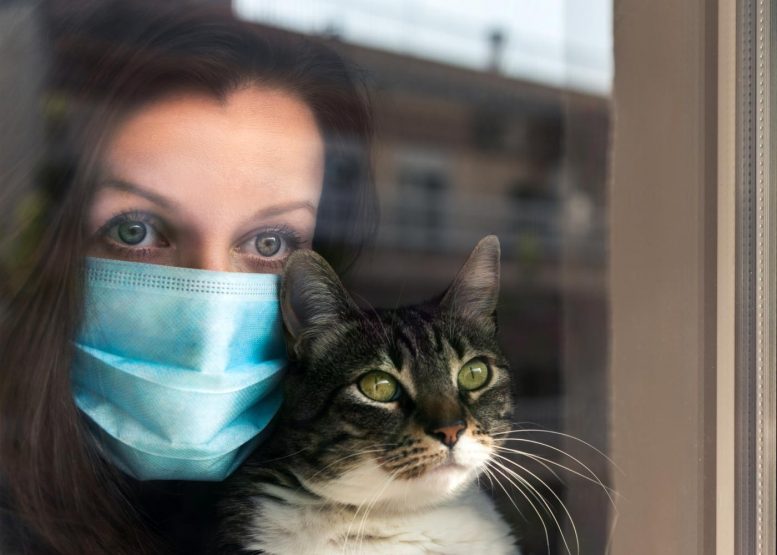
Two recently published studies from Kansas State University researchers and collaborators have led to two important findings related to the COVID-19 pandemic: Domestic cats can be asymptomatic carriers of SARS-CoV-2, but pigs are unlikely to be significant carriers of the virus. SARS-CoV-2 is the coronavirus responsible for COVID-19.
Cats can spread SARS-CoV-2 efficiently to other cats within two days. Further research is needed to study whether domestic cats can spread the virus to other animals and humans.
“Other research has shown that COVID-19-infected human patients are transmitting SARS-CoV-2 to cats; this includes domestic cats and even large cats, such as lions and tigers,” said Jürgen A. Richt, the Regents distinguished professor at Kansas State University in the College of Veterinary Medicine. “Our findings are important because of the close association between humans and companion animals.”
There are about 95 million house cats in the U.S. and about 60 million to 100 million feral cats, Richt said.
Richt is the senior author on the two recent collaborative publications in the journal Emerging Microbes & Infections: “SARS-CoV-2 infection, disease and transmission in domestic cats” and “Susceptibility of swine cells and domestic pigs to SARS-CoV-2.”
Through their in-depth study at the K-State Biosecurity Research Institute, or BRI, at Pat Roberts Hall, the researchers studied susceptibility to infection, disease, and transmission in domestic cats. They found that domestic cats may not have obvious clinical signs of SARS-CoV-2, but they still shed the virus through their nasal, oral, and rectal cavities and can spread it efficiently to other cats within two days. Further research is needed to study whether domestic cats can spread the virus to other animals and humans.
“This efficient transmission between domestic cats indicates a significant animal and public health need to investigate a potential human-cat-human transmission chain,” said Richt, who is also the director of the university’s Center of Excellence for Emerging and Zoonotic Animal Diseases, known as CEEZAD, and the Center on Emerging and Zoonotic Infectious Diseases, known as CEZID.
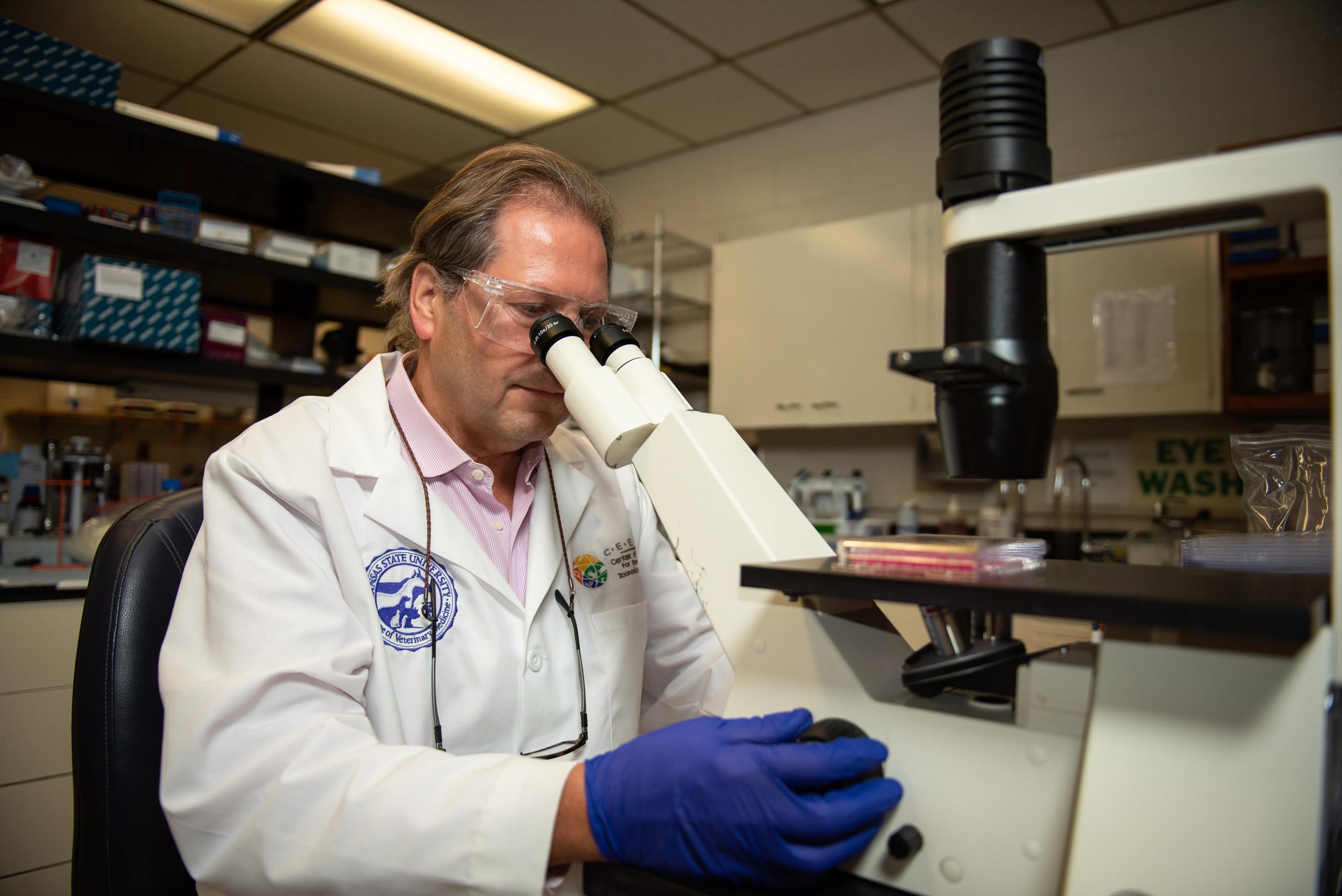
For the study involving pigs, the researchers found that SARS-CoV-2-infected pigs are not susceptible to SARS-CoV-2 infection and do not appear to transmit the virus to contact animals.
“Pigs play an important role in U.S. agriculture, which made it important to determine the potential SARS-CoV-2 susceptibility in pigs,” Richt said. “Our results show that pigs are unlikely to be significant carriers of SARS-CoV-2.”
The BRI has provided the high-security laboratories for Richt and collaborators to study SARS-CoV-2. It is a biosafety level-3 and biosafety level-3 agriculture facility that houses important multidisciplinary research, training, and educational programs on pathogens that affect animals, plants, and insects, as well as food safety and security.
Richt and his collaborators plan further studies to understand SARS-CoV-2 transmission in cats and pigs. They also plan to study whether cats are immune to SARS-CoV-2 reinfection after they have recovered from a primary SARS-CoV-2 infection.
“This research is important for risk assessment, implementing mitigation strategies, addressing animal welfare issues, and to develop preclinical animal models for evaluating drug and vaccine candidates for COVID-19,” Richt said.
References:
“SARS-CoV-2 infection, disease and transmission in domestic cats” by Natasha N. Gaudreault, Jessie D. Trujillo, Mariano Carossino, David A. Meekins, Igor Morozov, Daniel W. Madden, Sabarish V. Indran, Dashzeveg Bold, Velmurugan Balaraman, Taeyong Kwon, Bianca Libanori Artiaga, Konner Cool, Adolfo García-Sastre, Wenjun Ma, William C. Wilson, Jamie Henningson, Udeni B. R. Balasuriya and Juergen A. Richt, 25 October 2020, Emerging Microbes & Infections.
DOI: 10.1080/22221751.2020.1833687
“Susceptibility of swine cells and domestic pigs to SARS-CoV-2” by David A. Meekins, Igor Morozov, Jessie D. Trujillo, Natasha N. Gaudreault, Dashzeveg Bold, Mariano Carossino, Bianca L. Artiaga, Sabarish V. Indran, Taeyong Kwon, Velmurugan Balaraman, Daniel W. Madden, Heinz Feldmann, Jamie Henningson, Wenjun Ma, Udeni B. R. Balasuriya and Juergen A. Richt, 20 October 2020, Emerging Microbes & Infections.
DOI: 10.1080/22221751.2020.1831405
The research has involved other K-State researchers from the Department of Diagnostic Medicine and Pathobiology in the College of Veterinary Medicine: Natasha N. Gaudreault, Jessie D. Trujillo, David A. Meekins, Igor Morozov, Daniel W. Madden, Sabarish V. Indran, Dashzeveg Bold, Velmurugan Balaraman, Taeyong Kwon, Bianca L. Artiaga, Konner Cool, Wenjun Ma and Jamie Henningson, also director of the Kansas State Veterinary Diagnostic Laboratory.
Other researchers involved include Mariano Carossino and Udeni B. R. Balasuriya from Louisiana State University; William C. Wilson with the U.S., Department of Agriculture’s Arthropod-Borne Animal Disease Research Unit; Adolfo García-Sastre with Icahn School of Medicine at Mount Sinai; and Heinz Feldmann with the National Institutes of Health’s National Institute of Allergy and Infectious Diseases.
Never miss a breakthrough: Join the SciTechDaily newsletter.
Follow us on Google and Google News.
14 Comments
“Further research is needed to study whether domestic cats can spread the virus to other animals and humans.”
It would seem likely that cats can spread the virus to humans given the fact that they shed the virus and spread it to other cats.
However, it doesn’t seem like that would matter much given that the cat likely caught it from a human who already spread it to the other people in the household.
No more cats sorry we cannot risk it!
Denmark to kill 17 million mink linked to possible COVID-19 mutation
COVID kills 15,000 US mink as Denmark recommends nationwide cull
The US is keeping some dozen farms under quarantine while they investigate the cases, agriculture officials said.
https://www.aljazeera.com/economy/2020/11/10/covid-kills-15000-us-mink-as-denmark-sets-for-nationwide-cull
No more cats? No more pigs either. Too bad so sad, no more pork for you idiots! Even though further studies are needed to verify the results of this half way study, let’s spread unfounded fear now so the general idiotic population can go forth and just start arbitrarily killing animals. Hmmm…children spread diseases too. Sounds like a life for a life to me.
Kill the cats?? How about kill the people who don’t wear masks? That’s a much better solution.
You people are obviously cat haters looking for any excuse to get rid of them. Makes me not love scitechdaily, and I do not want to subscribe to it. It’s bogus, to say the least.
I agree with you Jean, we will start killing the people who disregard the safety precautions then get the virus and then spread it to others. We will start with the president.
No, we should line you and Jean up against a wall and shoot you.
I’d prefer dangerous psychos like you die.
Are you kidding me? This isn’t science, this is craziness on the part of supposed scientists!! So far you have no proof and yet you are putting it in an article and letting people read it – crazy people that are just as likely to kill the animals without need! How dare you?
You idiots just gave permission to half the (idiot) world to snap a lot of tiny necks. Are you Danish? Trying to assuage one mass slaughter with many others? Payback is an allied pack of mammal beeetches waiting for you ‘over there’. Vampire Rodents LOVE U
Incredible level of unfinished research. It is irresponsible to even publish such an article.
What about indoor cats, who never go out??
If the humans who dwell with them get sick then they will pass it to their indoor cat. Humans can pass to cats. Cats can pass to other cats. The rest is unknown at this time … when it comes to cats passing to humans they just don’t know yet. And not deemed ethical to purposefully expose well person to sick cat to find out quickly so they have to wait for clear case(s) of it happening to find out.
Simple answer to stop the spread of Covid.
Cats kill more than 1.5 billion native animals per year.
Pet and feral cats together are killing over two billion reptiles, birds and mammals per year in Australia, and most of these animals are natives, according to a new book written by three of Australia’s leading environmental scientists.
https://www.anu.edu.au/news/all-news/cats-kill-more-than-15-billion-native-animals-per-year
All of this talk about, kill this, kill that, is sickening. You all should be ashamed of yourselves. So what if cats are killing other animals, they are just trying to survive. You eat meat don’t you? Well maybe you should be more understanding and remember the circle of life. All this ignorance is stupid.