

Astronomers using NASA’s IXPE satellite have finally cracked a cosmic mystery—how X-rays are produced in the energetic jets of supermassive black holes like the blazar BL Lacertae.
The blazar BL Lacertae—a type of active galaxy powered by a supermassive black hole with bright, fast-moving jets aimed directly at Earth—offered scientists a rare opportunity to answer a longstanding astrophysical question: How are X-rays produced in such extreme cosmic environments?
To investigate, NASA’s IXPE (Imaging X-ray Polarimetry Explorer) teamed up with ground-based radio and optical telescopes. Their findings, soon to be published in the Astrophysical Journal Letters, reveal that the X-rays are most likely generated through interactions between high-speed electrons and particles of light known as photons.
The X-ray Mystery: Electrons or Protons?
For years, scientists debated whether these X-rays originated from electrons or protons within the black hole’s jets. Each scenario leaves a distinct signature in X-ray light’s polarization, which is the preferred orientation of the light’s electromagnetic waves.
A high degree of polarization would point to protons as the source, either spiraling in magnetic fields or interacting with surrounding photons. On the other hand, a lower degree of polarization would indicate that electrons are responsible, scattering photons in a process known as Compton scattering.

IXPE’s One-of-a-Kind Capabilities in Space
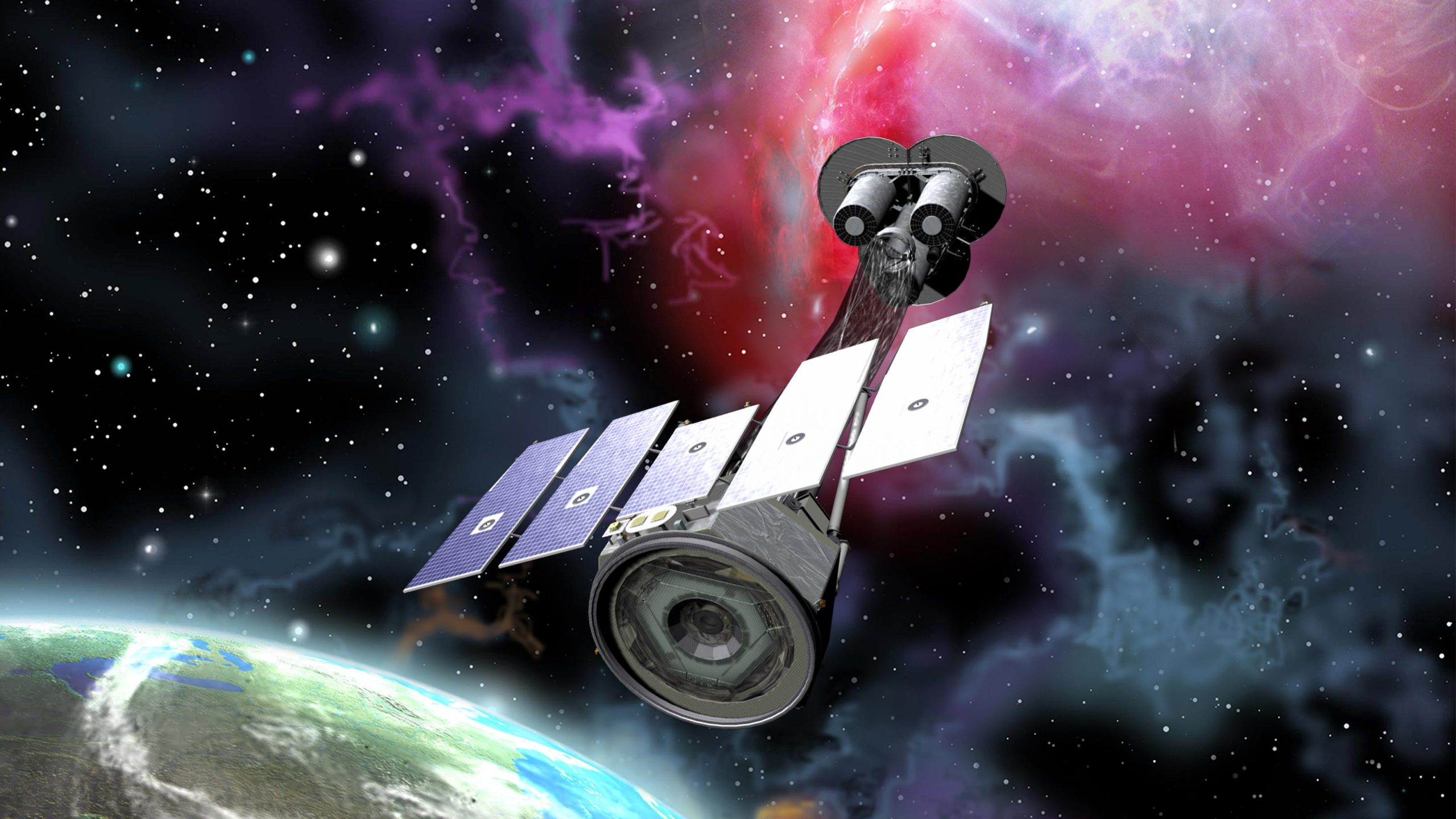
IXPE, which launched December 9, 2021, is the only satellite flying today that can make such a polarization measurement.
“This was one of the biggest mysteries about supermassive black hole jets,” said Iván Agudo, lead author of the study and astronomer at the Instituto de Astrofísica de Andalucía – CSIC in Spain. “And IXPE, with the help of a number of supporting ground-based telescopes, finally provided us with the tools to solve it.”
Groundbreaking Discovery Confirms Compton Scattering
Astronomers found that electrons must be the culprits through a process called Compton Scattering. Compton scattering (or the Compton effect) happens when a photon loses or gains energy after interacting with a charged particle, usually an electron. Within jets from supermassive black holes, electrons move near the speed of light. IXPE helped scientists learn that, in the case of a blazar jet, the electrons have enough energy to scatter photons of infrared light up to X-ray wavelengths.
BL Lacertae (BL Lac for short) is one of the first blazars ever discovered, originally thought to be a variable star in the Lacerta constellation. IXPE observed BL Lac at the end of November 2023 for seven days along with several ground-based telescopes measuring optical and radio polarization at the same time. While IXPE observed BL Lac in the past, this observation was special. Coincidentally, during the X-ray polarization observations, the optical polarization of BL Lac reached a high number: 47.5%.
Record-Breaking Optical Polarization Observed
“This was not only the most polarized BL Lac has been in the past 30 years, this is the most polarized any blazar has ever been observed!” said Ioannis Liodakis, one of the primary authors of the study and astrophysicist at the Institute of Astrophysics – FORTH in Greece.
IXPE found the X-rays were far less polarized than the optical light. The team was not able to measure a strong polarization signal and determined that the X-rays cannot be more polarized than 7.6%. This proved that electrons interacting with photons, via the Compton effect, must explain the X-rays.
“The fact that optical polarization was so much higher than in the X-rays can only be explained by Compton scattering.”
Steven Ehlert, Project Scientist for IXPE at Marshall Space Flight Center
“The fact that optical polarization was so much higher than in the X-rays can only be explained by Compton scattering,” said Steven Ehlert, project scientist for IXPE and astronomer at the Marshall Space Flight Center.
A Decade-Long Vision Realized Through IXPE
“IXPE has managed to solve another black hole mystery,” said Enrico Costa, astrophysicist in Rome at the Istituto di Astrofísica e Planetologia Spaziali of the Istituto Nazionale di Astrofísica. Costa is one of the scientists who conceived this experiment and proposed it to NASA 10 years ago, under the leadership of Martin Weisskopf, IXPE’s first principal investigator. “IXPE’s polarized X-ray vision has solved several long lasting mysteries, and this is one of the most important. In some other cases, IXPE results have challenged consolidated opinions and opened new enigmas, but this is how science works and, for sure, IXPE is doing very good science.”
What’s next for the blazar research?
“One thing we’ll want to do is try to find as many of these as possible,” Ehlert said. “Blazars change quite a bit with time and are full of surprises.”
Reference: “High optical to X-ray polarization ratio reveals Compton scattering in BL Lacertae’s jet” by Ivan Agudo, Ioannis Liodakis, Jorge Otero-Santos, Riccardo Middei, Alan Marscher, Svetlana Jorstad, Haocheng Zhang, Hui Li, Laura Di Gesu, Roger W. Romani, Dawoon E. Kim, Francesco Fenu, Herman L. Marshall, Luigi Pacciani, Juan Escudero Pedrosa, Francisco Jose Aceituno, Beatriz Agis-Gonzalez, Giacomo Bonnoli, Victor Casanova, Daniel Morcuende, Vilppu Piirola, Alfredo Sota, Pouya M. Kouch, Elina Lindfors, Callum McCall, Helen E. Jermak, Iain A. Steele, George A. Borman, Tatiana S. Grishina, Vladimir A. Hagen-Thorn, Evgenia N. Kopatskaya, Elena G. Larionova, Daria A. Morozova, Sergey S. Savchenko, Ekaterina V. Shishkina, Ivan S. Troitskiy, Yulia V. Troitskaya, Andrey A. Vasilyev, Alexey V. Zhovtan, Ioannis Myserlis, Mark Gurwell, Garrett Keating, Ramprasad Rao, Sincheol Kang, Sang-Sung Lee, Sanghyun Kim, Whee Yeon Cheong, Hyeon-Woo Jeong, Emmanouil Angelakis, Alexander Kraus, Dmitry Blinov, Siddharth Maharana, Rumen Bachev, Jenni Jormanainen, Kari Nilsson, Vandad Fallah Ramazani, Carolina Casadio, Antonio Fuentes, Efthalia Traianou, Clemens Thum, Jose L. Gomez, Lucio Angelo Antonelli, Matteo Bachetti, Luca Baldini, Wayne H. Baumgartner, Ronaldo Bellazzini, Stefano Bianchi, Stephen D. Bongiorno, Raffaella Bonino, Alessandro Brez, Niccolo Bucciantini, Fiamma Capitanio, Simone Castellano, Elisabetta Cavazzuti, Chien-Ting Chen, Stefano Ciprini, Enrico Costa, Alessandra De Rosa, Ettore Del Monte, Niccolo Di Lalla, Alessandro Di Marco, Immacolata Donnarumma, Victor Doroshenko, Michal Dovciak, Steven R. Ehlert, Teruaki Enoto, Yuri Evangelista, Sergio Fabiani, Riccardo Ferrazzoli, Javier A. Garcia, Shuichi Gunji, Kiyoshi Hayashida, Jeremy Heyl, Wataru Iwakiri, Philip Kaaret, Vladimir Karas, Fabian Kislat, Takao Kitaguchi, Jeffery J. Kolodziejczak, Henric Krawczynski , Fabio La Monaca, Luca Latronico, Simone Maldera, Alberto Manfreda, Frederic Marin, Andrea Marinucci, Francesco Massaro, Giorgio Matt, Ikuyuki Mitsuishi, Tsunefumi Mizuno, Fabio Muleri, Michela Negro, Chi-Yung Ng, Stephen L. O’Dell, Nicola Omodei, Chiara Oppedisano, Alessandro Papitto, George G. Pavlov, Abel L. Peirson, Matteo Perri, Melissa Pesce-Rollins, Pierre-Olivier Petrucci, Maura Pilia, Andrea Possenti, Juri Poutanen, Simonetta Puccetti, Brian D. Ramsey, John Rankin, Ajay Ratheesh, Oliver J. Roberts, Carmelo Sgro, Patrick Slane, Paolo Soffitta, Gloria Spandre, Douglas A. Swartz, Toru Tamagawa, Fabrizio Tavecchio, Roberto Taverna, Yuzuru Tawara, Allyn F. Tennant, Nicholas E. Thomas, Francesco Tombesi, Alessio Trois, Sergey S. Tsygankov, Roberto Turolla, Jacco Vink, Martin C. Weisskopf, Kinwah Wu, Fei Xie and Silvia Zane, Accepted, Astrophysical Journal Letters.
DOI: 10.3847/2041-8213/adc572
More about IXPE
IXPE (Imaging X-ray Polarimetry Explorer) is a pioneering space observatory that provides unprecedented data on the high-energy universe, enabling scientists to uncover the inner workings of some of the most extreme cosmic objects—such as black holes, neutron stars, and blazars.
A joint mission between NASA and the Italian Space Agency, IXPE brings together science collaborators from 12 countries, exemplifying global scientific cooperation. The mission is led by NASA’s Marshall Space Flight Center in Huntsville, Alabama. Spacecraft operations are managed by BAE Systems, Inc., based in Falls Church, Virginia, in partnership with the University of Colorado’s Laboratory for Atmospheric and Space Physics in Boulder.
Through its ability to measure X-ray polarization, IXPE opens a new window into the behavior of light and matter in the universe’s most energetic environments.
Never miss a breakthrough: Join the SciTechDaily newsletter.
Follow us on Google and Google News.
1 Comment
That was a bit messy for outsiders at the moment. AFAIU their refences point to simulations where the synchrotron electrons scatter their own produced photons (synchrotron self-Compton – SSC – process) to weaken any initial polarization from the synchrotron effect.