
Close Menu
    Facebook X (Twitter) Instagram
    SciTechDaily
    • Biology
    • Chemistry
    • Earth
    • Health
    • Physics
    • Science
    • Space
    • Technology
    Facebook X (Twitter) Pinterest YouTube RSS
    SciTechDaily
    Home»Space»Astronomers Believe They Have Spotted the First Known Light Flare From a Pair of Colliding Black Holes
    Space

    Astronomers Believe They Have Spotted the First Known Light Flare From a Pair of Colliding Black Holes

    By Jet Propulsion LaboratoryJune 27, 20202 Comments3 Mins Read
    Facebook Twitter Pinterest Telegram LinkedIn WhatsApp Email Reddit
    Share
    Facebook Twitter LinkedIn Pinterest Telegram Email Reddit
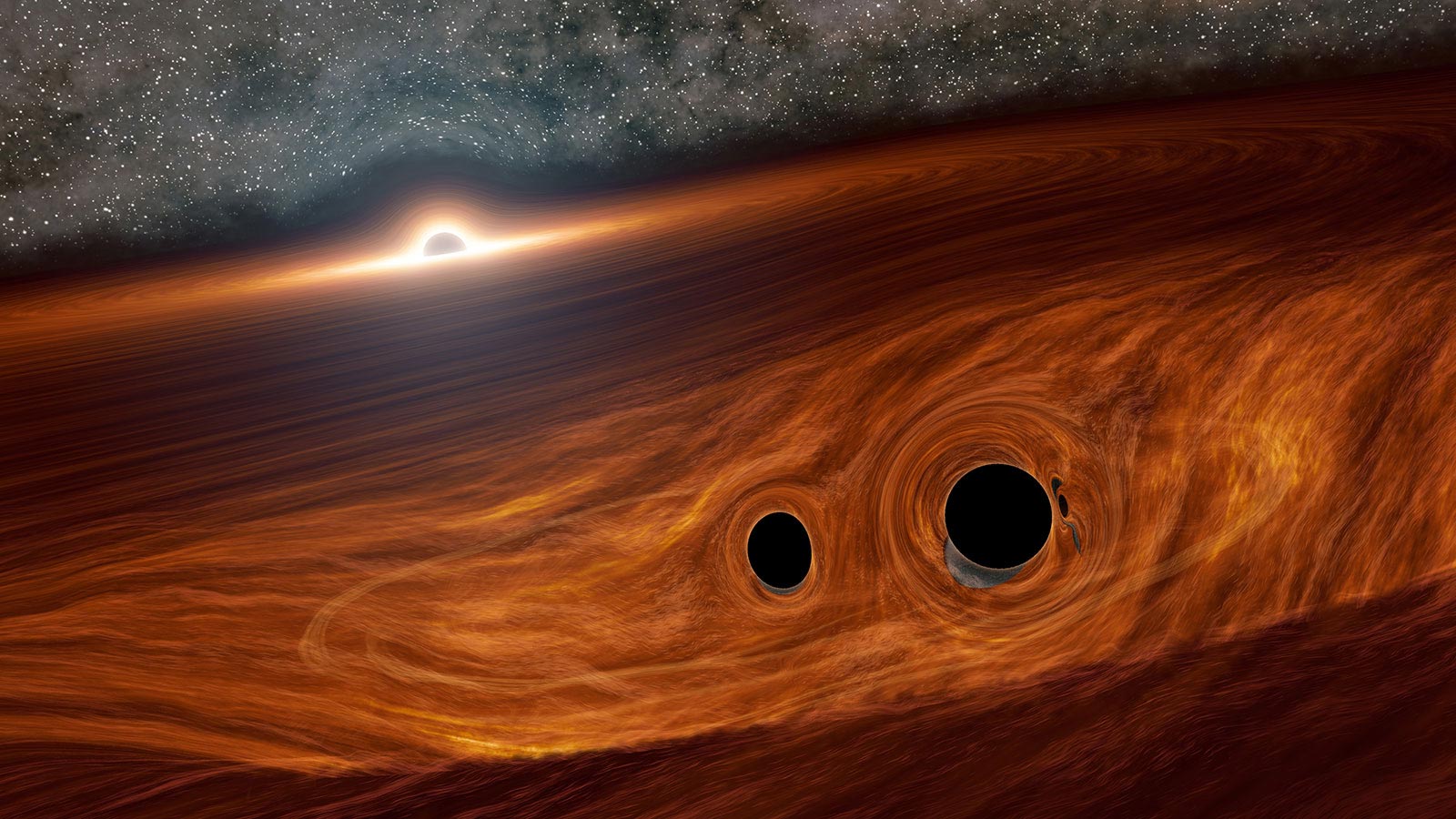
    Supermassive Black Hole Surrounded by Two Black Holes
    This artist’s concept shows a supermassive black hole surrounded by a disk of gas. Embedded in this disk are two smaller black holes that may have merged together to form a new black hole. Credit: Caltech/R. Hurt (IPAC)

    In a first, astronomers may have seen light from the merger of two black holes, providing opportunities to learn about these mysterious dark objects.

    When two black holes spiral around each other and ultimately collide, they send out gravitational waves — ripples in space and time that can be detected with extremely sensitive instruments on Earth. Since black holes and black hole mergers are completely dark, these events are invisible to telescopes and other light-detecting instruments used by astronomers. However, theorists have come up with ideas about how a black hole merger could produce a light signal by causing nearby material to radiate.

    Now, scientists using Caltech’s Zwicky Transient Facility (ZTF) located at Palomar Observatory near San Diego may have spotted what could be just such a scenario. If confirmed, it would be the first known light flare from a pair of colliding black holes.

    The merger was identified on May 21, 2019, by two gravitational wave detectors — the National Science Foundation’s Laser Interferometer Gravitational-wave Observatory (LIGO) and the European Virgo detector — in an event called GW190521g. That detection allowed the ZTF scientists to look for light signals from the location where the gravitational wave signal originated. These gravitational wave detectors have also spotted mergers between dense cosmic objects called neutron stars, and astronomers have identified light emissions from those collisions.

    The ZTF results are described in a new study published in the journal Physical Review Letters. The authors hypothesize that the two partner black holes, each several dozen times more massive than the Sun, were orbiting a third, supermassive black hole that is millions of times the mass of the Sun and surrounded by a disk of gas and other material. When the two smaller black holes merged, they formed a new, larger black hole that would have experienced a kick and shot off in a random direction. According to the new study, it may have plowed through the disk of gas, causing it to light up.

    “This detection is extremely exciting,” said Daniel Stern, coauthor of the new study and an astrophysicist at NASA’s Jet Propulsion Laboratory in Southern California, which is a division of Caltech. “There’s a lot we can learn about these two merging black holes and the environment they were in based on this signal that they sort of inadvertently created. So the detection by ZTF, coupled with what we can learn from the gravitational waves, opens up a new avenue to study both black hole mergers and these disks around supermassive black holes.”

    The authors note that while they conclude the flare detected by ZTF is likely the result of a black hole merger, they cannot completely rule out other possibilities.

    Read Astronomers Find Evidence Black Hole Collision Exploded With Light for more on this research.

    Reference: “Candidate Electromagnetic Counterpart to the Binary Black Hole Merger Gravitational-Wave Event S190521g” by M. J. Graham et al., 25 June 2020, Physical Review Letters.
    DOI: 10.1103/PhysRevLett.124.251102

    Never miss a breakthrough: Join the SciTechDaily newsletter.
    Follow us on Google and Google News.

    Astronomy Astrophysics Black Hole JPL NASA Popular
    Share. Facebook Twitter Pinterest LinkedIn Email Reddit

    Related Articles

    Andromeda’s Supermassive Black Hole Feeding Habits Revealed by NASA’s Spitzer

    Black Hole Tears Apart Unlucky Star – NASA Gets Unusually Close View of Dramatic Destruction

    Mysterious, Repeating Radio Burst Identified in Our Own Galaxy for the First Time

    “Echo Mapping” Light Bursts From Supermassive Black Holes in Faraway Galaxies to Measure Vast Cosmic Distances

    NASA’s Spitzer Spies a Massive Star Factory – 2 Quadrillion Miles Across

    Runaway Star Might Explain Mysterious Black Hole Disappearing Act

    Enticing Clues to Formation of Exotic Worlds From Young Giant Planet

    Dancing Black Hole Collision Unleashes a Flash of Light Brighter Than a Trillion Stars

    Scientists Measure the Spin Rates of Supermassive Black Holes

    2 Comments

    1. Petr Jandacek on June 28, 2020 5:09 am

      The two camps – refer to each other as “Evolution by JERKS” vs “Evolution by CREEPS”.
      See more on A CITY on the HILL – Faith and Science in the Atomic City of Los Alamos http://www.jandacek.com

      Reply
    2. Grayson on September 2, 2020 9:18 am

      crazy cool!

      Reply
    Leave A Reply Cancel Reply

    • Facebook
    • Twitter
    • Pinterest
    • YouTube

    Don't Miss a Discovery

    Subscribe for the Latest in Science & Tech!

    Trending News

    The Universe Is Expanding Too Fast and Scientists Can’t Explain Why

    “Like Liquid Metal”: Scientists Create Strange Shape-Shifting Material

    Early Warning Signals of Esophageal Cancer May Be Hiding in Plain Sight

    Common Blood Pressure Drug Shows Surprising Power Against Deadly Antibiotic-Resistant Superbug

    Scientists Uncover Dangerous Connection Between Serotonin and Heart Valve Disease

    Scientists Discover a “Protector” Protein That Could Help Reverse Hair Loss

    Bone-Strengthening Discovery Could Reverse Osteoporosis

    Scientists Uncover Hidden Trigger Behind Stem Cell Aging

    Follow SciTechDaily
    • Facebook
    • Twitter
    • YouTube
    • Pinterest
    • Newsletter
    • RSS
    SciTech News
    • Biology News
    • Chemistry News
    • Earth News
    • Health News
    • Physics News
    • Science News
    • Space News
    • Technology News
    Recent Posts
    • A Common Diabetes Drug May Hold the Key to Stopping HIV From Coming Back
    • Ancient “Syphilis-Like” Disease in Vietnam Challenges Key Scientific Assumptions
    • Drinking Alcohol To Cope in Your 20s Could Damage Your Brain for Life
    • Scientists Crack Alfalfa’s Chromosome Mystery After Decades of Debate
    • Ancient Ant-Plant Alliance Collapses As Predatory Wasps Move In
    Copyright © 1998 - 2026 SciTechDaily. All Rights Reserved.
    • Science News
    • About
    • Contact
    • Editorial Board
    • Privacy Policy
    • Terms of Use

    Type above and press Enter to search. Press Esc to cancel.