
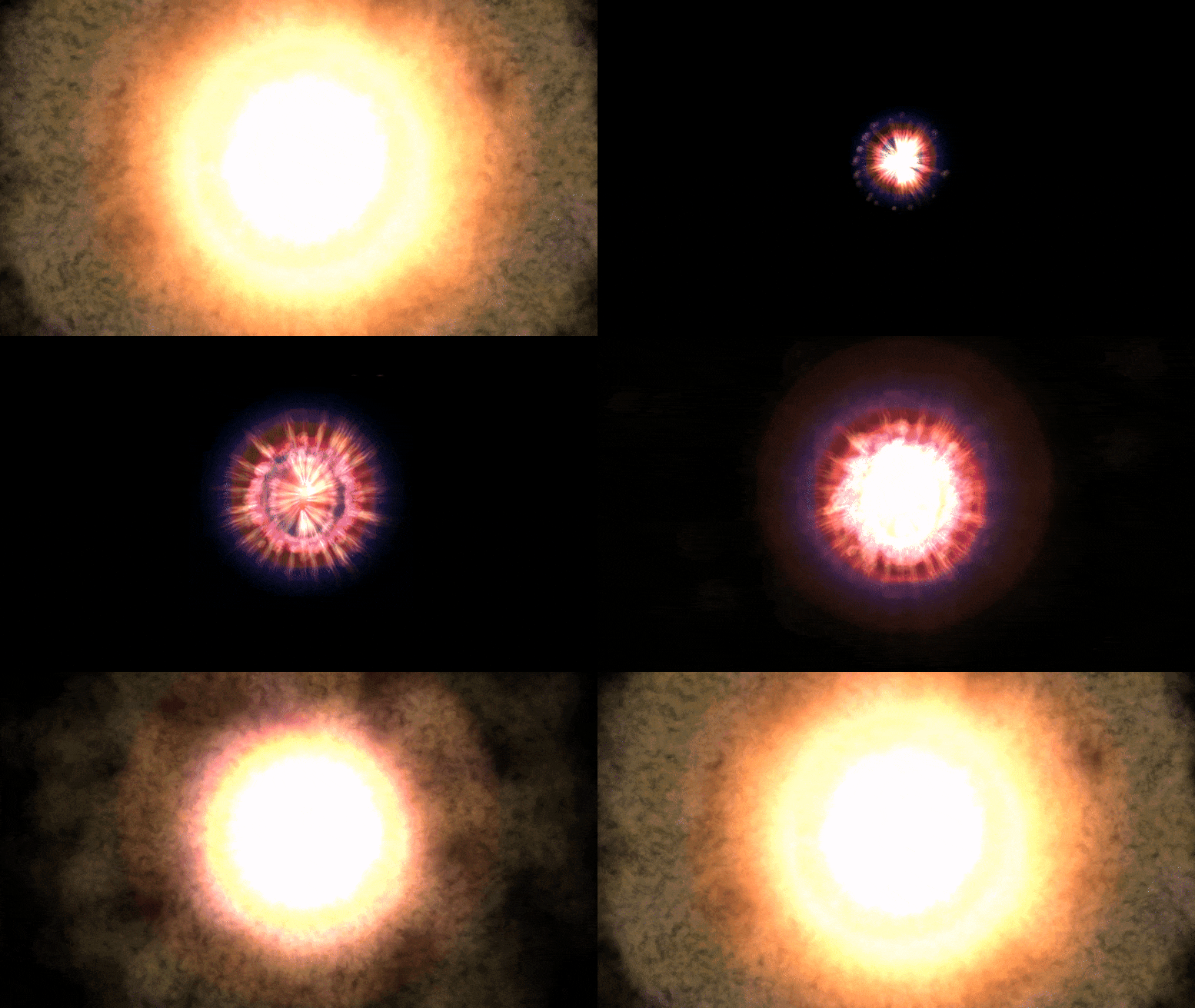
Possible light flare observed from small black holes within the disk of a massive black hole.
When two black holes spiral around each other and ultimately collide, they send out ripples in space and time called gravitational waves. Because black holes do not give off light, these events are not expected to shine with any light waves, or electromagnetic radiation. Graduate Center, CUNY astrophysicists K. E. Saavik Ford and Barry McKernan have posited ways in which a black hole merger might explode with light. Now, for the first time, astronomers have seen evidence of one of these light-producing scenarios. Their findings are available in the current issues of Physical Review Letters.
A team consisting of scientists from The Graduate Center, CUNY; Caltech’s Zwicky Transient Facility (ZTF); Borough of Manhattan Community College (BMCC); and The American Museum of Natural History (AMNH) spotted what appears to be a flare of light from a pair of coalescing black holes. The event (called S190521g) was first identified by the National Science Foundation’s (NSF) Laser Interferometer Gravitational-wave Observatory (LIGO) and the European Virgo detector on May 21, 2019. As the black holes merged, jiggling space and time, they sent out gravitational waves. Shortly thereafter, scientists at ZTF — which is located at the Palomar Observatory near San Diego — reviewed their recordings of the same event and spotted what may be a flare of light coming from the coalescing black holes.
“At the center of most galaxies lurks a supermassive black hole. It’s surrounded by a swarm of stars and dead stars, including black holes,” said study coauthor Ford, a professor with the Graduate Center, BMCC, and AMNH. “These objects swarm like angry bees around the monstrous queen bee at the center. They can briefly find gravitational partners and pair up but usually lose their partners quickly to the mad dance. But in a supermassive black hole’s disk, the flowing gas converts the mosh pit of the swarm to a classical minuet, organizing the black holes so they can pair up,” she says.
Once the black holes merge, the new, now-larger black hole experiences a kick that sends it off in a random direction, and it plows through the gas in the disk. “It is the reaction of the gas to this speeding bullet that creates a bright flare, visible with telescopes,” said co-author McKernan, an astrophysics professor with The Graduate Center, BMCC, and AMNH.
“This supermassive black hole was burbling along for years before this more abrupt flare,” said the study’s lead author Matthew Graham, a research professor of astronomy at Caltech and the project scientist for ZTF. “The flare occurred on the right timescale, and in the right location, to be coincident with the gravitational-wave event. In our study, we conclude that the flare is likely the result of a black hole merger, but we cannot completely rule out other possibilities.”
“ZTF was specifically designed to identify new, rare, and variable types of astronomical activity like this,” said NSF Division of Astronomical Science Director Ralph Gaume. “NSF support of new technology continues to expand how we can track such events.”
Such a flare is predicted to begin days to weeks after the initial splash of gravitational waves produced during the merger. In this case, ZTF did not catch the event right away, but when the scientists went back and looked through archival ZTF images months later, they found a signal that started days after the May 2019 gravitational-wave event. ZTF observed the flare slowly fade over the period of a month.
The scientists attempted to get a more detailed look at the light of the supermassive black hole, called a spectrum, but by the time they looked, the flare had already faded. A spectrum would have offered more support for the idea that the flare came from merging black holes within the disk of the supermassive black hole. However, the researchers say they were able to largely rule out other possible causes for the observed flare, including a supernova or a tidal disruption event, which occurs when a black hole essentially eats a star.
What is more, the team says it is not likely that the flare came from the usual rumblings of the supermassive black hole, which regularly feeds off its surrounding disk. Using the Catalina Real-Time Transient Survey, led by Caltech, they were able to assess the behavior of the black hole over the past 15 years, and found that its activity was relatively normal until May of 2019, when it suddenly intensified.
“Supermassive black holes like this one have flares all the time. They are not quiet objects, but the timing, size, and location of this flare was spectacular,” said co-author Mansi Kasliwal (MS ’07, PhD ’11), an assistant professor of astronomy at Caltech. “The reason looking for flares like this is so important is that it helps enormously with astrophysics and cosmology questions. If we can do this again and detect light from the mergers of other black holes, then we can nail down the homes of these black holes and learn more about their origins.”
The newly formed black hole should cause another flare in the next few years. The process of merging gave the object a kick that should cause it to enter the supermassive black hole’s disk again, producing another flash of light that ZTF should be able to see.
Reference: “Candidate Electromagnetic Counterpart to the Binary Black Hole Merger Gravitational-Wave Event S190521g” by M. J. Graham et al., 25 June 2020, Physical Review Letters.
DOI: 10.1103/PhysRevLett.124.251102
The paper, titled, “A Candidate Electromagnetic Counterpart to the Binary Black Hole Merger Gravitational Wave Event GW190521g,” was funded by the NSF, NASA, the Heising-Simons Foundation, and the GROWTH (Global Relay of Observatories Watching Transients Happen) program. Other co-authors include: K. Burdge, S.G. Djorgovski, A.J. Drake, D. Duev, A.A. Mahabal, J. Belecki, R. Burruss, G. Helou, S.R. Kulkarni, F.J. Masci, T. Prince, D. Reiley, H. Rodriguez, B. Rusholme, R.M. Smith, all from Caltech; N.P. Ross of the University of Edinburgh; Daniel Stern of the Jet Propulsion Laboratory, managed by Caltech for NASA; M. Coughlin of the University of Minnesota; S. van Velzen of University of Maryland, College Park and New York University; E.C. Bellm of the University of Washington; S.B. Cenko of NASA Goddard Space Flight Center; V. Cunningham of University of Maryland, College Park; and M.T. Soumagnac of the Lawrence Berkeley National Laboratory and the Weizmann Institute of Science.
Never miss a breakthrough: Join the SciTechDaily newsletter.
Follow us on Google and Google News.