
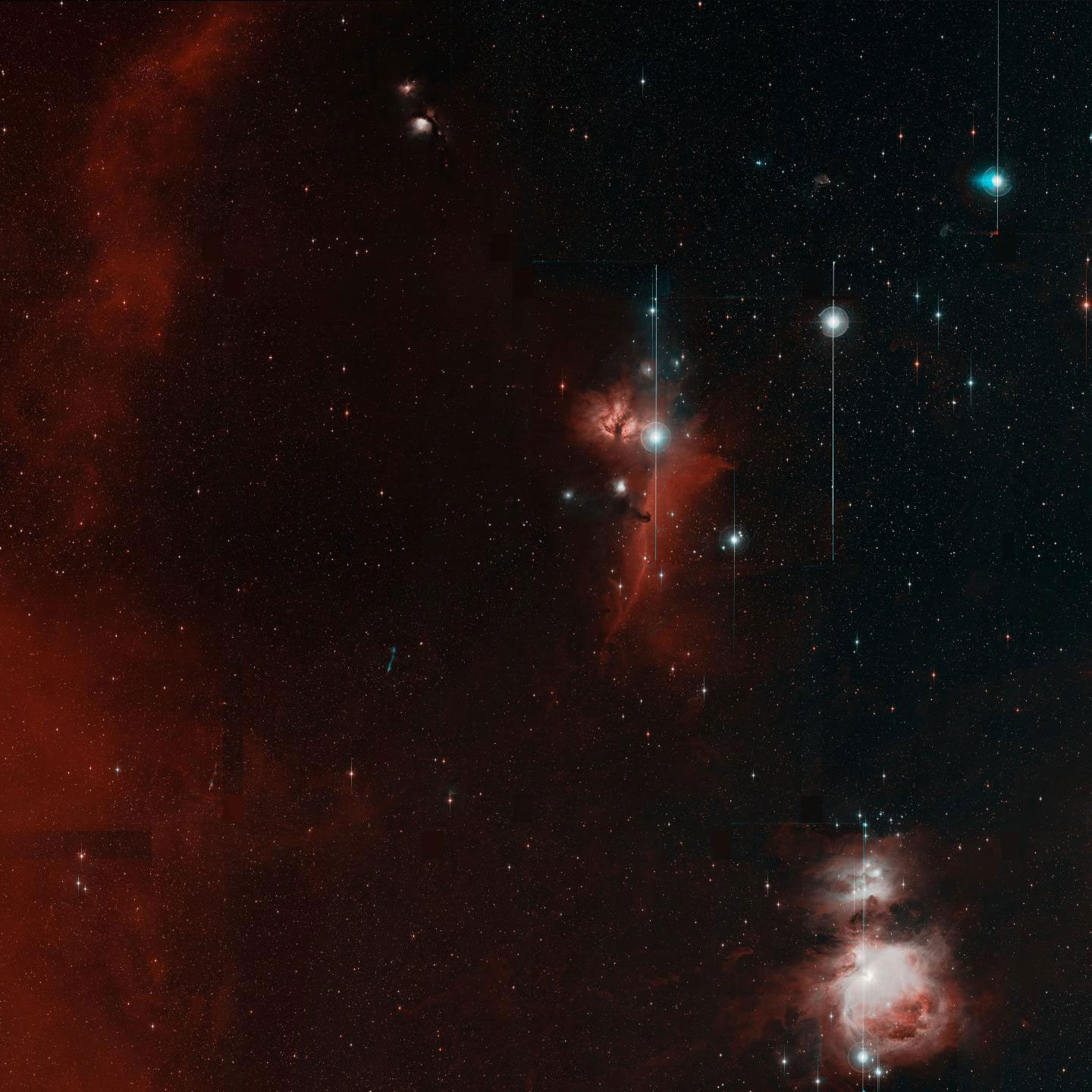
A new robotic camera with the ability to capture hundreds of thousands of stars and galaxies in a single shot has taken its first image of the sky. The camera is the centerpiece of a new automated sky survey project called the Zwicky Transient Facility (ZTF), based at Caltech’s Palomar Observatory near San Diego, California.
As partners in the ZTF effort, University of Maryland astronomers made important contributions to the planning and design of the survey project. UMD participation in ZTF is facilitated by the Joint Space-Science Institute, a partnership between UMD and NASA’s Goddard Space Flight Center in Greenbelt, Maryland.
Every night, ZTF’s camera will scan a large swath of the Northern sky, discovering objects and events that vary in brightness over time, collectively known as transients. Survey targets will include explosive supernovae, hungry black holes, and hurtling asteroids and comets.
“The ZTF survey will be transformative for the study of supermassive black holes feasting on stars in the centers of galaxies,” said Suvi Gezari, an assistant professor of astronomy at UMD and a fellow of the Joint Space-Science Institute whose research focuses on time-domain astronomy. “The timing of these events, known as tidal disruption events, can be used to constrain the mass and spin of black holes. Data from ZTF may also offer a rare, real-time glimpse into the formation of an accretion disk — and possibly relativistic jets–around a supermassive black hole.”
From 2009 to 2017, ZTF’s predecessor, the Palomar Transient Factory (PTF), caught the blinking and flaring of transient objects in the sky. The project took advantage of the Palomar Observatory’s three telescopes–the automated 48-inch (1.2-meter) Samuel Oschin Telescope, the automated 60-inch (1.5-meter) telescope and the 200-inch (5-meter) Hale Telescope.
During PTF’s surveys, the Oschin Telescope acted as the discovery engine, then the 60-inch (1.5-meter) telescope followed up on the targets, gathering information about their identities. From there, astronomers used either the Hale Telescope, the W.M. Keck Observatory in Hawaii, or the Discovery Channel Telescope in Arizona to zoom in on the various cosmic phenomena that enliven our night skies.
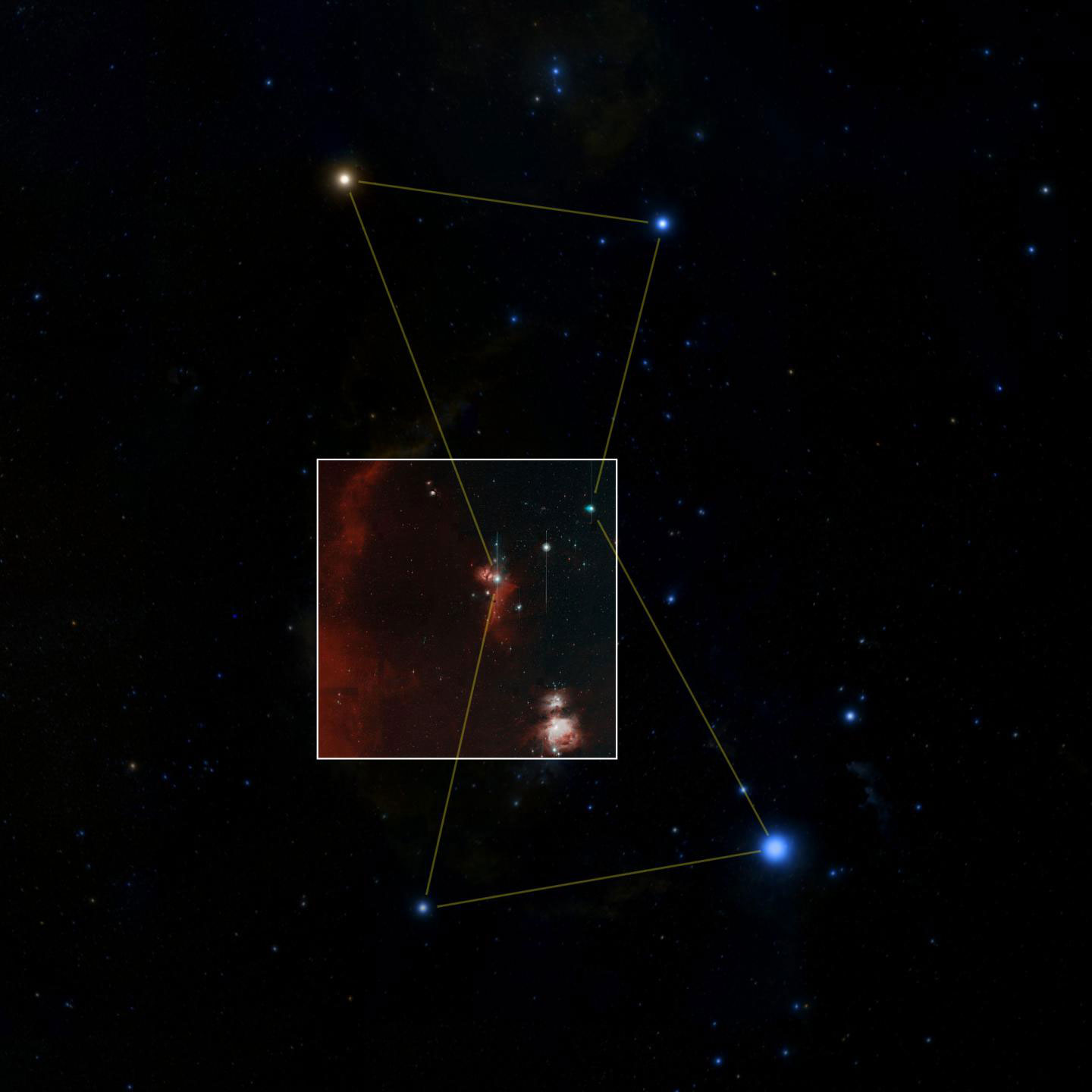
The ZTF survey is a powerful sequel to PTF. It is named after Caltech’s first astrophysicist, Fritz Zwicky, who discovered 120 supernovae in his lifetime. Recently installed at the Oschin Telescope, ZTF’s new survey camera can take in seven times more sky in a single image than its predecessor. At maximum resolution, each ZTF camera image is 24,000 by 24,000 pixels–so huge that the images are difficult to display on a normal computer screen.
Additionally, ZTF’s upgraded electronics and telescope drive systems enable the camera to take more than twice as many exposures every night. Astronomers will not only be able to discover more transient objects, they will also be able to catch more ephemeral features that appear and fade quickly.
“There’s a lot of activity happening in our night skies,” said Shrinivas (Shri) Kulkarni, the principal investigator for ZTF and the George Ellery Hale Professor of Astronomy and Planetary Science at Caltech. “In fact, every second, somewhere in the universe, there’s a supernova that’s exploding. Of course, we can’t see them all but with ZTF we will see up to tens of thousands of explosive transients every year over the three-year lifetime of the project.”
Images from Zwicky Transient Facility will be adjusted, cleaned and calibrated at IPAC, Caltech’s astronomy and data center. The software will search the flood of ZTF data for light sources–in particular those that change or move. These data will be made public to the entire astronomy community for both research and education.
“Data from Zwicky Transient Facility presents a really great opportunity for students here at UMD, because large survey programs like ZTF will play a big role in the future of astronomy,” said Melissa Hayes-Gehrke, a principal lecturer and undergraduate director of astronomy at UMD. Hayes-Gehrke has led efforts to develop educational materials that make use of data from PTF and ZTF. “It is fantastic to get students in on the ground floor. Astronomers will be mining this data for years to come, so this is an important step to help prepare students for a career in research.”
ZTF’s new first-light image is a taste of what’s to come. It showcases the large scale of the images and highlights the turbulent star-forming nebula known as Orion.
Astronomers are excited for the unexpected findings that Zwicky Transient Facility will likely yield. One of PTF’s biggest discoveries came in 2011 when it caught a supernova, named PTF11kly, just hours after it exploded. The ZTF survey will further expand astronomers’ knowledge of a host of cosmic objects, including young supernovae, planets around young stars, exotic binary star systems, and near-Earth comets and asteroids.
“I am most excited for ZTF’s potential to catch interesting comet outbursts. We know that they happen, we just don’t know how often. Many are caught by amateur astronomers,” said Dennis Bodewits, an astronomy associate research scientist at UMD who specializes in comet research. “This will change with Zwicky Transient Facility, which will pick up between 30 to 50 comets every time it scans the whole sky. Comets are found all over the sky, so we’re interested in seeing as many of them as we can, in as much detail as possible.”
The ZTF survey will also contribute to the burgeoning field of multi-messenger astrophysics. Broadly stated, this is the search for optical counterparts to extreme transient events seen with other instruments that detect different signals, or messengers. Examples include gravitational wave events observed by the Laser Interferometer Gravitational-wave Observatory (LIGO) and the Virgo detector; neutrino events observed by the IceCube South Pole Neutrino Observatory; and gamma-ray bursts seen by NASA’s Fermi Gamma-ray Space Telescope and Swift Gamma-ray Burst Mission.
“What excites me most about Zwicky Transient Facility is the huge field of view it will open up to connect optical transients with extreme events,” said Julie McEnery, Fermi project scientist at NASA’s Goddard Space Flight Center, adjunct associate professor of physics at UMD and a co-director of the Joint Space-Science Institute. “For future gravitational wave events from LIGO and Virgo, we’ll be given a very large region of the sky to search. Neutrino events and gamma-ray bursts are also not well localized. The ZTF survey will allow us to connect the optical universe to all three of these extreme phenomena.”
The science survey phase of Zwicky Transient Facility is scheduled to begin in February of 2018. The project will be completed by the end of 2020. In the future, even larger surveys will build on ZTF’s rapid scans of the sky, such as the upcoming Large Synoptic Survey Telescope (LSST), scheduled to be operational in 2023.
Never miss a breakthrough: Join the SciTechDaily newsletter.
Follow us on Google and Google News.