
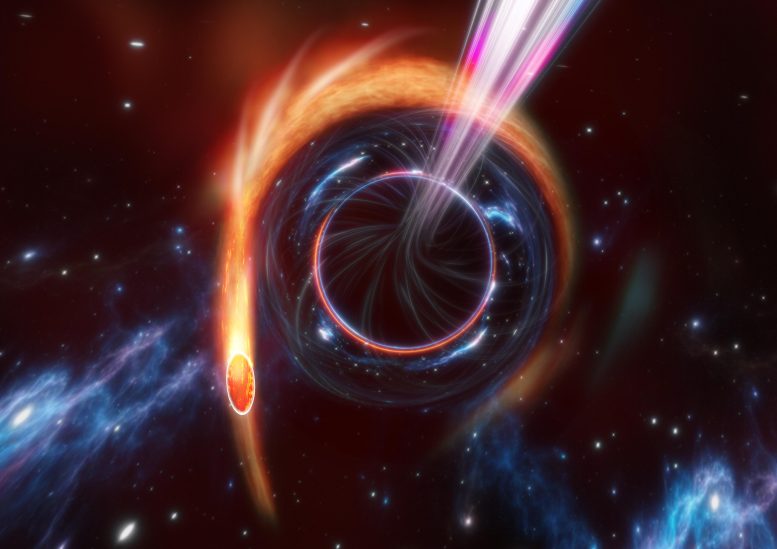
Rare Sighting of Luminous Jet Spewed by Supermassive Black Hole
Astronomers discover a bright optical flare caused by a dying star’s encounter with a supermassive black hole.
What happens when a dying star flies too close to a supermassive black hole?
Several things happen, according to University of Maryland (UMD) astronomer Igor Andreoni: first, the star is violently ripped apart by the black hole’s gravitational tidal forces—similar to how the Moon pulls tides on Earth but with greater strength. Next, pieces of the star are captured into a swiftly spinning disk orbiting the black hole. Finally, the black hole consumes what remains of the doomed star in the disk. This is what astronomers call a tidal disruption event (TDE).
Relativistic Jets: A Rare Phenomenon
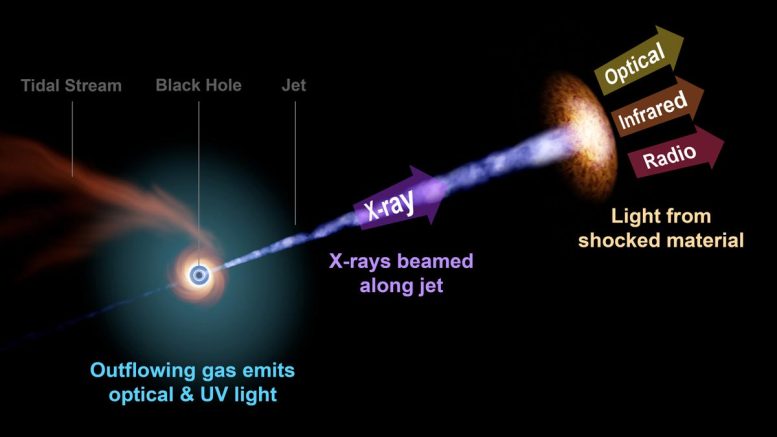
However, in some extremely rare cases, the supermassive black hole launches “relativistic jets” after destroying a star. These are beams of matter traveling close to the speed of light. Andreoni discovered one such case with his team in the Zwicky Transient Facility (ZTF) survey in February 2022. After the group publicly announced the sighting, the event was named “AT 2022cmc.” The team published its findings on November 30, 2022, in the journal Nature.
“The last time scientists discovered one of these jets was well over a decade ago,” said Michael Coughlin, an assistant professor of astronomy at the University of Minnesota Twin Cities and co-lead on the project. “From the data we have, we can estimate that relativistic jets are launched in only 1% of these destructive events, making AT 2022cmc an extremely rare occurrence. In fact, the luminous flash from the event is among the brightest ever observed.”
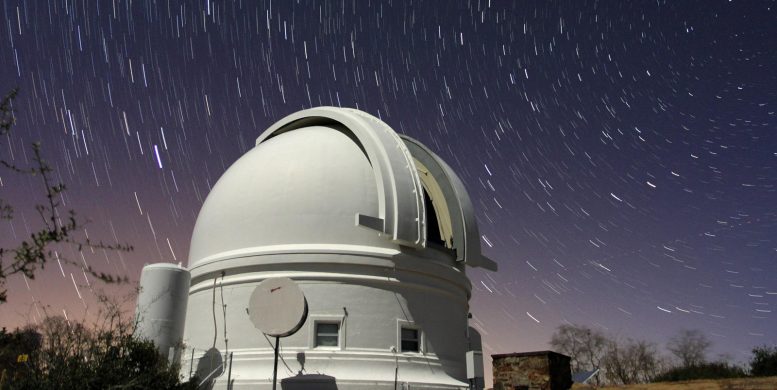
Before AT 2022cmc, the only two previously known jetted TDEs were discovered through gamma-ray space missions, which detect the highest-energy forms of radiation produced by these jets. As the last such discovery was made in 2012, new methods were required to find more events of this nature. To help address that need, Andreoni, who is a postdoctoral associate in the Department of Astronomy at UMD and NASA Goddard Space Flight Center, and his team implemented a novel, “big picture” tactic to find AT 2022cmc. They used ground-based optical surveys, or general maps of the sky without specific observational targets. Using ZTF, a wide-field sky survey taken by the Samuel Oschin Telescope in California, the team was able to identify and uniquely study the otherwise dormant-looking black hole.
“We developed an open-source data pipeline to store and mine important information from the ZTF survey and alert us about atypical events in real-time,” Andreoni explained. “The rapid analysis of ZTF data, the equivalent to a million pages of information every night, allowed us to quickly identify the TDE with relativistic jets and make follow-up observations that revealed an exceptionally high luminosity across the electromagnetic spectrum, from the X-rays to the millimeter and radio.”
Follow-up observations with many observatories confirmed that AT 2022cmc was fading rapidly and the ESO Very Large Telescope revealed that AT 2022cmc was at cosmological distance, 8.5 billion light years away.
Hubble Space Telescope optical/infrared images and radio observations from the Very Large Array pinpointed the location of AT 2022cmc with extreme precision. The researchers believe that AT 2022cmc was at the center of a galaxy that is not yet visible because the light from AT 2022cmc outshone it, but future space observations with Hubble or James Webb Space Telescopes may unveil the galaxy when the transient eventually disappears.
Jet Launching: The Role of Black Hole Spin
It is still a mystery why some TDEs launch jets while others do not seem to. From their observations, Andreoni and his team concluded that the black holes in AT 2022cmc and other similarly jetted TDEs are likely spinning rapidly so as to power the extremely luminous jets. This suggests that a rapid black hole spin may be one necessary ingredient for jet launching—an idea that brings researchers closer to understanding the physics of supermassive black holes at the center of galaxies billions of light years away.
“Astronomy is changing rapidly,” Andreoni said. “More optical and infrared all-sky surveys are now active or will soon come online. Scientists can use AT 2022cmc as a model for what to look for and find more disruptive events from distant black holes. This means that more than ever, big data mining is an important tool to advance our knowledge of the universe.”
See Astronomical Signal Is Black Hole Jet Pointing Straight Toward Earth for related research on AT 2022cmc.
Reference: “A very luminous jet from the disruption of a star by a massive black hole” by Igor Andreoni, Michael W. Coughlin, Daniel A. Perley, Yuhan Yao, Wenbin Lu, S. Bradley Cenko, Harsh Kumar, Shreya Anand, Anna Y. Q. Ho, Mansi M. Kasliwal, Antonio de Ugarte Postigo, Ana Sagués-Carracedo, Steve Schulze, D. Alexander Kann, S. R. Kulkarni, Jesper Sollerman, Nial Tanvir, Armin Rest, Luca Izzo, Jean J. Somalwar, David L. Kaplan, Tomás Ahumada, G. C. Anupama, Katie Auchettl, Sudhanshu Barway, Eric C. Bellm, Varun Bhalerao, Joshua S. Bloom, Michael Bremer, Mattia Bulla, Eric Burns, Sergio Campana, Poonam Chandra, Panos Charalampopoulos, Jeff Cooke, Valerio D’Elia, Kaustav Kashyap Das, Dougal Dobie, José Feliciano Agüí Fernández, James Freeburn, Cristoffer Fremling, Suvi Gezari, Simon Goode, Matthew J. Graham, Erica Hammerstein, Viraj R. Karambelkar, Charles D. Kilpatrick, Erik C. Kool, Melanie Krips, Russ R. Laher, Giorgos Leloudas, Andrew Levan, Michael J. Lundquist, Ashish A. Mahabal, Michael S. Medford, M. Coleman Miller, Anais Möller, Kunal P. Mooley, A. J. Nayana, Guy Nir, Peter T. H. Pang, Emmy Paraskeva, Richard A. Perley, Glen Petitpas, Miika Pursiainen, Vikram Ravi, Ryan Ridden-Harper, Reed Riddle, Mickael Rigault, Antonio C. Rodriguez, Ben Rusholme, Yashvi Sharma, I. A. Smith, Robert D. Stein, Christina Thöne, Aaron Tohuvavohu, Frank Valdes, Jan van Roestel, Susanna D. Vergani, Qinan Wang and Jielai Zhang, 30 November 2022, Nature.
DOI: 10.1038/s41586-022-05465-8
Other UMD collaborators include: adjunct associate professor of astronomy Brad Cenko; astronomy professor M. Coleman Miller; graduate student Erica Hammerstein and Tomas Ahumada (M.S. ’20, astronomy).
The research was supported by the National Science Foundation (Grant Nos. PHY-2010970 425, OAC-2117997, 1106171 and AST-1440341), Wenner-Gren Foundation, Swedish Research Council (Reg. No. 427 2020-03330), European Research Council (Grant No. 759194 432 – USNAC), VILLUM FONDEN (Grant No. 19054), the Netherlands Organization for Scientific Research, Spanish National Research Project (RTI2018-098104-J-I00), NASA (Award No. No. 80GSFC17M0002), the Knut and Alice Wallenberg Foundation (Dnr KAW 2018.0067), Heising-Simons Foundation (Grant No. 12540303), European Union Seventh Framework Programme (Grant No. 312430) Caltech, IPAC, the Weizmann Institute for Science, the Oskar Klein Center at Stockholm University, the University of Washington, Deutsches Elektronen-Synchrotron and Humboldt University, Los Alamos National Laboratories, the TANGO Consortium of Taiwan, the University of Wisconsin at Milwaukee and Lawrence Berkeley National Laboratories.
Never miss a breakthrough: Join the SciTechDaily newsletter.
Follow us on Google and Google News.
10 Comments
So…..did this actually happen 8.5 billion years ago and the light is now reaching earth ?
What a stupid headline. Hey everybody, freak out!
I guess the headlines are clickbait. The black hole is 8.5 billion light years away. So what they are seeing now happened 8.5 billion years ago. The Earth did not exist then. Do they mean that, when it was ejected, the jet was pointing towards where the Earth would be 8.5 billion years later? It seems that they are trying to get clicks from people worried about the jet burning us to crispy critters. I wonder if it might have cooled a bit in 8.5 billion years?
As a wise man once said: black holes are also pink on the inside. Nothing to worry about, folks.
Does it happening 8,5B yrs ago change the fact that the jet arrives now?
This is actually great news, about black holes. Previously the holes were considered black because not even light could escape. Now according to this article something traveling slower than the speed of light can in fact escape.
Will we die from a black hole anytime soon?!!!
Will this black hole or black hole jet kill us!!!!?
Only you, of course.
We’re on Earth are the light pointed to and if you’ve already found the fifth dimension where does this lead have you decided whether or not to send a probe