
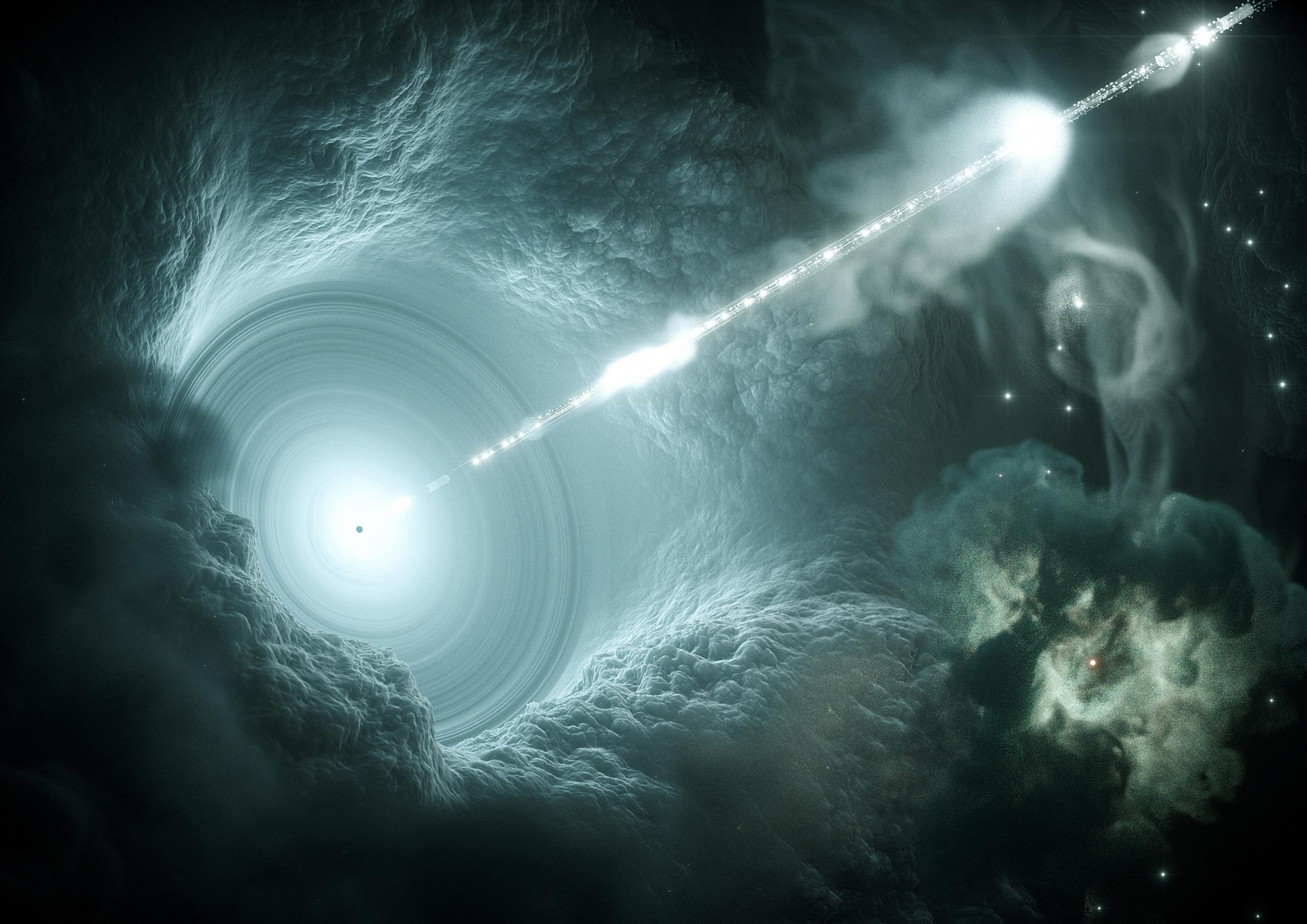
An international team of astronomers has identified the farthest example of a rare class of gamma-ray emitting galaxies. The so-called BL Lacertae object was discovered at cosmic dawn, within the first two billion years of the age of the universe. Today, the cosmos is 13.8 billion years old. The researchers from DESY, Universidad Complutense de Madrid, University of California Riverside, and Clemson University report their discovery in The Astrophysical Journal Letters. They used one of the largest optical telescopes in the world, Gran Telescopio Canarias (GTC), located at the Observatorio del Roque de los Muchachos on the island of La Palma.
Only a small fraction of the galaxies emit gamma rays, which is the most extreme form of light. Astronomers believe that these highly energetic photons originate from the vicinity of a supermassive black hole residing at the centers of these galaxies. When this happens, they are known as active galaxies. The black hole swallows matter from its surroundings and emits jets or, in other words, collimated streams of matter and radiation. Few of these active galaxies (less than one percent) have their jets pointing by chance toward Earth. Scientists call them blazars, and these are one of the most powerful sources of radiation in the universe.
Blazars come in two flavors: BL Lacertae (BL Lac) objects and flat-spectrum radio-quasars (FSRQs). The current understanding about these mysterious astronomical objects is that FSRQs are relatively young active galaxies, rich in dust and gas that surround the central black hole. As time passes, the amount of matter available to feed the black hole is consumed and the FSRQ evolves to become a BL Lac object. “In other words, BL Lacs may represent the elderly and evolved phase of a blazar’s life, while FSRQs resemble an adult,” explains Vaidehi Paliya from DESY, first author of the paper.
“Since the speed of light is limited, the farther we look, the earlier in the age of the Universe we investigate,” says Alberto Domínguez from the Institute of Physics of Particles and the Cosmos (IPARCOS) at Universidad Complutense de Madrid and co-author of the study. The most distant FSRQ was identified at a distance when the age of the universe was merely a billion years. For comparison, the previously farthest BL Lac was found at an age when the Universe was around 2.5 billion years old, corroborating the hypothesis of the evolution from FSRQ to BL Lacs.
However, the newly discovered BL Lac object with the catalog number 4FGL J1219.0+3653, is substantially farther away than the previous record holder. “We have discovered a BL Lac existing even 800 million years earlier, this is when the Universe was less than 2 billion years old,” reports co-author Cristina Cabello, a graduate student at IPARCOS. “This finding challenges the current scenario that BL Lacs are actually an evolved phase of FSRQ,” adds IPARCOS professor Nicolás Cardiel, also a co-author of the paper. And IPARCOS professor and co-author Jesús Gallego concludes: “This discovery has challenged our knowledge of the cosmic evolution of blazars and active galaxies in general.”
Reference: “The First Gamma-Ray Emitting BL Lacertae Object at the Cosmic Dawn” by Vaidehi S. Paliya, A. Domínguez, C. Cabello, N. Cardiel, J. Gallego, Brian Siana, M. Ajello, D. Hartmann, A. Gil de Paz and C. S. Stalin, 27 October 2020, The Astrophysical Journal Letters.
DOI: 10.3847/2041-8213/abbc06
Never miss a breakthrough: Join the SciTechDaily newsletter.
Follow us on Google and Google News.
15 Comments
Chemical composition bond length,bond angle,gravity units measurement,fission,amplitude,colidal force,range,intensity,gaseus co-ordinations,speeds,radio isotopes,carbon dating,observation standard wavelength,frequency,parametric parameter group mechanism.
Fascinating…can’t wait for the next one to be discovered.
“Only a small fraction of the galaxies emits gamma rays, which is the most extreme form of light.”
No. Gamma rays are not a form of light at all. Not even close. Not even sort-of or in summary.
Light falls in a specific range of frequencies that humans can detect without instruments. Gamma rays lie outside that range on the far end of the electromagnetic spectrum.
Saying Gama rays are a form of light is like saying planets are a type of star.
All light is essentially electro magnetic radiation aswell lol
Some parts of the spectrum are more energetic than others. Also does nature not give a sh*t about what humans can see or not and so nature does not build physics around mankind it nature’s laws don’t just cease to exist as all human life gets extincted.
Your misunderstanding the intention of that statement. Visible light is made of photons. Gamma rays are also made of photons. That is why the article refers to gamma rays as a form of light. The notion that light is defined by what we can see is not a scientific definition. Light in science refers to photons as in the speed of light which is how fast a photon travels.
Maybe it should be considered as a pulsating QSO piercing thru the elements of the universe and its galaxies ejecting rays of its immediate surroundings of gases and particles.
Is it straight as an arrow or does it have a form of its own?
I like the term extruded material.
I’m pretty sure gamma rays are still considered light they just don’t fall in the visible spectrum, like ultraviolet light, x-rays, or infrared. Just like some sound waves aren’t within the range of human hearing but we don’t say they’re not sound. we just need instruments to detect them.
Do planets get engulfed by stars? And do the different make ups of each planet once all swallowed cause so kind of regeneration of the the star eating eat? Just curious..each planet in our solar system alone is all unique..like the weird moons all of different stuff eventually becoming something else
Is our earth in danger?
Hi, sorry about my stupid question but if they have a telescope which can pick something that is billions of light years from here. How they haven’t come up with any trace of intelligent life in the universe yet?? When I read something like that is same as saying you can see an ant on the other side of the town but not an elephant in front of you!!
Gus, now that was a classic, why don’t they turn their big eye on the moom and take a photo of the old buggy
Are these gamma rays detected directly coming towards us or is there any chance of their being detected after hitting or scattering from other galactic objects as well?
I would pay to send Trump there right now.
Gus.When searching for signals in the universe(gamma,radio,etc.)
Instruments are set to detect specifically what they are looking for and a distant,possibly very ancient,intelligent civilization could use a frequincy of some sort that we have no way of detecting or havent discovered yet.Maybe we have received signals fron them but its just not what we consider a communication and has been overlooked or decided as something else.