
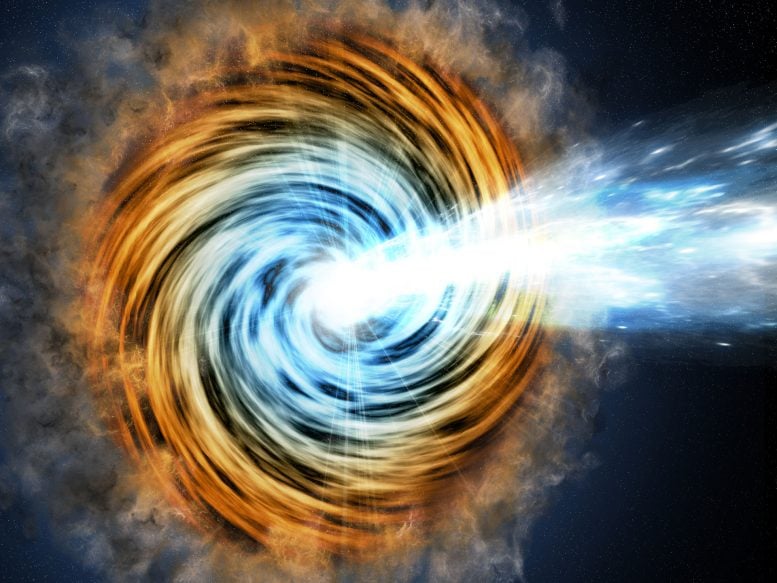
New research on 106 dim blazars confirmed the blazar sequence theory, refining our understanding of black hole jets and high-energy physics.
Penn State researchers have recently characterized over a hundred blazars – far-off, dynamic galaxies hosting a central supermassive black hole that propels potent jets – from a catalog of previously unclassified high-energy cosmic emissions. The newly recognized blazars, which are dim compared to most of their counterparts, have given the scientists a chance to test a contentious theory regarding blazar emissions. This newfound knowledge contributes to our grasp of black hole expansion and even impacts our theories on general relativity and high-energy particle physics.
A paper describing the blazars and the theory was recently published in the Astrophysical Journal.
Supermassive black holes can be millions or billions of times the mass of our sun. In some cases, matter outside of the black hole’s event horizon is propelled in a jet, accelerating to nearly the speed of light and sending emissions across the universe. When the jet happens to be pointed directly at the Earth, the system is typically called a blazar.
“Because the jet of a blazar is pointed directly at us, we can see them from much farther away than other black hole systems, similar to how a flashlight appears brightest when you’re looking directly at it,” said Stephen Kerby, a graduate student in astronomy and astrophysics at Penn State and first author of the paper. “Blazars are exciting to study because their properties allow us to answer questions about supermassive black holes throughout the universe. In this study, we used relatively new methods to characterize 106 dim blazars and test the predictions of a contentious theory called the ‘blazar sequence.’”
Multiwavelength Observations and Classification Challenges
Blazars emit light across the entire electromagnetic spectrum, from lower-energy wavelengths such as radio, infrared, and visible light, up to higher-energy wavelengths like X-rays and gamma rays. When astronomers study observations of these emissions, they typically see two broad peaks, one in gamma rays and one at lower-energy wavelengths. The wavelengths and the intensity of these peaks vary from blazar to blazar and with time. An overarching theory of blazars defined by the “blazar sequence” predicts that the lower-energy peak for brighter blazars will, on average, be redder — lower energy — than that of dimmer blazars, while the lower-energy peak for dim blazars will be bluer — higher energy.
“Some of the most exciting and extreme blazars are discovered by detecting their gamma-ray emission, but we can’t usually classify or understand these objects without further multiwavelength observations,” said Abe Falcone, research professor of astronomy and astrophysics and the lead of a high energy astrophysics group at Penn State. “With our currently operating telescopes, it’s actually very difficult to detect and classify the lower-energy peaked — red — blazars that are also dim, whereas it is much easier to find these blazars when their peaks are at higher energies or when they are bright. So, with this research, we are minimizing a selection bias and exploring the blazar sequence by delving deeper into lower luminosities of both the low-energy and high-energy peaked blazars.”
The researchers, alongside Amanpreet Kaur — associate research professor of astronomy and astrophysics at Penn State at the time of the research — previously identified potential blazars from a catalog of gamma-ray sources detected by the Fermi Large Area Telescope, many of which had not yet been paired up with lower-energy emissions that may have come from the same source. For each of the blazars, the researchers then identified these counterpart emissions in X-ray, UV, and optical — detected by the Neil Gehrels Swift Observatory, whose Mission Operations Center is located at Penn State — and in infrared and radio emissions from archival data. Cross-referencing the information ultimately allowed the researchers to characterize the spectra of 106 new, dim blazars.
“The Swift telescope observations allowed us to pinpoint the positions of these blazars with much more precision than with the Fermi data alone,” said Kerby. “Pulling together all this emission data, combined with two new technical approaches, helped us identify where in the electromagnetic spectrum the low-energy peak occurs for each of the blazars, which, for example, can provide information about the strength of the jet’s magnetic field, how fast the charged particles are moving, and other information.”
New Insights into the Blazar Sequence
To identify where this peak occurred for the dim blazars, the researchers used machine learning and direct physical fitting approaches, each of which, according to Kerby, has advantages and disadvantages. The machine-learning approach filters out emissions that might actually be noise, such as from dust in the galaxy or light from other stars. The direct physical fitting approach does not filter out noise and is considerably more difficult to use but provides more detailed properties of the blazar jet.
“For both approaches, the emissions of our sample of dim blazars generally peaks in the blue, higher-energy light, though the fitting approach produced less extreme values,” said Kerby. “This is in agreement with the blazar sequence and extends what we know about this pattern. However, there are still a thousand Fermi unassociated sources for which we have found no X-ray counterpart, and it’s a fairly safe assumption that many of those sources are also blazars that are just too dim in the X-rays for us to detect. We can use the lessons we’ve learned here about the shape of these blazar’s spectra to make predictions about the blazars that are still too dim for us to detect, which would further test the blazar sequence.”
The catalog of new blazars is available for other astronomers to study in detail.
“It’s important to always work to expand our datasets to reach dimmer and dimmer sources because it makes our theories more complete and less prone to failures from unexpected biases,” said Kerby. “I’m excited for new telescopes to probe even dimmer blazars in the future.”
According to the researchers, studying supermassive black holes also provides a unique way to understand the physical theories in the universe.
“Supermassive black holes, and their surroundings, are cosmic laboratories that are far more energetic than anything we can produce in particle accelerators on Earth,” said Falcone. “They provide us with opportunities to study theories of relativity, to better understand how particles behave at high energies, to study potential sources of cosmic rays that arrive here on Earth, and to study the evolution and formation of supermassive black holes and their jets.”
Reference: “Testing the Blazar Sequence with Spectra of Recently Discovered Dim Blazars from the Fermi Unassociated Catalog” by Stephen Kerby and Abraham D. Falcone, 10 July 2023, The Astrophysical Journal.
DOI: 10.3847/1538-4357/acd4c0
The study was funded by NASA.
Never miss a breakthrough: Join the SciTechDaily newsletter.
Follow us on Google and Google News.
2 Comments
(((BLAAAZ-ZARS))) …
The Tres MODERNE equivalent of the MEDIEVAL HOMUNKULOUS.
🧙♂️
THE INFERENCE OF THE DIFFERENCE IS THE DIFFERENCE OF THE INFERENCE.
Thusly: And YET, one doesn’t know one’s arse from a BLACK HOLE in the ground…
Interesting articles, but consent to Cookies is a
minefield. I don’t know if the person who wrote
the ‘consent’ page is very clever or an idiot.
It is impossible to know if one is accepting
or rejecting cookies, particularly when using
ones mobile. I do not read ScitechDaily any
more for that reason. Please have a reject
all button like everyone else.
Thanks,
Keith