
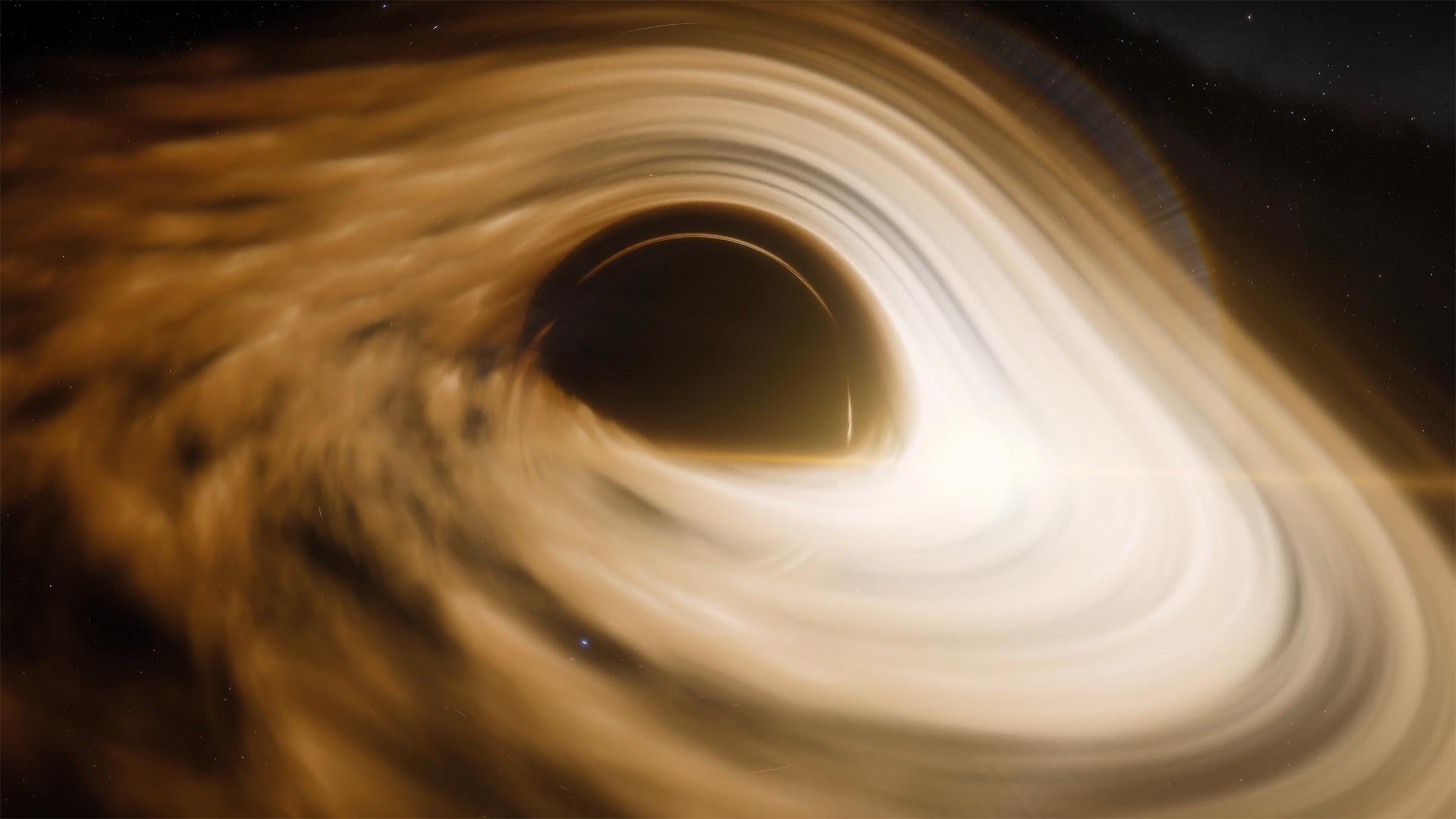
Researchers combined X-ray surveys and supercomputer simulations to track 12 billion years of cosmic black-hole growth.
Their findings reveal that black hole growth is primarily driven by accretion, with mergers playing a secondary role, especially in the early universe. These insights help explain the rapid growth of black holes during the universe’s younger phases.
How Do Supermassive Black Holes Get Super Massive?
By combining forefront X-ray observations with state-of-the-art supercomputer simulations of the buildup of galaxies over cosmic history, researchers have provided the best modeling to date of the growth of the supermassive black holes found in the centers of galaxies. Using this hybrid approach, a research team led by Penn State astronomers derived a complete picture of black-hole growth over 12 billion years, from the Universe’s infancy at around 1.8 billion years old to now at 13.8 billion years old.
The research comprises two papers, one published in The Astrophysical Journal in April 2024, and one as yet unpublished that will be submitted to the same journal. The results will be presented at the 244th meeting of the American Astronomical Society, held June 9 through June 13 at the Monona Terrace Convention Center in Madison, Wisconsin. The results were featured during a press conference that was live-streamed and is available to view now:
Mechanisms of Supermassive Black Hole Growth
“Supermassive black holes in galaxy centers have millions-to-billions of times the mass of the Sun,” said Fan Zou, a graduate student at Penn State and first author of the papers. “How do they become such monsters? This is a question that astronomers have been studying for decades, but it has been difficult to track all the ways black holes can grow reliably.”
Supermassive black holes grow through a combination of two main channels. They consume cold gas from their host galaxy — a process called accretion — and they can merge with other supermassive black holes when galaxies collide.
Data Sources and Accretion Measurement
“During the process of consuming gas from their hosting galaxies, black holes radiate strong X-rays, and this is the key to tracking their growth by accretion,” said W. Niel Brandt, Eberly Family Chair Professor of Astronomy and Astrophysics and professor of physics at Penn State and a leader of the research team. “We measured the accretion-driven growth using X-ray sky survey data accumulated over more than 20 years from three of the most powerful X-ray facilities ever launched into space.”
The research team used complementary data from NASA’s Chandra X-ray Observatory, the European Space Agency’s X-ray Multi-Mirror Mission-Newton (XMM-Newton), and the Max Planck Institute for Extraterrestrial Physics’ eROSITA telescope. In total, they measured the accretion-driven growth in a sample of 1.3 million galaxies that contained over 8,000 rapidly growing black holes.
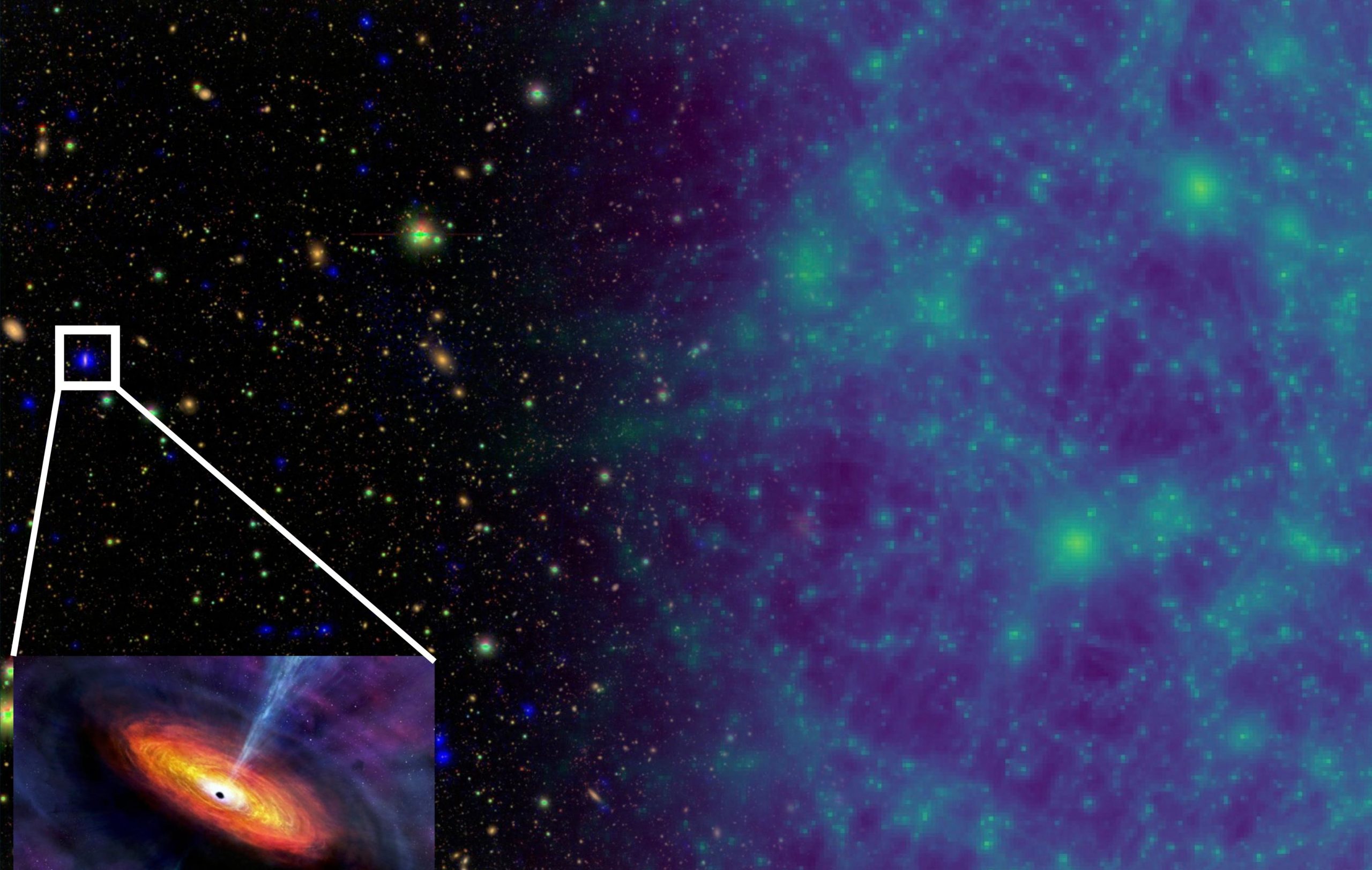
“All of the galaxies and black holes in our sample are very well characterized at multiple wavelengths, with superb measurements in the infrared, optical, ultraviolet, and X-ray bands,” Zou said. “This allows for robust conclusions, and the data show that, at all cosmic epochs, more massive galaxies grew their black holes by accretion faster. With the quality of the data, we were able to quantify this important phenomenon much better than in past works.”
Mergers and Simulated Growth
The second way that supermassive black holes grow is through mergers, where two supermassive black holes collide and merge together to form a single, even more massive, black hole. To track growth by mergers, the team used IllustrisTNG, a set of supercomputer simulations that model galaxy formation, evolution, and merging from shortly after the Big Bang until the present.
“In our hybrid approach, we combine the observed growth by accretion with the simulated growth through mergers to reproduce the growth history of supermassive black holes,” Brandt said. “With this new approach, we believe we have produced the most realistic picture of the growth of supermassive black holes up to the present day.”
Impact and Historical Growth Patterns
The researchers found that, in most cases, accretion dominated black-hole growth. Mergers made notable secondary contributions, especially over the past 5 billion years of cosmic time for the most-massive black holes. Overall, supermassive black holes of all masses grew much more rapidly when the Universe was younger. Because of this, the total number of supermassive black holes was almost settled by 7 billion years ago, while earlier in the Universe many new ones kept emerging.
“With our approach, we can track how central black holes in the local universe most likely grew over cosmic time,” Zou said. “As an example, we considered the growth of the supermassive black hole in the center of our Milky Way Galaxy, which has a mass of 4 million solar masses. Our results indicate that our Galaxy’s black hole most likely grew relatively late in cosmic time.”
Reference: “Mapping the Growth of Supermassive Black Holes as a Function of Galaxy Stellar Mass and Redshift” by Fan Zou, Zhibo Yu, W. N. Brandt, Hyungsuk Tak, Guang Yang and Qingling Ni, 29 March 2024, The Astrophysical Journal.
DOI: 10.3847/1538-4357/ad27cc
In addition to Zou and Brandt, the research team includes Zhibo Yu, graduate student at Penn State; Hyungsuk Tak, assistant professor of statistics and of astronomy and astrophysics at Penn State; Elena Gallo at the University of Michigan; Bin Luo at Nanjing University in China; Qingling Ni at the Max Planck Institute for Extraterrestrial Physics in Germany; Yongquan Xue at the University of Science and Technology of China; and Guang Yang at the University of Groningen in the Netherlands.
Funding from the U.S. National Science Foundation, the Chandra X-ray Center, and Penn State supported this work. The work was also made possible by the sharing of the IllustrisTNG simulation results with the scientific community.
Never miss a breakthrough: Join the SciTechDaily newsletter.
Follow us on Google and Google News.
7 Comments
but it has been difficult to track all the ways black holes can grow reliably.”
do you mean “but it has been difficult to reliably track all the ways black holes can grow.”
1. The Universe is multidimensional. It is a Macrocosm structured, stratified on multiple dimensions and planes, with different frequencies and vibrations. (M-theory of theoretical physics, for example, talks about 11 such dimensions.)
2. The PHYSICAL Universe was born from the primordial supermassive black holes. I call this theory “The Supermassive Black Holes Bang”. (It’s a theory of mine with few elements borrowed from metaphysics.) Consequently, there’s no such thing as the Big Bang; or at least there’s no such thing as the Big Bang in the current format that is presented in the Standard Model. The Big Bang could be seen as a primordial supermassive black hole from where later many other such structures formed.
3. All the galaxies are born from the supermassive black holes found in their centers. The giant black holes regulate their entire structure and physiology (possibly via dark matter) ever since their beginnings, as dwarf galaxies. Dwarf galaxies represent basically the galaxies in their infancy, after their birth from their supermassive black holes. There were recently made multiple observations which showed again and again that the supermassive black holes release periodically superheated jets of energy, matter, gas all throughout their galactic environments, feeding their galactic hosts systematically. These observations include the supermassive black holes of Henize 2-10, NGC 1275, M27, SDSS J1531, or even Milky Way’s Sagittarius A. Many other cases of supermassive black holes in the early Universe, with their galactic hosts in their infancy having the same mass (1 to 1), prove again that the galaxies are born from their supermassive black holes, and after that they gradually evolve, expand.
4. Dark energy, which fills the physical Universe, comes out of the supermassive black holes as well. Scientists also theorized that recently, in 2023. This explains, for example, why some areas of the Universe expand faster than other areas. I believe that a larger concentration of supermassive black holes which release dark energy into one area of the Cosmos would lead inevitably at a faster expansion of space within that area.
5. The different types of energies released by the supermassive black holes during the galactic evolution (dark energy, dark matter, or baryonic matter, which, as we know, is energy condensed into this physical plane) shape the galaxies in a spiral or lenticular way. By the mode in which the supermassive black holes release these energies into this dimensional layer, the galaxies get that flat shape. In the case of the elliptical galaxies, I suspect that the supermassive black hole physics is changed; in other words, here they stopped releasing dark repulsive energy winds perpendicular to the galactic structure, and because of this reason these galaxies are not flat, disk-shaped.
6. All the energy that condenses and materializes into this four dimensional spacetime environment comes, via these supermassive black holes, from the higher dimensional layers of the Macrocosm. Therefore, the origins of the physical Universe are found, via these supermassive black holes, NOT in another parallel Universe (as some physicists like John Wheeler used to theorize in the past), but in the higher dimensional layers of the same Universe or Macrocosm. The black holes could be seen in this way as interdimensional gateways of energy exchange between this physical layer observed by us and the higher extradimensional planes of the Macrocosm.
Metaphysics also supports the idea that the physical plane is emanated from the higher macrocosmic layers. This emanation is done through the same black holes. More future scientific observations will clarify the validity of my statements revealed here very briefly.
What are the origins, the essence, and the nature of the entire multidimensional Macrocosm? It’s a very long, complicated story (too long for this comment section), a story around which I developed my own personal theory which tries to explain the ultimate nature of nature.
It has to be mentioned here that not all galaxies contain at their center a supermassive black hole, and I’m referring here especially to the dwarf, satellite galaxies, like the Magellanic Clouds. In their case, according to the Supermassive Black Holes Bangs model, they would be formed as independent small galactic structures, in general irregular, with the energy, gas ejected from the central supermassive black hole of the main galaxy around which they revolve. Some of the clouds of gas ejected from the supermassive black hole would escape the galactic environment and would organize themselves later, when new stars would be born, in the form irregular, dwarf, satellite galaxies, with no supermassive black holes at their center. Astronomers from the Green Bank Telescope observed recently that 250 neutral gaseous clouds were blasted out from the center of the Milky Way galaxy, being the product of the same phenomenon that produces the Fermi Bubbles. The clouds carry with them matter out of the galactic nucleus. The velocities of these hydrogen clouds are tremendous, making them to even escape the galaxy, and the main suspect for this phenomenon is none other than the activity of the inevitable central supermassive black hole, Sagittarius A and its exhaust vent. Therefore, the clouds that escape the galactic environment would lead at the formation and the evolution of the irregular, satellite galaxies. In this way, the supermassive black hole would feed not only its own galaxy with gas, but also the satellites that lack one at their centers. That’s how satellite galaxies, with no central supermassive black holes, would form and would evolve.
Another aspect that needs to be highlighted here is the cause of Inflation, the super-fast expansion of space after the beginning of the physical Universe. In my model, immediately after the formation of the first smbh singularity (which science wrongly calls it the Big Bang), innumerable other such structures formed which together expelled energy within this new physical dimension created. The super-fast multiplication, replication of smbhs after the first singularity produced the Inflation; basically, once they formed, their bangs, their massive release of energy produced the inflation. Since then, the Universe continued to be banged constantly because every time a smbh erupts, releasing energy, it contributes to the evolution of the Cosmos. Porphyrion jets, located at 7,5 billion light years from Earth and observed recently by astronomers, are one such example of how the Universe continued to be banged way before its beginnings. (The huge amount of energy released from this smbh could not have been produced with matter devoured by it because the proportion of the energy hypothetically swallowed vs. the energy released in this case was way too big. The two jets of energy extend 23 million light years from end to end. That’s a tremendous amount of energy, enough to create new galaxies. The energy of the Porphyrion jets had to come from somewhere else. Therefore, the smbhs can’t be seen only as recyclers of energy devoured in this dimensional environment. They’re much more than that. Each of them are the engines of their galaxies and their surroundings, and together the engines of the entire Universe.)
Consequently, this model explains very well so many astronomical and cosmological conundrums (including the formation and the evolution of the galaxies) that at first sight do not make sense. All black holes, regardless their size, make the interconnection, the interexchange of energy and information within the multidimensional layers of the Macrocosm. For those familiarized with the multidimensional anatomy of the human being, the black holes could be seen as the chakras, the secondary, and the tertiary points of the Macrocosm.
Anyway, returning to Inflation, this event does not prove the existence of a Metaverse or Multiverse (parallel universes) because its causes can be found within the same Universe, its higher dimensional layers. There are other stand alone multidimensional universes (Macrocosms) within the Metaverse, but their existence can’t be proven with the Inflation event. All Macrocosms would evolve in the Metaverse totally independent of each other. Therefore, the Inflation produced at the beginning of the physical plane was an event connected strictly with the higher dimensional layers of this Universe.
Correction: Porphyrion jets, located at 7,5 billion light years from Earth and observed recently by astronomers, are one such example of how the Universe continued to be banged way after its beginnings.
With regard to the Magellanic Clouds; if they do contain supermassive black holes, as it was recently observed, then they should not be considered satellite galaxies anymore. They would have the status of stand-alone dwarf galaxies found in the proximity of the Milky Way. Also, as astronomers observed via Hubble, it seems that they do not even revolve around it, which is another reason to consider them independent galaxies. Their irregularity would be probably the result of the gravitational influence produced by the Milky Way galaxy.
I have to add here that just as satellite galaxies form without supermassive black holes at their centers, being built with the material expelled from the supermassive black hole of the parental galaxy around which they revolve, there would also have to exist dwarf galaxies at the dawn of the Universe without a central supermassive black holes which formed with material ejected from the supermassive black holes of the surrounded galaxies.
Also, I said above that all macrocosms evolve independent of each other inside the Metaverse (the incommensurable, entangled Fundamental Field of energy, called Brahman by the Hindus, Ain Soph by the Cabbalists, or Tao by the Chinese philosophers, and in which the macrocosms manifest), but I have to complete that first they are born one from the other through a law envisioned by me last year that involves Intelligent Design and the notion of Universal Consciousness, a law about which I can’t talk here because I would have to write an entire book in this comment section, and that’s not what I intend to do here. After the macrocosms are born one from the other, then they develop and evolve independent of each other, each as a multidimensional standalone structure owned by a Universal Consciousness. (The Universal or Cosmic Consciousness, so mysterious for the metaphysical schools of all ages, can’t be defined with the term “God”. “God” and the “gods” are terms connected with religions and galactic extradimensional Superintelligences that are byproducts, just like us, as spiritual elements of awareness, of this Universal Consciousness. Essentially, humans, the gods, and everything else within the Macrocosm have the spiritual origins in this Universal Consciousness.) Still, even if they evolve independent of each other, all macrocosms would remain entangled by the Fundamental Field of the Metaverse within which they manifest. After its birth, each Macrocosm permeated, organized, owned by its Universal Consciousness would develop independently its dimensional layers, one from the other, from the highest vibrational layer to the lowest. Black holes, regardless their size, would play a key role in the formation and later the evolution of each macrocosmic dimensional layer. That’s what the extended model (which goes beyond this SMBHs Bangs model for the physical layer) predicts.
According to the SMBHs Bangs model (or more shortly the Big Bangs model), the physical Universe was not born and evolved from a Big Bang singularity (as modern science predicts), but it was born, evolved, and continues to evolve and to be banged right now as I’m writing these lines here via the singularities of all supermassive black holes. (As we saw recently, the jets of energies released by supermassive black holes represent essentially remnants of other bangs that led to the evolution of the Cosmos. These jets may defy the mainstream models, but they confirm again my alternative model. The same type of jets can be seen released by quasars and the active galactic nuclei in the early Universe. Quasars’ jets and their release of energy within this dimensional layer is another key element in understanding the evolution of the early physical Universe.)
Still, thats not all. Seeing my extended model from quantum physics perspective this time, it also has to be mentioned for those that visit this article and view this comment section that the evolution of the physical layer of the Macrocosm is not dependant only of the supermassive black holes. In an interconnected, holographic, multidimensional Macrocosm, where the spacetime layers are sandwiched, stratified one above the other in different frequency vibrations of energies, with different densities and speeds of the particles (hypothetical exotic particles, like tachyons, psyons, or mindons) generated by those energies, black holes would be present within each layer. They would also be present down to the basic structure of matter of this physical layer, in the quantum world. In this way, black holes (regardless their size, supermassive, mini, quantum, etc), true holes of energy, would regulate the physiology of the Macrocosm, and that’s because the entire Macrocosm is a hyperintelligent living being. Everything is intelligently organized by the laws of nature given by this Hyperintelligence (how I baptized it), this Universal Consciousness in which we all have our spiritual origins and manifest. The atoms themselves would contain what could be called quantum black holes that would interconnect the physical layer with the higher dimensional layers. Nothing in the physical layer would exist by itself, as a standalone atomic structure, but it would be intelligently interconnected with the higher layers. In this way, when particles pop in and out of this spacetime layer, they don’t do anything else actually than to jump between this physical dimensional layer and another one within the multidimensional structure of the Macrocosm. That’s how the interexchange of energies would be made at the quantum level, according to my extended multidimensional model which deals with the nature and the structure of the entire Macrocosm. Therefore, in the quantum world, the interexchange of energies would be made again via the same black holes; in this case, quantum black holes.