
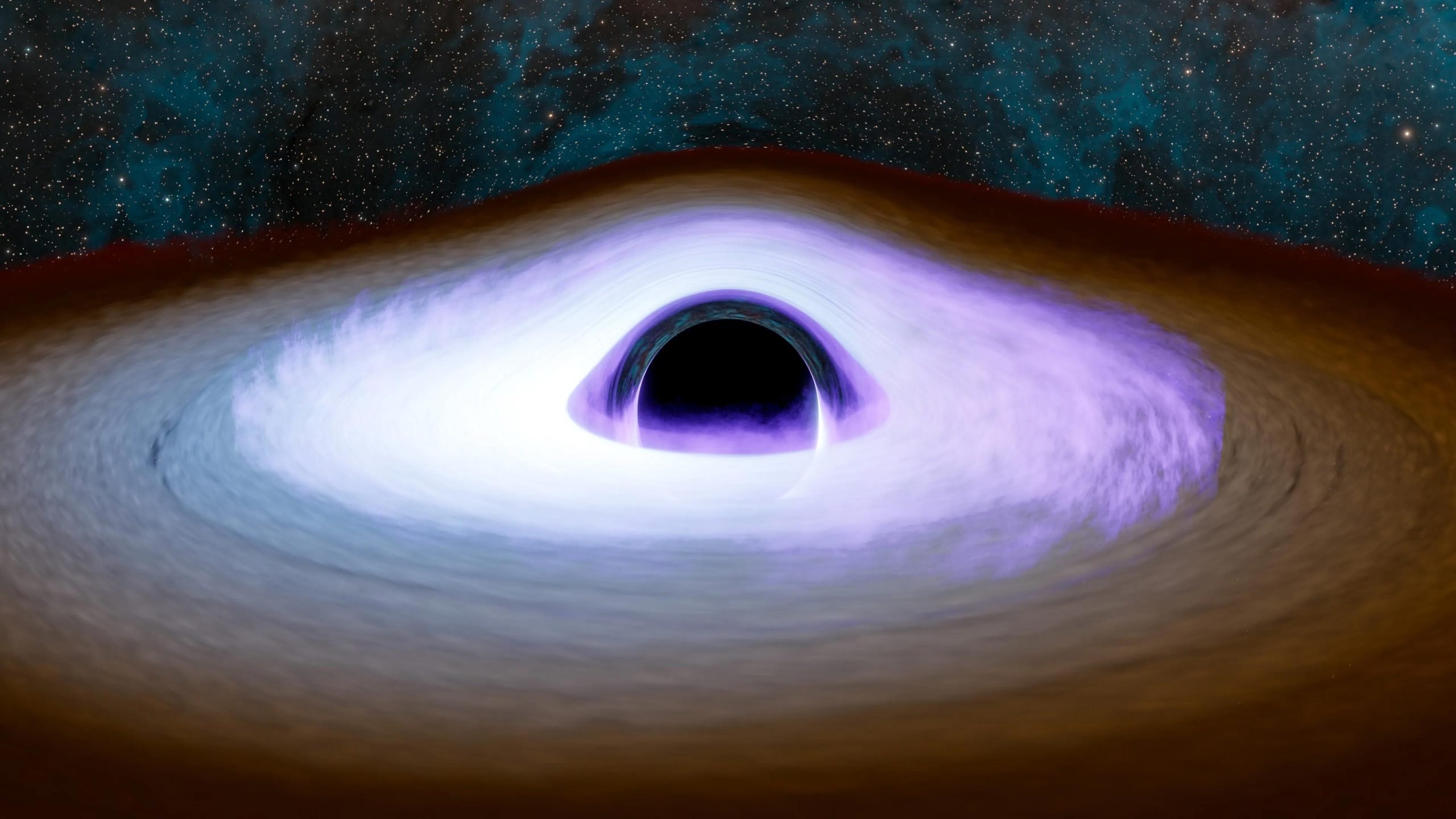
NASA’s IXPE mission has provided new insights into black holes’ coronae, revealing their shape and enhancing our understanding of their structure.
This data, derived from the observation of both stellar-mass and supermassive black holes, indicates a similarity in the accretion disks’ geometry regardless of the black hole’s size.
New discoveries from NASA’s IXPE (Imaging X-ray Polarimetry Explorer) mission have provided unprecedented insight into the shape and nature of a black hole’s corona. A corona is a region of hot, shifting plasma that surrounds a black hole, where matter flows inwards. Until now, scientists had only theoretical ideas about what this structure looked like. These new findings reveal the corona’s shape for the first time, offering clues about how it helps feed and sustain black holes.
Black holes, known for their immense gravity that prevents even light from escaping, are often surrounded by accretion disks—whirling, debris-filled disks of gas. Some black holes also produce relativistic jets, powerful streams of matter ejected into space at incredible speeds as the black hole actively draws in material from its surroundings.
The Role of Accretion Disks and Jets
Many black holes, so named because not even light can escape their titanic gravity, are surrounded by accretion disks, debris-cluttered whirlpools of gas. Some black holes also have relativistic jets – ultra-powerful outbursts of matter hurled into space at high speed by black holes that are actively eating material in their surroundings.
Less well known, perhaps, is that snacking black holes, much like Earth’s Sun and other stars, also possess a superheated corona. While the Sun’s corona, which is the star’s outermost atmosphere, burns at roughly 1.8 million degrees Fahrenheit, the temperature of a black hole corona is estimated at billions of degrees.
Astrophysicists previously identified coronae among stellar-mass black holes – those formed by a star’s collapse – and supermassive black holes such as the one at the heart of the Milky Way galaxy.
“Scientists have long speculated on the makeup and geometry of the corona,” said Lynnie Saade, a postdoctoral researcher at NASA’s Marshall Space Flight Center in Huntsville, Alabama, and lead author of the new findings. “Is it a sphere above and below the black hole, or an atmosphere generated by the accretion disk, or perhaps plasma located at the base of the jets?”
Methods of Observing Black Hole Structures
Enter IXPE, which specializes in X-ray polarization, the characteristic of light that helps map the shape and structure of even the most powerful energy sources, illuminating their inner workings even when the objects are too small, bright, or distant to see directly. Just as we can safely observe the Sun’s corona during a total solar eclipse, IXPE provides the means to clearly study the black hole’s accretion geometry, or the shape and structure of its accretion disk and related structures, including the corona.
“X-ray polarization provides a new way to examine black hole accretion geometry,” Saade said. “If the accretion geometry of black holes is similar regardless of mass, we expect the same to be true of their polarization properties.”
Expanding Our Understanding of Black Hole Geometry
IXPE demonstrated that, among all black holes for which coronal properties could be directly measured via polarization, the corona was found to be extended in the same direction as the accretion disk – providing, for the first time, clues to the corona’s shape and clear evidence of its relationship to the accretion disk. The results rule out the possibility that the corona is shaped like a lamppost hovering over the disk.
The research team studied data from IXPE’s observations of 12 black holes, among them Cygnus X-1 and Cygnus X-3, stellar-mass binary black hole systems about 7,000 and 37,000 light-years from Earth, respectively, and LMC X-1 and LMC X-3, stellar-mass black holes in the Large Magellanic Cloud more than 165,000 light-years away. IXPE also observed a number of supermassive black holes, including the one at the center of the Circinus galaxy, 13 million light-years from Earth, and those in galaxies NGC 1068 and NGC 4151, 47 million light-years away and nearly 62 million light-years away, respectively.
Implications for Black Hole Research
Stellar mass black holes typically have a mass roughly 10 to 30 times that of Earth’s Sun, whereas supermassive black holes may have a mass that is millions to tens of billions of times larger. Despite these vast differences in scale, IXPE data suggests both types of black holes create accretion disks of similar geometry.
That’s surprising, said Marshall astrophysicist Philip Kaaret, principal investigator for the IXPE mission, because the way the two types are fed is completely different.
“Stellar-mass black holes rip mass from their companion stars, whereas supermassive black holes devour everything around them,” he said. “Yet the accretion mechanism functions much the same way.”
That’s an exciting prospect, Saade said, because it suggests that studies of stellar-mass black holes – typically much closer to Earth than their much more massive cousins – can help shed new light on properties of supermassive black holes as well.
Future Directions in Black Hole Studies
The team next hopes to make additional examinations of both types.
Saade anticipates there’s much more to glean from X-ray studies of these behemoths. “IXPE has provided the first opportunity in a long time for X-ray astronomy to reveal the underlying processes of accretion and unlock new findings about black holes,” she said.
The complete findings are available in the latest issue of The Astrophysical Journal.
Reference: “A Comparison of the X-Ray Polarimetric Properties of Stellar and Supermassive Black Holes” by M. Lynne Saade, Philip Kaaret, Ioannis Liodakis and Steven R. Ehlert, 8 October 2024, The Astrophysical Journal.
DOI: 10.3847/1538-4357/ad73a3
More About IXPE
The Imaging X-ray Polarimetry Explorer (IXPE) is a joint mission between NASA and the Italian Space Agency, designed to deliver unprecedented data on celestial objects throughout the universe. Since its launch, IXPE has been a key tool in advancing our understanding of cosmic phenomena, such as black holes and neutron stars, by measuring X-ray polarization. The mission is led by NASA’s Marshall Space Flight Center, with spacecraft operations managed by Ball Aerospace and the University of Colorado’s Laboratory for Atmospheric and Space Physics. Scientists from 12 countries contribute to IXPE, making it a global collaboration in cutting-edge space exploration.
Never miss a breakthrough: Join the SciTechDaily newsletter.
Follow us on Google and Google News.
4 Comments
The universe is not algebra, formulas, or fractions. The universe is the superposition, deflection, and entanglement of geometric shapes, is the interaction and balance of topological vortices and their fractal structures. The imagined particles are no different from the imagined God.
I thought ZHANG was the imagined God.
I do not like articles that say the same sentence several times. Are longer articles needed for ad space? When you write something – the information has been offered. Get to the point. Sometimes, I have found, there is no point.
What use do black holes have for us? In my opinion, they are just a waste of time, although they are amazing and fun, but they have no use in our lives. Black holes, I will always say this. Let’s reach the valuable inscriptions of the human civilization that will transform science. The secrets written in the inscriptions are from the history, civilization and technology of the people who lived on earth before us and created the superior force that we call the superior force of God. I say they knew that the big arms of the galaxy will collide with solar bodies and the sun, and they knew that life on earth would be destroyed and it would start again from single cells in water, and the symbol of humans from mammals would appear on earth again