
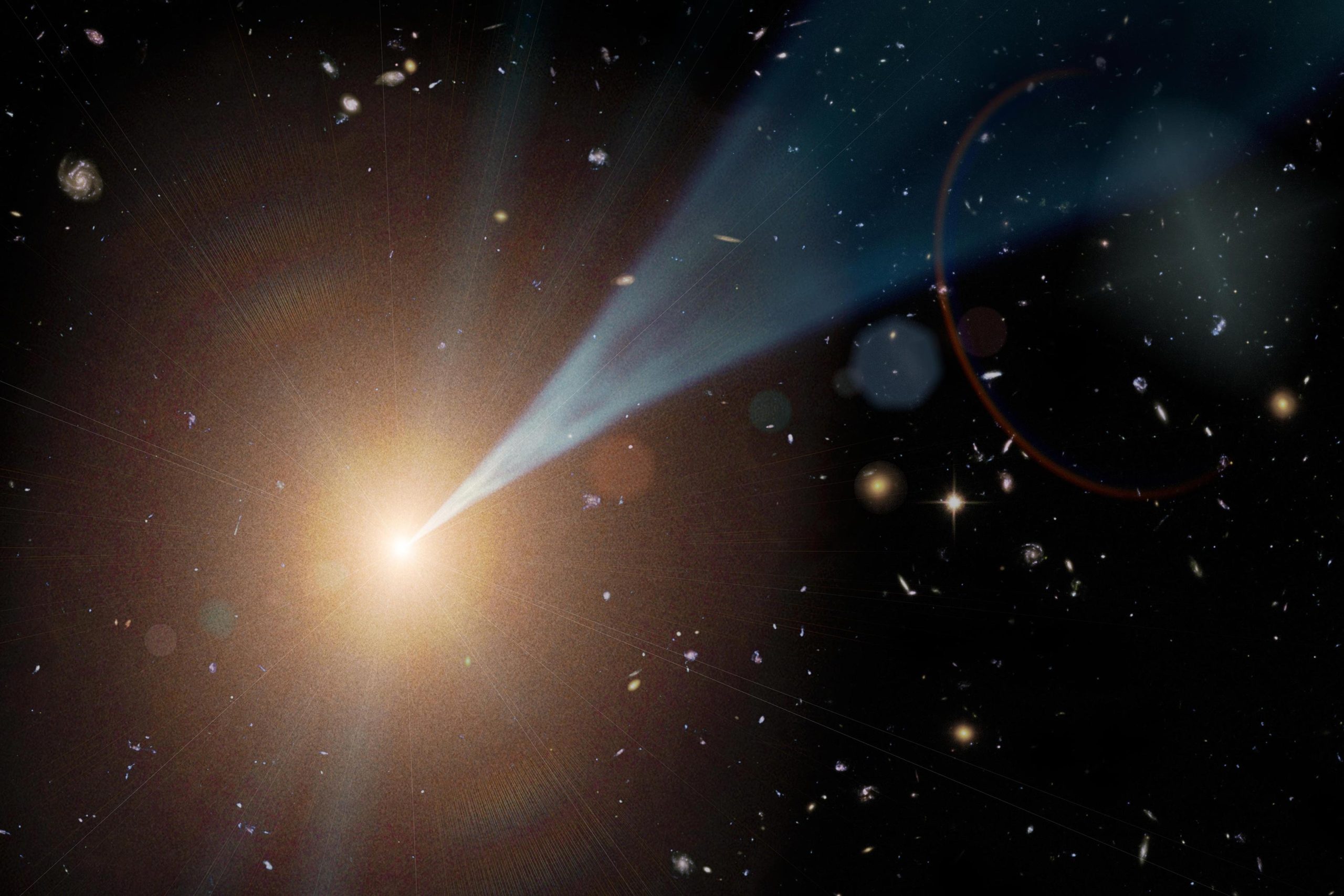
BL Lacertae, an enigmatic blazar, has shattered long-held classification norms, leaving astronomers baffled. Originally mistaken for a variable star, this active galaxy emits high-energy jets that have suddenly defied expectations.
Observations from 2020-2023 revealed that BL Lacertae doesn’t neatly fit into any of the three known blazar categories, shifting unpredictably between classifications. This rapid transformation, particularly in X-ray emissions, has sparked intense debate about the underlying physics. Could it be an entirely new type of blazar? Or is an unknown mechanism at play, altering its radiation patterns at unprecedented speeds?
Mysterious Blazar Challenges Astronomers
The universe has once again surprised astronomers. Blazars – active galaxies that emit powerful jets of matter toward Earth – have long been categorized based on their electromagnetic radiation. However, this once-clear classification system has just been thrown into question. A team of Polish and German scientists from the Institute of Nuclear Physics of the Polish Academy of Sciences (IFJ PAN) in Cracow and the University of Heidelberg (HU) has published new findings in Astronomy & Astrophysics, revealing a blazar that doesn’t fit into any known category.
BL Lacertae, the blazar in question, was first observed in 1929 in the Lacerta (Lizard) constellation. At the time, astronomers believed it was just another variable star within our galaxy. But later observations revealed something astonishing: what appeared to be a star was actually located about 900 million light-years away – far beyond the Milky Way, confirming that it was something far more powerful.
Blazars: The Cosmic Powerhouses
Of the hundreds of billions of galaxies visible within the observable Universe, some are active galaxies. These are galaxies whose nuclei emit large amounts of electromagnetic radiation, presumably as a result of the complex processes that occur when matter falls into the central supermassive black hole. In some galaxies, narrow jets of ionized matter ejected from near the poles of the black hole over gigantic distances, in extreme cases even exceeding a million light-years, are a spectacular sign of activity. If the jet runs towards Earth, astronomers call the galaxy producing it a blazar. BL Lacertae turned out to be just such an object.
What Makes Blazars So Fascinating?
“Blazars are interesting for many reasons, not least because the orientation of the jets and the enormous velocities of their particles, close to the speed of light, lead to a variety of effects described by the theory of relativity. Emission from blazars is observed at various electromagnetic wavelengths, ranging from radio to very high-energy gamma rays,” explains Dr. Alicja Wierzcholska (IFJ PAN) and specifies: “We focused on the analyses of the energy of electromagnetic radiation emitted by one of the earliest discovered blazars: BL Lacertae. Why did we focus on this particular one? Because of its activity in recent years and some interesting features of the radiation emitted by it, which we had already noticed during earlier observation sessions.”
High-Energy Observations and Unexpected Findings
The reported observations took place in 2020-2023. They were carried out in orbit around the Earth with instruments from the American Neil Gehrels Swift Observatory satellite; only in the hard X-ray range were they complemented by data from the NuSTAR space telescope. In addition to the X-ray range which was of most interest to the Polish-German researchers, the optical and ultraviolet regions of the spectrum were also recorded. This is because the electromagnetic radiation produced by blazars extends from the radio range through the optical, ultraviolet, and X-ray regions to gamma radiation of the highest energies.
Classification Chaos: BL Lacertae Defies Categories
Blazars are subdivided into flat spectrum radio quasars and BL Lacertae objects (BL Lacs), which are characterized by weaker emission lines and whose name is derived precisely from the BL Lacertae blazar. Within the BL Lacs, a further division is possible. Indeed, diagrams showing the entire energy spectrum of blazars resemble volcanic cones: they have two peaks separated by an arched depression. If the spectral ‘volcano’ is shifted towards the high-energy side, the BL Lacertae object is classified as HBL (High-frequency peaked BL Lac), if towards the low-energy side – as LBL (Low-frequency peaked BL Lac), while objects with an intermediate shift are referred to as IBLs (Intermediate BL Lacs).
A Shape-Shifting Blazar?
“BL Lacertae objects lend themselves quite unambiguously to being assigned to a specific type. Blazar BL Lacertae has so far been considered a representative of the intermediate class, the IBL. It was therefore with no small degree of surprise that we noticed that in the X-ray range, it looked like an HBL at some phases of the observation period, at others like an LBL, and at other times ‘politely’ gave the impression of an IBL-type object. As if this were not enough, these sorts of changes occurred very quickly. This is unusual behavior, the physical basis of which we are not yet able to explain,” says Dr. Wierzcholska, and emphasizes that there were more surprises: the recorded X-ray activity of the blazar turned out to be a record in the entire history of its observations.
A Mystery That Keeps Astrophysicists Awake
It is currently assumed that separate physical phenomena involving different populations of particles in the jet are responsible for the existence of the two peaks in the spectra of blazars. Many astrophysicists agree with the assumption that the low-energy peak is related to electrons and the synchrotron radiation they emit. There is no consensus of opinion for the second peak. Perhaps it too is a consequence of the electrons’ behavior, for example, their collisions with low-energy photons, which would result in an increase in the photons’ energy (this is known as inverse Compton scattering). However, other hypotheses have also been put forward, for example, those involving hadrons (i.e. clusters of quarks such as protons or neutrons). But in order to explain the behavior of the BL Lacertae blazar, it would be necessary to point to something more: not only the physical processes responsible for the formation of the two peaks, but above all the mechanism responsible for their rapid switching. One could venture to say that before this happens, many an astrophysicist-theorist will spend many a sleepless night.
Reference: “Exceptional X-ray activity in BL Lacertae” by Alicja Wierzcholska and Stefan Wagner, 28 January 2025, Astronomy & Astrophysics.
DOI: 10.1051/0004-6361/202451349
The computational part of the research was carried out thanks to the Academic Computer Centre Cyfronet AGH. On the Polish side, the work was funded by a grant from the National Agency for Academic Exchange.
Never miss a breakthrough: Join the SciTechDaily newsletter.
Follow us on Google and Google News.
2 Comments
Working hard to give information to this information true information should also given to the nations
The truth of the matter is “Who Cares?