
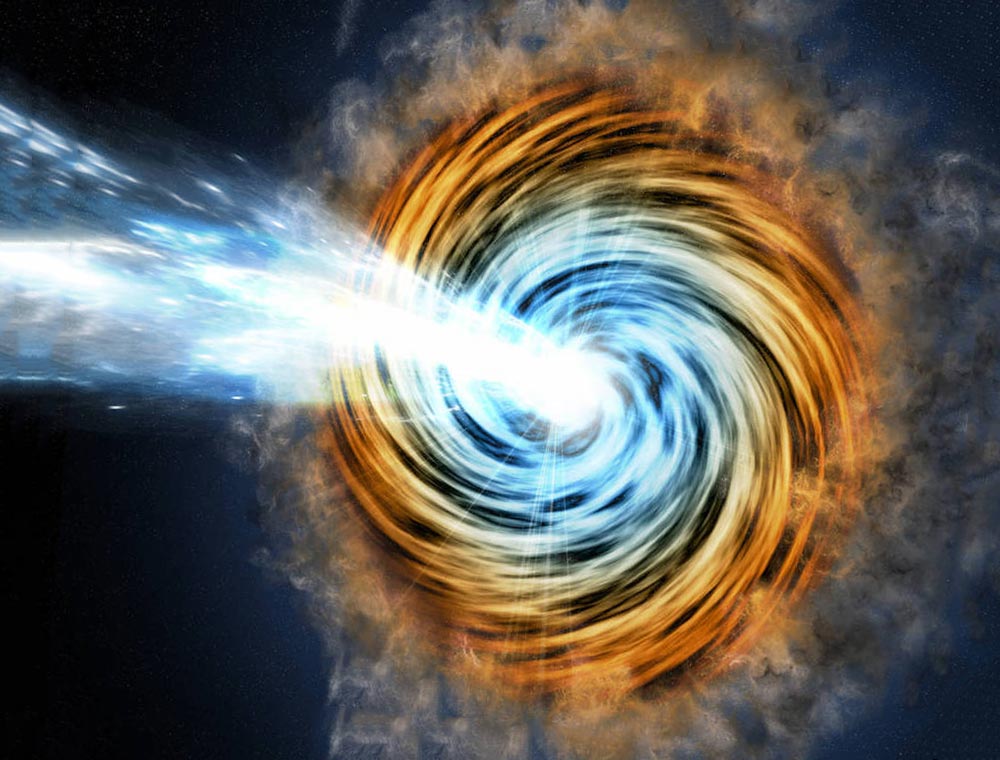
A University of Oklahoma doctoral student, graduate and undergraduate research assistants, and an associate professor in the Homer L. Dodge Department of Physics and Astronomy in the University of Oklahoma College of Arts and Sciences are lead authors on a paper describing a “changing-look” blazar — a powerful active galactic nucleus powered by a supermassive black hole at the center of a galaxy. The paper is published in The Astrophysical Journal.
Hora D. Mishra, a Ph.D. student, and faculty member Xinyu Dai are lead authors of the paper, along with Christopher Kochanek and Kris Stanek at the Ohio State University and Ben Shappee at the University of Hawaii. The paper represents the findings of researchers from 12 different institutions who participated in a two-year collaborative project involving the collection of spectra or imaging data in different electromagnetic bands. The OU team led the effort in analyzing all the data collected from the collaboration and contributed primarily on the interpretation of the analysis results, assisted by OU graduate student Saloni Bhatiani and undergraduate students Cora DeFrancesco and John Cox who performed ancillary analyses to the project.
Blazars, explains Mishra, who also serves as president of Lunar Sooners, appear as parallel rays of light or particles, or jets, pointing to observers and radiating across all wavelengths of the electromagnetic spectrum. These jets span distances on the million light-year scales and are known to impact the evolution of the galaxy and galaxy cluster in which they reside via the radiation. These features make blazars ideal environments in which to study the physics of jets and their role in galaxy evolution.
“Blazars are a unique kind of AGN with very powerful jets,” she said. “Jets are a radio mode of feedback and because of their scales, they penetrate the galaxy into their large-scale environment. The origin of these jets and processes driving the radiation are not well-known. Thus, studying blazars allows us to understand these jets better and how they are connected to other components of the AGN, like the accretion disk. These jets can heat up and displace gas in their environment affecting, for example, the star formation in the galaxy.”
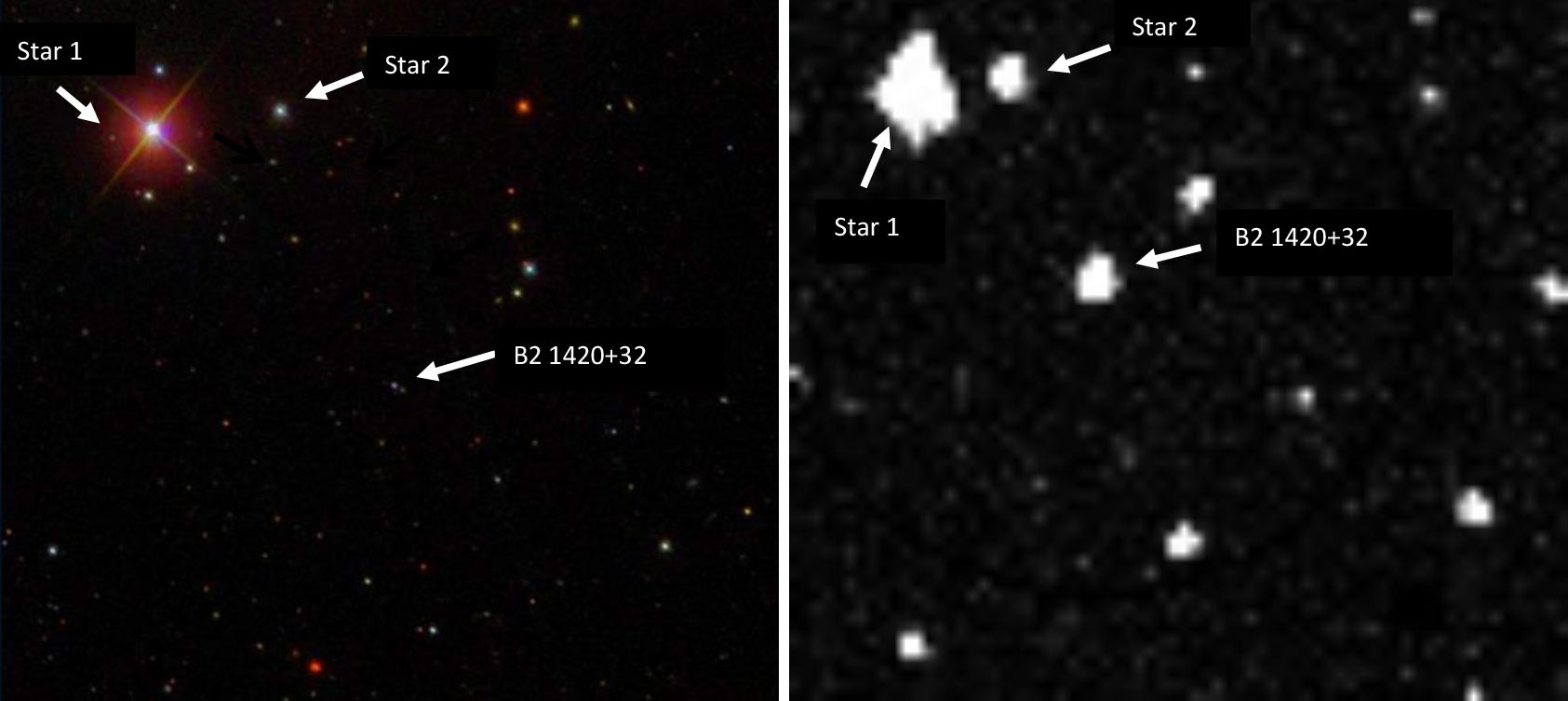
The team’s paper highlights the results of a campaign to investigate the evolution of a blazar known as B2 1420+32. At the end of 2017, this blazar exhibited a huge optical flare, a phenomenon captured by the All Sky Automated Survey for SuperNovae telescope network.
“We followed this up by observing the evolution of its spectrum and light curve over the next two years and also retrieved archival data available for this object,” Mishra said. “The campaign, with data spanning over a decade, has yielded some most exciting results. We see dramatic variability in the spectrum and multiple transformations between the two blazar sub-classes for the first time for a blazar, thus giving it the name ‘changing-look’ blazar.”
The team concluded that this behavior is caused by the dramatic continuum flux changes, which confirm a long-proposed theory that separates blazars into two major categories.
“In addition, we see several very large multiband flares in the optical and gamma-ray bands on different timescales and new spectral features,” Mishra said. “Such extreme variability and the spectral features demand dedicated searches for more such blazars, which will allow us to utilize the dramatic spectral changes observed to reveal AGN/jet physics, including how dust particles around supermassive black holes are destructed by the tremendous radiation from the central engine and how energy from a relativistic jet is transferred into the dust clouds, providing a new channel linking the evolution of the supermassive black hole with its host galaxy.”
“We are very excited by the results of discovering a changing-look blazar that transforms itself not once, but three times, between its two sub-classes, from the dramatic changes in its continuum emission,” she added. “In addition, we see new spectral features and optical variability that is unprecedented. These results open the door to more such studies of highly variable blazars and their importance in understanding AGN physics.”
“It is really interesting to see the emergence of a forest of Iron emission lines, suggesting that nearby dust particles were evaporated by the strong radiation from the jet and released free Iron ions into the emitting clouds, a phenomenon predicted by theoretical models and confirmed in this blazar outburst,” Dai said.
Reference: “The Changing-look Blazar B2 1420+32” by Hora D. Mishra, Xinyu Dai, Ping Chen, Jigui Cheng, T. Jayasinghe, Michael A. Tucker, Patrick J. Vallely, David Bersier, Subhash Bose, Aaron Do, Subo Dong, Thomas W.-S. Holoien, Mark E. Huber, Christopher S. Kochanek, Enwei Liang, Anna V. Payne, Jose Prieto, Benjamin J. Shappee, K. Z. Stanek, Saloni Bhatiani, John Cox, Cora DeFrancesco, Zhiqiang Shen, Todd A. Thompson and Junfeng Wang, 7 June 2021, The Astrophysical Journal.
DOI: 10.3847/1538-4357/abf63d
Never miss a breakthrough: Join the SciTechDaily newsletter.
Follow us on Google and Google News.
1 Comment
Assumptions
Dark matter has a liquid and gas state
Dark matter condenses in a gravity well
Dark matter circulation from the galaxy is diverted along the jets
Dark matter undergoes a state change in the vortices alongside the jets
The released heat ionizes the gas and dust that is pulling the dark matter along
This I believe is the source for the heat that appears may light years from the black hole
This is also the same thing that heats the suns corona