
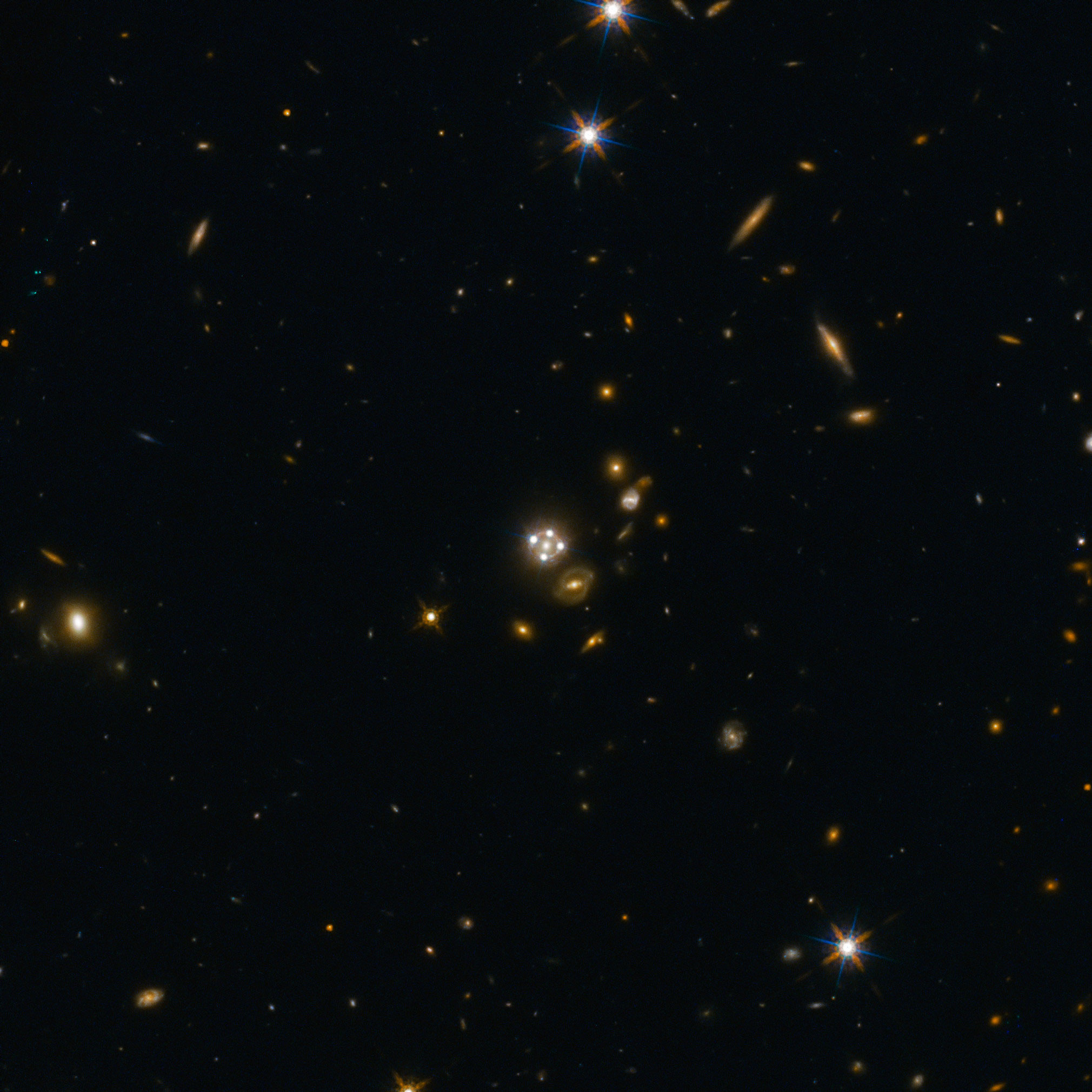
A team of astronomers used the Hubble Space Telescope and galaxies as giant gravitational lenses to make an independent measurement of how fast the Universe is expanding. The newly measured expansion rate for the local Universe is consistent with earlier findings.
The Hubble constant — the rate at which the Universe is expanding — is one of the fundamental quantities describing our Universe. A group of astronomers from the H0LiCOW collaboration, led by Sherry Suyu (associated with the Max Planck Institute for Astrophysics in Germany, the ASIAA in Taiwan, and the Technical University of Munich), used the NASA/ESA Hubble Space Telescope and other telescopes[1] in space and on the ground to observe five galaxies in order to arrive at an independent measurement of the Hubble constant.[2]
The new measurement is completely independent of — but in excellent agreement with — other measurements of the Hubble constant in the local Universe that used Cepheid variable stars and supernovae as points of reference.
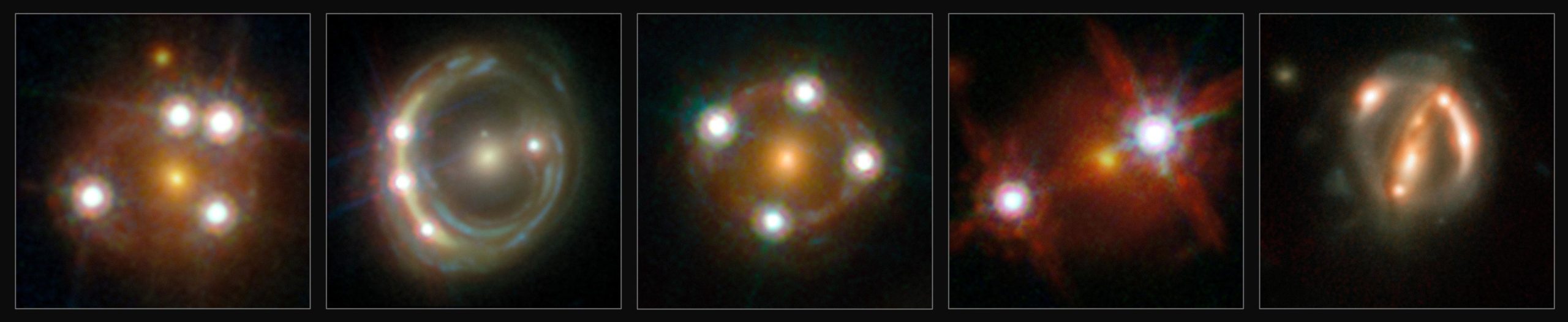
ESA/Hubble, NASA, Suyu et al.
However, the value measured by Suyu and her team, as well as those measured using Cepheids and supernovae, are different from the measurement made by the ESA Planck satellite. But there is an important distinction — Planck measured the Hubble constant for the early Universe by observing the cosmic microwave background.
While the value for the Hubble constant determined by Planck fits with our current understanding of the cosmos, the values obtained by the different groups of astronomers for the local Universe are in disagreement with our accepted theoretical model of the Universe. “The expansion rate of the Universe is now starting to be measured in different ways with such high precision that actual discrepancies may possibly point towards new physics beyond our current knowledge of the Universe,” elaborates Suyu.
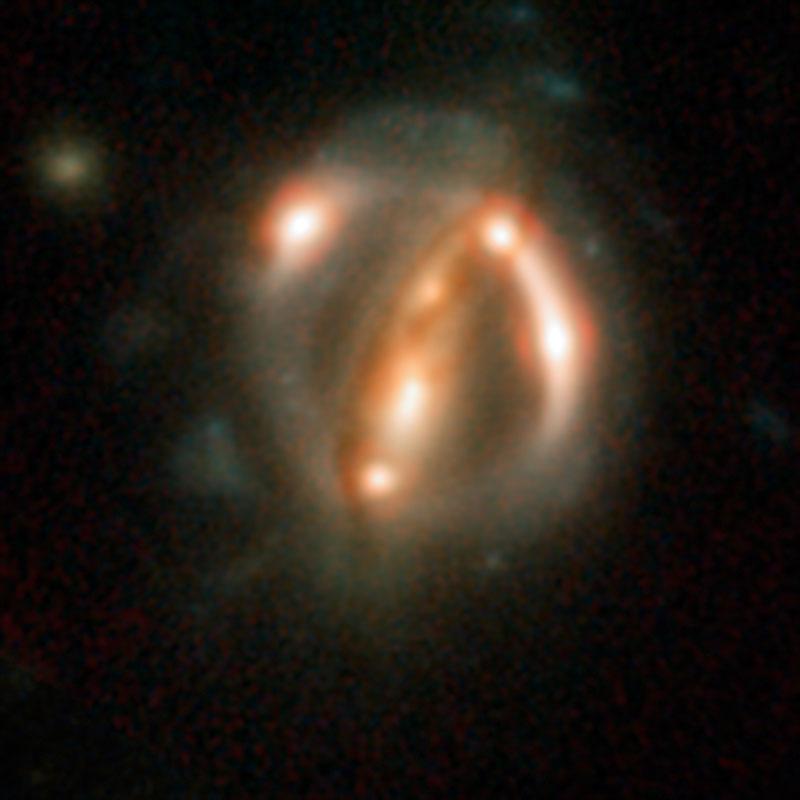
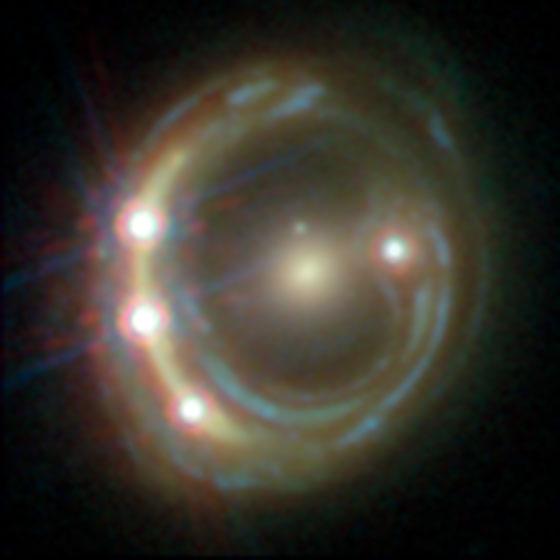
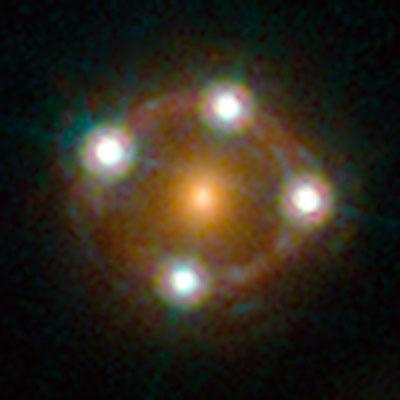
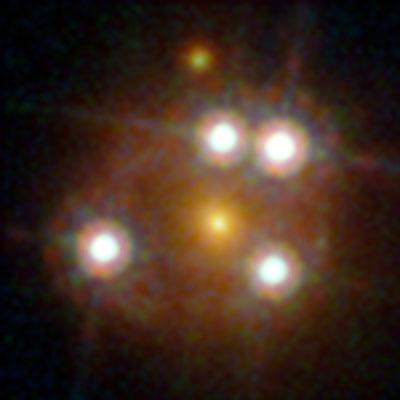
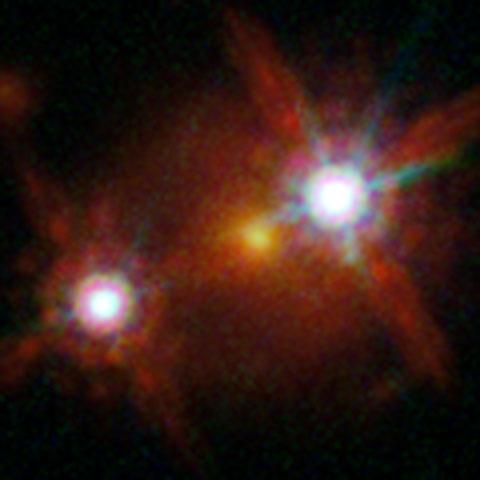
The targets of the study were massive galaxies positioned between Earth and very distant quasars — incredibly luminous galaxy cores. The light from the more distant quasars is bent around the huge masses of the galaxies as a result of strong gravitational lensing.[3] This creates multiple images of the background quasar, some smeared into extended arcs.
Because galaxies do not create perfectly spherical distortions in the fabric of space and the lensing galaxies and quasars are not perfectly aligned, the light from the different images of the background quasar follows paths that have slightly different lengths. Since the brightness of quasars changes over time, astronomers can see the different images flicker at different times, the delays between them depending on the lengths of the paths the light has taken. These delays are directly related to the value of the Hubble constant. “Our method is the most simple and direct way to measure the Hubble constant as it only uses geometry and General Relativity, no other assumptions,” explains co-lead Frédéric Courbin from EPFL, Switzerland
Using the accurate measurements of the time delays between the multiple images, as well as computer models, has allowed the team to determine the Hubble constant to an impressively high precision: 3.8%.[4] “An accurate measurement of the Hubble constant is one of the most sought-after prizes in cosmological research today,” highlights team member Vivien Bonvin, from EPFL, Switzerland. And Suyu adds: “The Hubble constant is crucial for modern astronomy as it can help to confirm or refute whether our picture of the Universe — composed of dark energy, dark matter, and normal matter — is actually correct, or if we are missing something fundamental.”
Distant quasars tend to change their brightness, causing them to flicker. As the light which creates the different images of the quasar follows paths with slightly different lengths, the images do not flicker simultaneously but are delayed with respect to each other by several days. This delay in flickering can be used to measure the Hubble constant which describes the speed of expansion of our Universe.
Objects with large masses such as galaxies or clusters of galaxies warp the spacetime surrounding them in such a way that they can create multiple images of background objects. This effect is called strong gravitational lensing.
Notes
- The study used, alongside the NASA/ESA Hubble Space Telescope, the Keck Telescope, ESO’s Very Large Telescope, the Subaru Telescope, the Gemini Telescope, the Victor M. Blanco Telescope, the Canada-France-Hawaii telescope, and the NASA Spitzer Space Telescope. In addition, data from the Swiss 1.2-meter Leonhard Euler Telescope and the MPG/ESO 2.2-meter telescope were used.
- The gravitational lensing time-delay method that the astronomers used here to achieve a value for the Hubble constant is especially important owing to its near-independence of the three components our Universe consists of: normal matter, dark matter, and dark energy. Though not completely separate, the method is only weakly dependent on these.
- Gravitational lensing was first predicted by Albert Einstein more than a century ago. All matter in the Universe warps the space around itself, with larger masses producing a more pronounced effect. Around very massive objects, such as galaxies, light that passes close by follows this warped space, appearing to bend away from its original path by a clearly visible amount. This is known as strong gravitational lensing.
- The H0LiCOW team determined a value for the Hubble constant of 71.9±2.7 kilometers per second per Megaparsec. In 2016 scientists using Hubble measured a value of 73.24±1.74 kilometers per second per Megaparsec. In 2015, the ESA Planck Satellite measured the constant with the highest precision so far and obtained a value of 66.93±0.62 kilometers per second per Megaparsec.
References:
“H0LiCOW – I. H0, Lenses in COSMOGRAIL’s Wellspring: program overview” by S. H. Suyu, V. Bonvin, F. Courbin, C. D. Fassnacht, C. E. Rusu, D. Sluse, T. Treu, K. C. Wong, M. W. Auger, X. Ding, S. Hilbert, P. J. Marshall, N. Rumbaugh, A. Sonnenfeld, M. Tewes, O. Tihhonova, A. Agnello, R. D. Blandford, G. C.-F. Chen, T. Collett, L. V. E. Koopmans, K. Liao, G. Meylan and C. Spiniello, 27 February 2017, Monthly Notices of the Royal Astronomical Society.
DOI: 10.1093/mnras/stx483
“H0LiCOW – II. Spectroscopic survey and galaxy-group identification of the strong gravitational lens system HE 0435−1223” by D. Sluse, A. Sonnenfeld, N. Rumbaugh, C. E. Rusu, C. D. Fassnacht, T. Treu, S. H. Suyu, K. C. Wong, M. W. Auger, V. Bonvin, T. Collett, F. Courbin, S. Hilbert, L. V. E. Koopmans, P. J. Marshall, G. Meylan, C. Spiniello and M. Tewes, 15 June 2017, Monthly Notices of the Royal Astronomical Society.
DOI: 10.1093/mnras/stx1484
“H0LiCOW – III. Quantifying the effect of mass along the line of sight to the gravitational lens HE 0435−1223 through weighted galaxy counts” by Cristian E. Rusu, Christopher D. Fassnacht, Dominique Sluse, Stefan Hilbert, Kenneth C. Wong, Kuang-Han Huang, Sherry H. Suyu, Thomas E. Collett, Philip J. Marshall, Tommaso Treu and Leon V. E. Koopmans, 22 February 2017, Monthly Notices of the Royal Astronomical Society.
DOI: 10.1093/mnras/stx285
“H0LiCOW – IV. Lens mass model of HE 0435−1223 and blind measurement of its time-delay distance for cosmology” by Kenneth C. Wong, Sherry H. Suyu, Matthew W. Auger, Vivien Bonvin, Frederic Courbin, Christopher D. Fassnacht, Aleksi Halkola, Cristian E. Rusu, Dominique Sluse, Alessandro Sonnenfeld, Tommaso Treu, Thomas E. Collett, Stefan Hilbert, Leon V. E. Koopmans, Philip J. Marshall and Nicholas Rumbaugh, 29 November 2016, Monthly Notices of the Royal Astronomical Society.
DOI: 10.1093/mnras/stw3077
“H0LiCOW – V. New COSMOGRAIL time delays of HE 0435−1223: H0 to 3.8 per cent precision from strong lensing in a flat ΛCDM model” by V. Bonvin, F. Courbin, S. H. Suyu, P. J. Marshall, C. E. Rusu, D. Sluse, M. Tewes, K. C. Wong, T. Collett, C. D. Fassnacht, T. Treu, M. W. Auger, S. Hilbert, L. V. E. Koopmans, G. Meylan, N. Rumbaugh, A. Sonnenfeld and C. Spiniello, 22 November 2016, Monthly Notices of the Royal Astronomical Society.
DOI: 10.1093/mnras/stw3006
Never miss a breakthrough: Join the SciTechDaily newsletter.
Follow us on Google and Google News.
1 Comment
Rather calling them as different rates of expansion , it will be appropriate to call them as three dimensional distortion in different directions for the galaxies formed in rather non-spheroidal shapes. Thank You.