
Close Menu
    Facebook X (Twitter) Instagram
    SciTechDaily
    • Biology
    • Chemistry
    • Earth
    • Health
    • Physics
    • Science
    • Space
    • Technology
    Facebook X (Twitter) Pinterest YouTube RSS
    SciTechDaily
    Home»Science»Innovative Hydrogen Boride Nanosheets: Huge Potential As Hydrogen Carrier
    Science

    Innovative Hydrogen Boride Nanosheets: Huge Potential As Hydrogen Carrier

    By Tokyo Institute of TechnologyOctober 25, 2019No Comments3 Mins Read
    Facebook Twitter Pinterest Telegram LinkedIn WhatsApp Email Reddit
    Share
    Facebook Twitter LinkedIn Pinterest Telegram Email Reddit
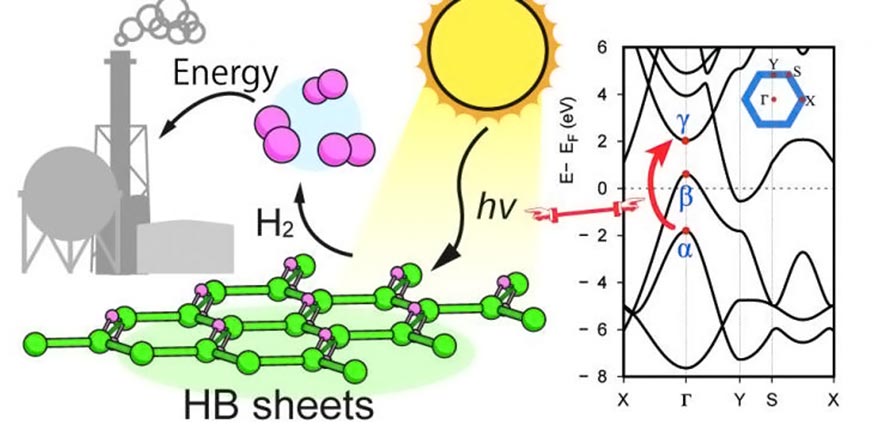
    Hydrogen Boride Nanosheets Release Hydrogen under UV Light
    The hydrogen storage and release capacity of HB sheets is exceptionally high due to their two-dimensional nature and unique electronic band structure. Credit: Nature Communications

    Researchers at the Tokyo Institute of Technology, University of Tsukuba, and colleagues in Japan report a promising hydrogen carrier in the form of hydrogen boride nanosheets[1]. This two-dimensional material, which has only recently begun to be explored, could go on to be used as safe, lightweight, high-capacity hydrogen storage material.

    Innovative nanosheets made from equal parts of hydrogen and boron have a greater capacity to store and release hydrogen compared with conventional metal-based materials.

    This finding by researchers at the Tokyo Institute of Technology (Tokyo Tech), the University of Tsukuba, Kochi University of Technology, and the University of Tokyo reinforces the view that hydrogen boride nanosheets (HB sheets) could go beyond graphene as a nano-sized multifunctional material.

    Their study, published today (October 25, 2019) in Nature Communications, found that hydrogen can be released in significant amounts (up to eight weight percent) from HB sheets under ultraviolet light, even under mild conditions — that is, at ambient room temperature and pressure.

    Such an easy-to-handle setup opens up possibilities for HB sheets to be utilized as highly efficient hydrogen carriers, which are expected to become increasingly in demand as a clean energy source in the coming decades.

    When HB sheets burst onto the scene in 2017, scientists recognized they could become an exciting new material for energy, catalysis, and environmental applications. The breakthrough research garnered plaudits for its creative approach to materials design. A review article published in Chem in 2018 hailed the successful realization of HB sheets as “an exquisite example of human ingenuity at the pinnacle of innovative synthetic chemistry.”

    HB sheets are expected to be applied for lightweight, light-responsive, and safe hydrogen carriers. Currently, HB sheets are only responsive to ultra-violet light, thus, the visible-light sensitivity is important for their industrial application.

    Also, refilling hydrogen remains a key challenge in developing sustainable, viable hydrogen storage solutions. To address this issue, Miyauchi explains his team is investigating the visible-light sensitivity, rechargeability, and long-term durability of HB sheets.

    “Cost reduction of the starting materials — magnesium diboride — for HB sheets will be another important factor,” he adds.

    The cross-institutional study showcases the predictive power of first-principles calculations [2] in materials science, namely as a way of investigating the mechanism of hydrogen release.

    Terms:

    [1] hydrogen boride nanosheets: Two-dimensional materials derived from magnesium diboride (MgB2) that were first reported by researchers in Japan in 2017. The nanosheets exhibit extraordinary electronic and mechanical properties in addition to hydrogen storage capacity.

    [2] First-principles calculations: Referring to a way of calculating mechanical, electronic or other properties of a given material based on the laws of quantum mechanics, which can lead to useful, predictive results prior to experimentation.

    Reference: “Photoinduced hydrogen release from hydrogen boride sheets” by Reiya Kawamura, Nguyen Thanh Cuong, Takeshi Fujita, Ryota Ishibiki, Toru Hirabayashi, Akira Yamaguchi, Iwao Matsuda, Susumu Okada, Takahiro Kondo and Masahiro Miyauchi, 25 October 2019, Nature Communications.
    DOI: 10.1038/s41467-019-12903-1

    Never miss a breakthrough: Join the SciTechDaily newsletter.
    Follow us on Google and Google News.

    Energy Green Energy Hydrogen Materials Science Nanotechnology Tokyo Institute of Technology
    Share. Facebook Twitter Pinterest LinkedIn Email Reddit

    Related Articles

    Turning Rocks Into Renewable Energy With Hydrogen Breakthrough

    “Truly Mind-Boggling” Breakthrough: Graphene Surprise Could Help Generate Hydrogen Cheaply and Sustainably

    More Graphene Magic Starts When Flatness Ends: A Proton Permeability Puzzle Solved!

    Clean Energy 24/7: Engineers Use Nanotechnology To Harvest Electricity “From Thin Air”

    Speeding Toward Improved Hydrogen Fuel Production With a New Nanomaterial

    Highly Efficient Eco-Friendly Perovskite Solar Cells With Enhanced Stability

    Harvesting Ocean Energy: Bio-Inspired Membrane Efficiently Produces Electricity From Saltwater

    Remarkable New Material Turns Heat Into Electricity at World Record Rate

    Hybrid-Solid Electrolysis Cell System – A New Strategy for Efficient Hydrogen Production

    Leave A Reply Cancel Reply

    • Facebook
    • Twitter
    • Pinterest
    • YouTube

    Don't Miss a Discovery

    Subscribe for the Latest in Science & Tech!

    Trending News

    Your Blood Pressure Reading Could Be Wrong Because of One Simple Mistake

    Astronomers Stunned by Ancient Galaxy With No Spin

    Physicists May Be on the Verge of Discovering “New Physics” at CERN

    Scientists Solve 320-Million-Year Mystery of Reptile Skin Armor

    Scientists Say This Daily Walking Habit May Be the Secret to Keeping Weight Off After Dieting

    New Therapy Rewires the Brain To Restore Joy in Depression Patients

    Giant Squid Detected off Western Australia in Stunning Deep-Sea Discovery

    Popular Sugar-Free Sweetener Linked to Liver Disease, Study Warns

    Follow SciTechDaily
    • Facebook
    • Twitter
    • YouTube
    • Pinterest
    • Newsletter
    • RSS
    SciTech News
    • Biology News
    • Chemistry News
    • Earth News
    • Health News
    • Physics News
    • Science News
    • Space News
    • Technology News
    Recent Posts
    • A Crucial Atlantic Current Is Weakening and Weather Could Change Worldwide
    • Scientists Stunned As Volcano Removes Methane From the Air
    • Scientists Discover Signs Africa May Be Splitting Apart Beneath Zambia
    • New Stroke Study Challenges Decades-Old Medical Beliefs
    • These Simple Plant Foods Are Linked to Lower Blood Pressure
    Copyright © 1998 - 2026 SciTechDaily. All Rights Reserved.
    • Science News
    • About
    • Contact
    • Editorial Board
    • Privacy Policy
    • Terms of Use

    Type above and press Enter to search. Press Esc to cancel.