
UMass Amherst, Arizona, Australian team finds new evidence for huge deep space objects.
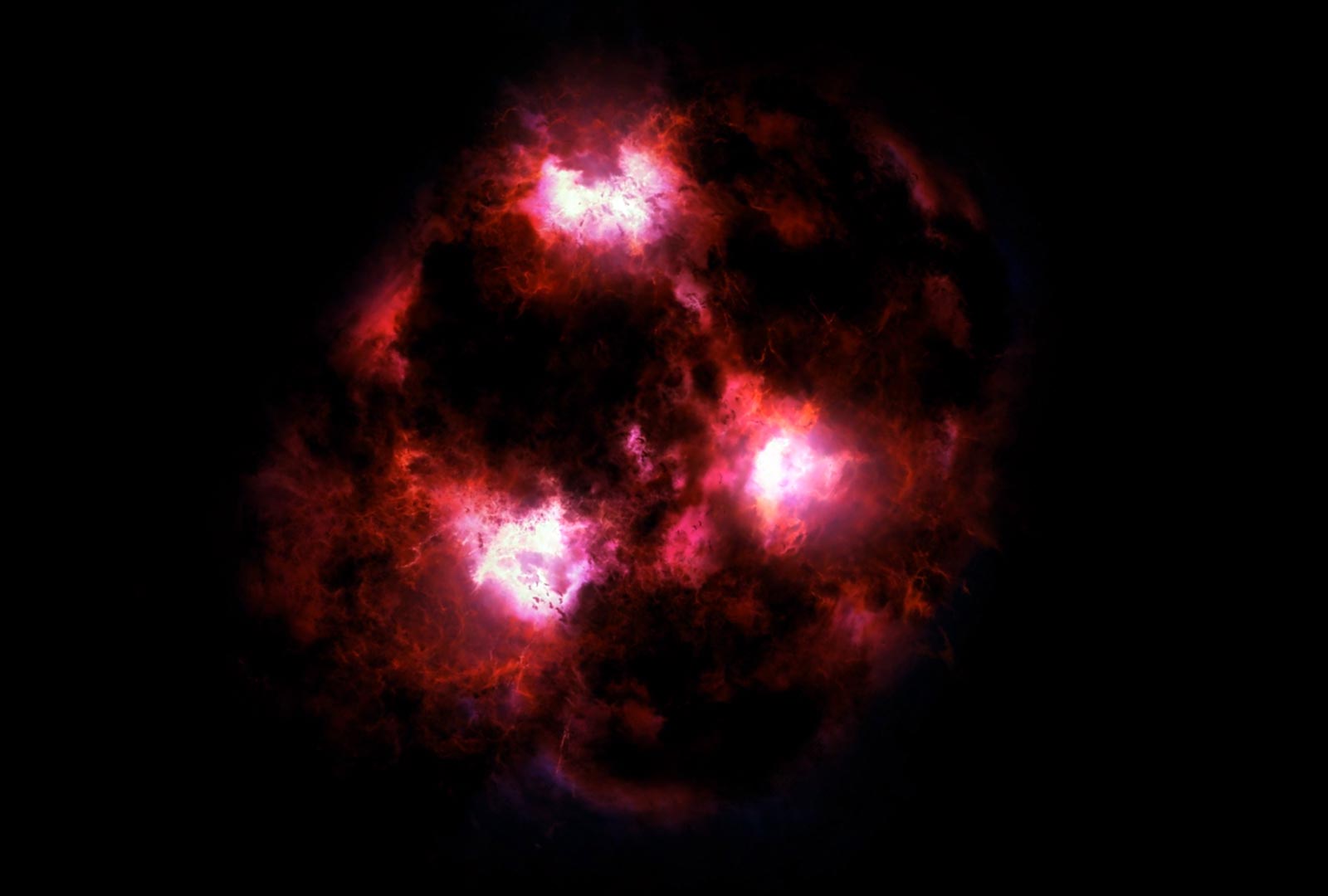
A team of astronomers including assistant professor Kate Whitaker at the University of Massachusetts Amherst reports today that they have by chance discovered faint traces of a huge galaxy never seen before, dating from the early universe. Likening the finding to photographing footprints of the mythical Yeti, the authors, led by postdoctoral fellow Christina Williams at the University of Arizona, say the scientific community once regarded such monster galaxies as folklore because there was no evidence for them, until now.
The authors say the discovery provides new insights into the first growing steps of some of the biggest galaxies in the universe. Details appear in the current Astrophysical Journal.
Whitaker, an expert in early galaxy formation and evolution, says, “These otherwise hidden galaxies are truly intriguing; it makes you wonder if this is just the tip of the iceberg, with a whole new type of galaxy population just waiting to be discovered.”
For this work, the astronomers used the ALMA – the Atacama Large Millimeter Array –a collection of 66 radio telescopes located in the high mountains of Chile. In new observations with extremely sensitive detection limits, Williams noticed a faint blob of light. “It was very mysterious,” she says, “but the light seemed not to be linked to any known galaxy at all. When I saw this galaxy was invisible at any other wavelength, I got really excited, because it meant that it was probably really far away and hidden by clouds of dust.”
The researchers estimate that the signal came from so far away that it took 12.5 billion years to reach Earth, when the universe was in its infancy. They think the observed emission is caused by the warm glow of dust particles – which effectively obscure all light – heated by stars forming deep inside a young galaxy.
Study co-author Ivo Labbé at the Swinburne University of Technology, Melbourne, Australia, says, “We figured out that the galaxy is actually a massive monster galaxy with as many stars as our Milky Way but brimming with activity, forming new stars at 100 times the rate of our own galaxy.”
“Right now we are eager for the James Webb Space Telescope (JWST) to take a look at these things. JWST will be able to look through the dust veil so we can learn how big these galaxies really are and how fast they are growing, to better understand why models fail in explaining them.” – Christina Williams
Whitaker and Williams, both UMass Amherst alumni, and their colleagues say the discovery may solve a long-standing question in astronomy. Some of the biggest galaxies in the young universe appear to have grown up and matured very quickly, which doesn’t match theoretical predictions. Even more puzzling is that these mature galaxies appear to come out of nowhere when the universe was comparatively young, only 10 percent of its current age, they point out.
Further, astronomers never seem to catch them while they are forming, Williams notes. Smaller galaxies have been seen in the early universe with the Hubble space telescope, but they are not growing fast enough. Other monster galaxies have also been previously reported but those sightings have been far too rare for a satisfying explanation of what was occurring. She now says, “Our hidden monster galaxy has precisely the right ingredients to be that missing link, because they are probably a lot more common.”
The open question today, the astronomers say, is exactly how many there are. The current study was done in a tiny part of the sky, less than 1/100th the size of the full moon. It could mean that finding “Yeti footprints” in a tiny strip of wilderness means either it was a lucky find, or they are cloaked but lurking everywhere.
Williams says, “Right now we are eager for the James Webb Space Telescope (JWST) to take a look at these things,” referring to a revolutionary new telescope scheduled to launch in March 2021. “JWST will be able to look through the dust veil so we can learn how big these galaxies really are and how fast they are growing, to better understand why models fail in explaining them,” she adds.
For more on this discovery, read Monster Galaxy From Dawn of the Universe Discovered by Accident.
Reference: “Discovery of a Dark, Massive, ALMA-only Galaxy at z ~ 5–6 in a Tiny 3 mm Survey” by Christina C. Williams, Ivo Labbe, Justin Spilker, Mauro Stefanon, Joel Leja, Katherine Whitaker, Rachel Bezanson, Desika Narayanan, Pascal Oesch and Benjamin Weiner, 22 October 2019, Astrophysical Journal.
DOI: 10.3847/1538-4357/ab44aa
Never miss a breakthrough: Join the SciTechDaily newsletter.
Follow us on Google and Google News.
1 Comment
😮 wow from noob