
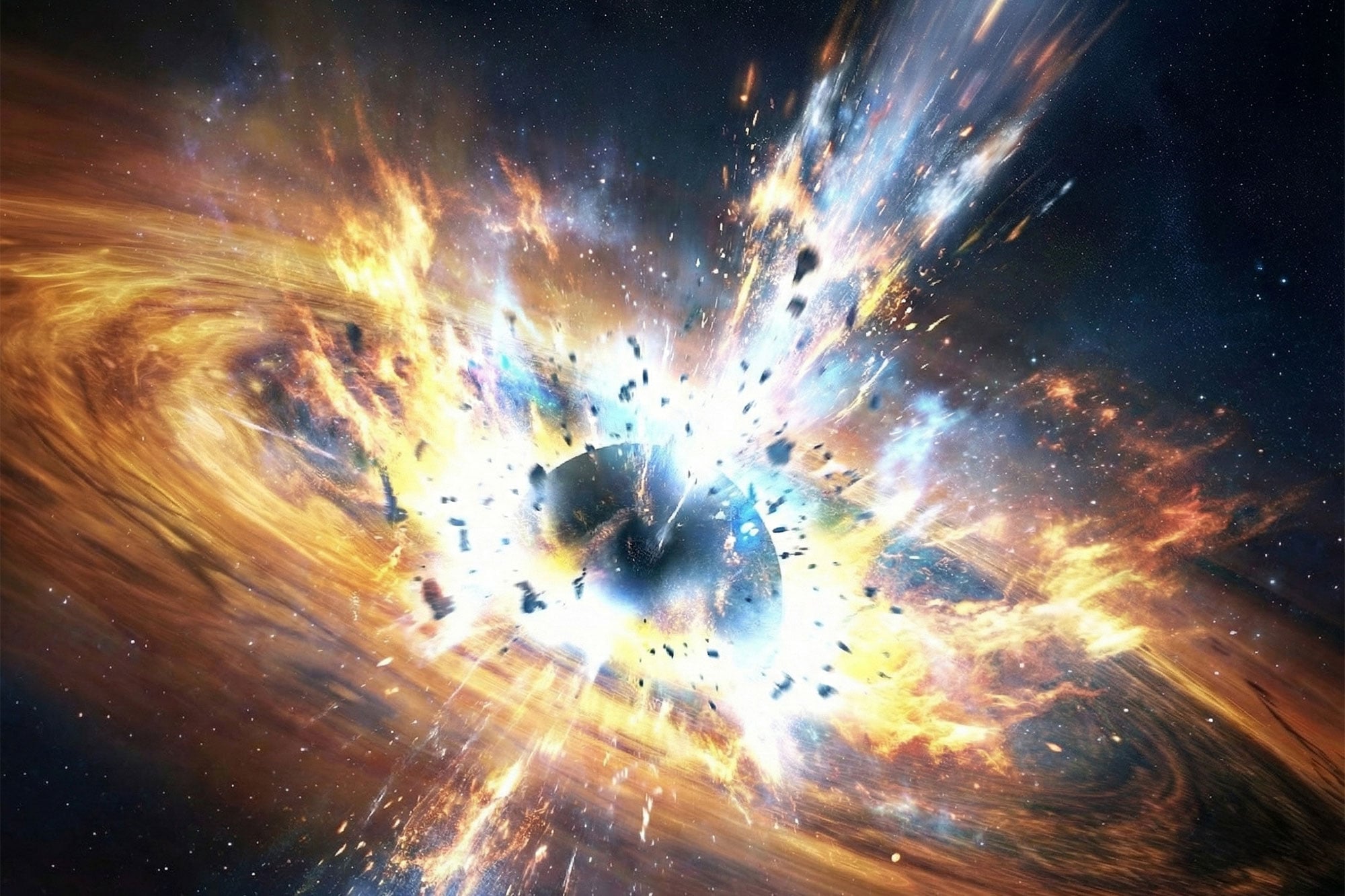
Scientists say an ultra-powerful neutrino once thought impossible may be explained by an exotic black hole model involving a so-called “dark charge.”
In 2023, a neutrino slammed into Earth carrying more energy than any particle ever observed. The detection stunned physicists. The particle’s energy was measured roughly 100,000 times greater than the most powerful collisions produced by the Large Hadron Collider, the world’s leading particle accelerator. No known astrophysical engine, including supernovae or supermassive black holes, is thought capable of accelerating a particle to such extremes.
Physicists at the University of Massachusetts Amherst have recently hypothesized that something like this could happen when a special kind of black hole, called a “quasi-extremal primordial black hole,” explodes.
In a study published in Physical Review Letters, the team presents a model that not only explains how such an extraordinary neutrino could form but also argues that the event may offer clues about the universe at its most fundamental level.
Black Holes and Hawking Radiation
Most black holes form when massive stars collapse under their own gravity. These stellar remnants are immense, long lived, and relatively stable. But primordial black holes, if they exist, would have formed in the chaotic first moments after the Big Bang, when tiny fluctuations in density could have compressed matter into miniature black holes.
Unlike their stellar cousins, primordial black holes could be far smaller. And according to Stephen Hawking’s groundbreaking work in the 1970s, small black holes are not entirely black. They slowly lose mass by emitting particles through a quantum process now known as Hawking radiation. As they shrink, they heat up. As they heat up, they radiate faster. Eventually, this feedback loop could end in a powerful burst of particles.
“The lighter a black hole is, the hotter it should be and the more particles it will emit,” says Andrea Thamm, co-author of the new research and assistant professor of physics at UMass Amherst. “As PBHs evaporate, they become ever lighter, and so hotter, emitting even more radiation in a runaway process until explosion. It’s that Hawking radiation that our telescopes can detect.”
Explosions as Cosmic Particle Catalogs
Detecting such an explosion would be scientifically transformative. It could effectively reveal a full inventory of fundamental particles, including well known ones such as electrons, quarks, and Higgs bosons, as well as hypothetical particles like those thought to make up dark matter, and possibly entirely new particles that have never been observed.
Previous work by the UMass Amherst group suggests that these explosive events might occur as often as once every decade. With careful monitoring, existing observatories could potentially capture them.
So far, so theoretical.
Then, in 2023, an experiment called the KM3NeT Collaboration captured that impossible neutrino—exactly the kind of evidence the UMass Amherst team hypothesized we might soon see.
This artist’s concept takes a fanciful approach to imagining small primordial black holes. In reality, such tiny black holes would have a difficult time forming the accretion disks that make them visible here. Credit: NASA’s Goddard Space Flight Center
But there was a hitch: A similar experiment, called IceCube, also set up to capture high-energy cosmic neutrinos, not only didn’t register the event, it had never clocked anything with even one hundredth of its power. If the universe is relatively thick with PBHs, and they are exploding frequently, shouldn’t we be showered in high-energy neutrinos? What can explain the discrepancy?
Dark Charge and Quasi-Extremal Black Holes
“We think that PBHs with a ‘dark charge’—what we call quasi-extremal PBHs—are the missing link,” says Joaquim Iguaz Juan, a postdoctoral researcher in physics at UMass Amherst and one of the paper’s co-authors. The dark charge is essentially a copy of the usual electric force as we know it, but which includes a very heavy, hypothesized version of the electron, which the team calls a “dark electron.”
“There are other, simpler models of PBHs out there,” says Michael Baker, co-author and an assistant professor of physics at UMass Amherst; “our dark-charge model is more complex, which means it may provide a more accurate model of reality. What’s so cool is to see that our model can explain this otherwise unexplainable phenomenon.”
“A PBH with a dark charge,” adds Thamm, “has unique properties and behaves in ways that are different from other, simpler PBH models. We have shown that this can provide an explanation of all of the seemingly inconsistent experimental data.
Implications for Dark Matter
The team is confident that, not only can their dark-charge model PBHs explain the neutrino, it can also answer the mystery of dark matter. “Observations of galaxies and the cosmic microwave background suggest that some kind of dark matter exists,” says Baker.
“If our hypothesized dark charge is true,” adds Iguaz Juan, “then we believe there could be a significant population of PBHs, which would be consistent with other astrophysical observations, and account for all the missing dark matter in the universe.”
“Observing the high-energy neutrino was an incredible event,” Baker concludes. “It gave us a new window on the universe. But we could now be on the cusp of experimentally verifying Hawking radiation, obtaining evidence for both primordial black holes and new particles beyond the Standard Model, and explaining the mystery of dark matter.”
Reference: “Explaining the PeV Neutrino Fluxes at KM3NeT and IceCube with Quasiextremal Primordial Black Holes” by Michael J. Baker, Joaquim Iguaz Juan, Aidan Symons and Andrea Thamm, 10 February 2026, Physical Review Letters.
DOI: 10.1103/r793-p7ct
Never miss a breakthrough: Join the SciTechDaily newsletter.
Follow us on Google and Google News.
2 Comments
CB note 2602_131223,140144_source1.reinterpretation【
Source 1.
https://scitechdaily.com/did-a-black-hole-just-explode-physicists-say-it-might-explain-everything/
1.
_Did a Black Hole Explode? Physicists say that it may explain everything.
-b2.[When a black hole is treated as a star nk, it can collapse. Only when it loses its status. In a world of vixxa quasi-powers that are reduced from vixer to vixxa in a system or have no black hole vixxa as a whole, it is very common to remove colleagues or have them under their wing like a double-edged sword. Uh-huh. 1510.
The instinct to use one’s authority to create one’s own exclusive world is to black hole vixer, and vixxa is only a predator.
-The toolbox of destruction is nqvixer.2system.neutrino.qpeoms (0,2).uh. 140146.49.
】
_One neutrino detected in 2023 had energy that could not be produced by any known cosmic process. Now physicists suggest that the answer may lie in the explosive death of an unusual form of primordial black hole.
_Scientists say super-strong neutrinos, once considered impossible, can be described as an unusual black hole model containing so-called ‘dark charges’.
1-1.
_In 2023, a neutrino with more energy than any particle ever observed hit Earth.
_The discovery surprised physicists. The measured neutrino energy was about 100,000 times greater than the strongest collisions ever made at the Large Hadron Accelerator (LHC), the world’s leading particle accelerator.
_No celestial phenomena, including supernovae or supergiant black holes, are known to be able to accelerate particles with such extreme energies.
-a1.【High-energy neutrinos are likely to be massive qqxell.nqvixar.highmass.neutrino.msoss(*). It is possible that the planet generated electrostatic force. 1208.1212.14.
– The problem is not the usual nk star, but the explosion of a stellar primordial black hole vixer resulted in vixxa high mass neutrinos. Uh-huh. They shower high energy directly on stars or planets in galaxies with electromagnetic fields. Thus nk stars may collapse. Uh-huh. 1218.
–Such a collapse appears as nkstar.mb(massbase.xell)xell. 140143.
-_Physicists at the University of Amherst, Massachusetts, recently hypothesized that this can happen when a special type of black hole called a “quasi-extreme primordial black hole” explodes.
-_In a study published in Physical Review Letters, the team not only explains how these unusual neutrinos can be formed, but also presents a model that the event can provide clues to the most fundamental level of the universe.
-Like sample1.oms.vix.ain., there is a duality of bilateral symmetry, top-down asymmetry. 2602140111.
-Whether neutrinos have high energy symmetry or not depends on whether they move quickly and communicate with each other because there is an orbital rotation path between their distributions. 140113.
-Ultra-high-energy neutrinos in the_peta-electron-volt unit are actually present and are being observed. IceCube in Antarctica and KM3NeT detectors in the Mediterranean Sea have found high-energy neutrinos coming from outside the galaxy.
Ultra-high energy neutrinos:
Neutrinos with high energies have been observed, which are presumed to occur mainly in supermassive black holes in distant galaxies.
Presence of Mass: Neutrinos are proved to have a non-zero fine mass (K2K research team). According to a recent study, the mass of neutrinos has been determined to be around the maximum.
High mass (relativistic mass): Very high-energy neutrinos travel close to the speed of light and have a very high relativistic mass (energy)
–sample1. It seems to be a controversy over whether the top and bottom are symmetrical or not. 131457.140117.
Particles with high energy are made in qqxell. Their distribution is a quantum field. Um. 2602140119.
—And a giant star collapses, creating smaller stars.
#1.<<<<<<>> 140128.36.
–When massive stars undergo banc.qpeoms decay, the final units are electron-type, quark-type, lepton-type, boson-type, and fermion-type charge unit structures netrinos.qpeoms. 140123.38.
】
1-2. Copy Black Hole and Hawking
_Most black holes form when massive stars collapse into their own gravity. The remnants of these stars are enormous, long-lived, and relatively stable. However, if primordial black holes are present, it is possible that the material was compressed by microscopic density fluctuations in the initial chaotic moments immediately after the Big Bang, resulting in the formation of small black holes.
_Unlike stellar black holes, primordial black holes can be much smaller.
To me the big bang theory was a cosmic infrastructure caused by black holes. Most theorists would tend to think that black holes exist as a biproduct of the big bang theory. I think black holes actually form the universe as we know it. The question is do black holes actually create alternative universe’s by using surrounding matter and then transforming it to anti matter then reforming it back into matter which could be the beginning of a big bang in another parallel universe. Nobody knows exactly how things work it’s all theoretical but I’m not a theorist just an ordinary person with an idea on how things work. In the words of Stephen Hawkins I do not think mankind will ever explore the universe. We are trapped here because that’s the way it is.