
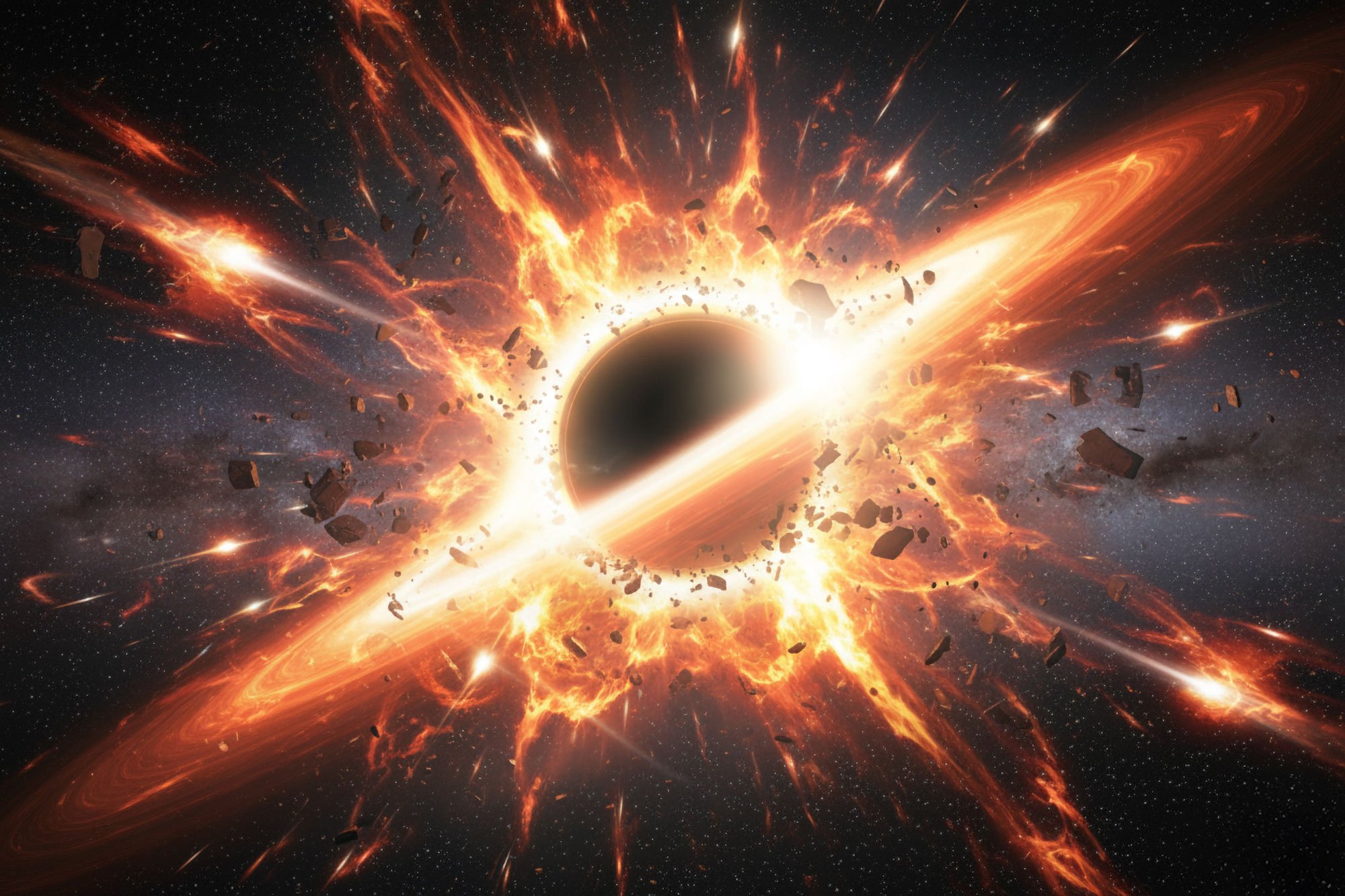
UMass Amherst physicists believe such an explosion could occur within the next decade, potentially “revolutionizing physics and rewriting the history of the universe.”
Physicists have long thought that black holes end their lives in rare explosions that occur, at most, once every 100,000 years. New research in Physical Review Letters from University of Massachusetts Amherst physicists points to a different outlook. The team estimates a probability greater than 90% that one such explosion could be observed within the next decade. If observers prepare in advance, today’s space and ground observatories should be able to capture the event.
Such a blast would strongly support the existence of a theorized but never directly observed kind of black hole called a “primordial black hole,” which may have formed less than a second after the Big Bang 13.8 billion years ago.
The explosion could also deliver a definitive inventory of all subatomic particles. That list would include known particles such as electrons, quarks, and Higgs bosons, proposed particles like dark matter candidates, and anything else that is currently unknown to science. With such a catalog, researchers could finally tackle one of humanity’s oldest questions: where did everything come from?
Understanding Black Holes
We know that black holes exist, and we have a good understanding of their life cycle: an old, large star runs out of fuel, implodes in a massively powerful supernova, and leaves behind an area of spacetime with such intense gravity that nothing, not even light, can escape. These black holes are incredibly heavy and are essentially stable.
But, as physicist Stephen Hawking pointed out in 1970, another kind of black hole—a primordial black hole (PBH), could be created not by the collapse of a star but from the universe’s primordial conditions shortly after the Big Bang. PBHs, like the standard black holes, are so massively dense that almost nothing can escape them—which is what makes them “black.” However, despite their density, PBHs could be much lighter than the black holes we have so far observed. Furthermore, Hawking also showed that black holes have a temperature and could, in theory, slowly emit particles via what is now known as “Hawking radiation” if they got hot enough.
This artist’s concept takes a fanciful approach to imagining small primordial black holes. In reality, such tiny black holes would have a difficult time forming the accretion disks that make them visible here. Credit: NASA’s Goddard Space Flight Center
“The lighter a black hole is, the hotter it should be and the more particles it will emit. As PBHs evaporate, they become ever lighter, and so hotter, emitting even more radiation in a runaway process until explosion. It’s that Hawking radiation that our telescopes can detect,” says Andrea Thamm, co-author and assistant professor of physics at UMass Amherst.
Yet, while we should be able to, no one has ever directly observed a PBH.
“We know how to observe this Hawking radiation,” says Joaquim Iguaz Juan, a postdoctoral researcher in physics at UMass Amherst. “We can see it with our current crop of telescopes, and because the only black holes that can explode today or in the near future are these PBHs, we know that if we see Hawking radiation, we are seeing an exploding PBH.”
A Paradigm Shift in Expectations
Though physicists since Hawking’s time have thought that the chances of seeing an exploding PBH are infinitesimally slight, Iguaz Juan notes that “our job as physicists is to question the received assumptions, to ask better questions and come up with more precise hypotheses.”
The team’s new hypothesis? Get ready now to see the explosion. “We believe that there is up to a 90% chance of witnessing an exploding PBH in the next 10 years,” says Aidan Symons, one of the paper’s co-authors and a graduate student in physics at UMass Amherst.
In its work, the team explores a “dark-QED toy model.” This is essentially a copy of the usual electric force as we know it, but which includes a very heavy, hypothesized version of the electron, which the team calls a “dark electron.”
The team then reconsidered long-held assumptions about the electrical charge of black holes. Standard black holes have no charge, and it was assumed that PBHs are likewise electrically neutral.
“We make a different assumption,” says Michael Baker, co-author and an assistant professor of physics at UMass Amherst. “We show that if a primordial black hole is formed with a small dark electric charge, then the toy model predicts that it should be temporarily stabilized before finally exploding.” Taking all known experimental data into account, they find that we could then potentially observe a PBH explosion not once every 100,000 years as previously thought, but once every 10 years.
“We’re not claiming that it’s absolutely going to happen this decade,” says Baker, “but there could be a 90% chance that it does. Since we already have the technology to observe these explosions, we should be ready.”
Iguaz Juan adds, “This would be the first-ever direct observation of both Hawking radiation and a PBH. We would also get a definitive record of every particle that makes up everything in the universe. It would completely revolutionize physics and help us rewrite the history of the universe.”
Reference: “Could We Observe an Exploding Black Hole in the Near Future?” by Michael J. Baker, Joaquim Iguaz Juan, Aidan Symons and Andrea Thamm, 10 September 2025, Physical Review Letters.
DOI: 10.1103/nwgd-g3zl
Never miss a breakthrough: Join the SciTechDaily newsletter.
Follow us on Google and Google News.
6 Comments
Rewriting history…hmm
All was created by God.
The law of the speed of light says that whatever event that is happening, the event can progress no faster than the speed of light. So if a small PBH should pop, the time that the emitted light is observed will be no longer than the diameter of the black hole. So, how small is a black hole when its Hawking Radiation drains the hole until it finally pops. It won’t be very big, so, the pulse of light will be very short. That will be its unique signiture. But, we can’t blink, or we’ll miss it. However there might be Billions of years worth of emitted light wrapped up in there. That could be a very bright flash.
My hypothesis is that a dark Unicorn ate some tainted dark hay and became so flatulent that it emitted a dark fart into the universe, leading to the formation of all life.
Seriously, what are they doing?
How did this get published in Physical Review Letters? Seriously, the level of quality research and peer-review is lacking with time. But it is click bait fodder. Cut the taxpayer-footed funding.
My head hurts