
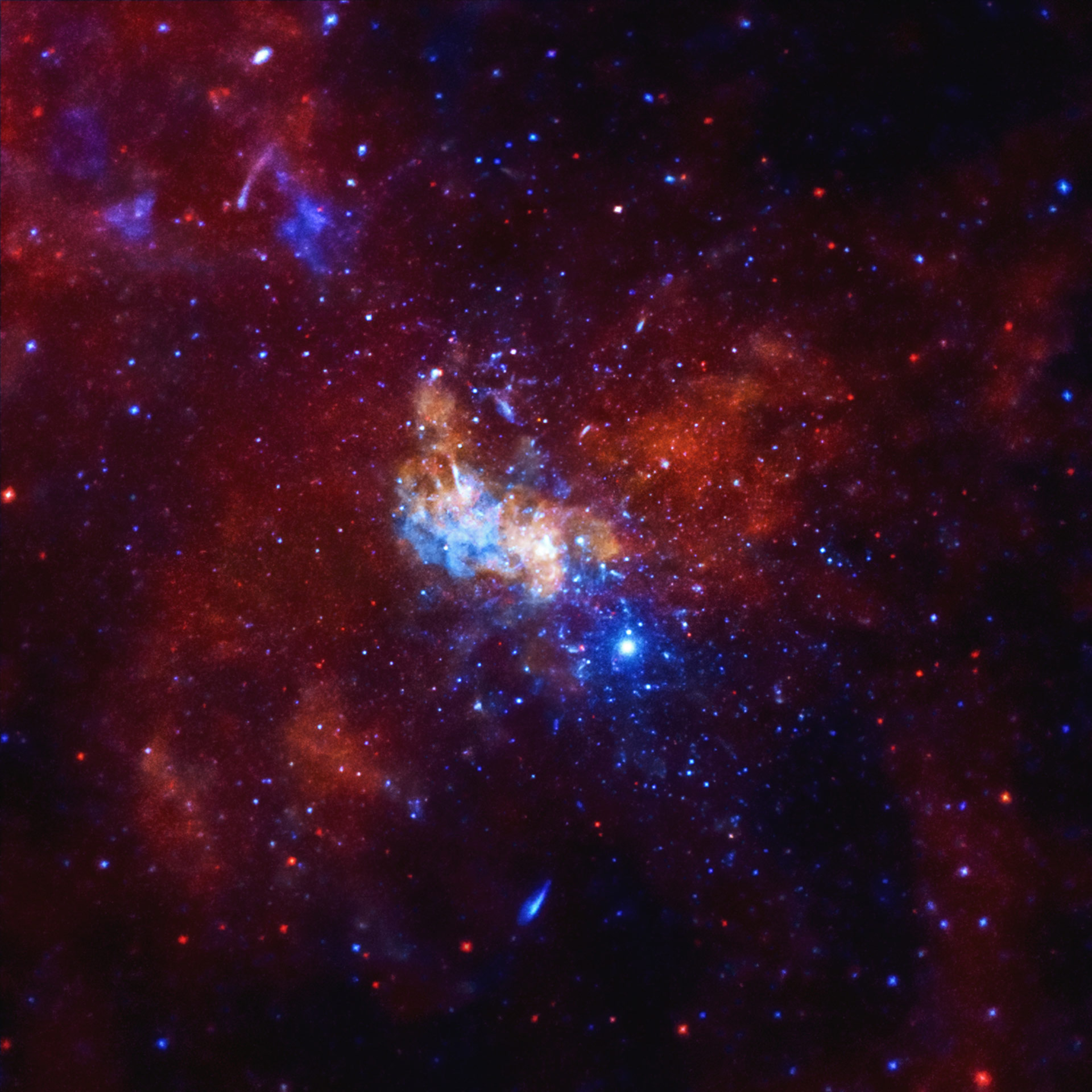
Using three NASA satellites, astronomers have revealed the first evidence that the Milky Way’s supermassive black hole (Sagittarius A*) may be producing neutrinos.
The giant black hole at the center of the Milky Way may be producing mysterious particles called neutrinos. If confirmed, this would be the first time that scientists have traced neutrinos back to a black hole.
The evidence for this came from three NASA satellites that observe in X-ray light: the Chandra X-ray Observatory, the Swift gamma-ray mission, and the Nuclear Spectroscopic Telescope Array (NuSTAR).
Neutrinos are tiny particles that carry no charge and interact very weakly with electrons and protons. Unlike light or charged particles, neutrinos can emerge from deep within their cosmic sources and travel across the universe without being absorbed by intervening matter or, in the case of charged particles, deflected by magnetic fields.
The Earth is constantly bombarded with neutrinos from the sun. However, neutrinos from beyond the solar system can be millions or billions of times more energetic. Scientists have long been searching for the origin of ultra-high energy and very high-energy neutrinos.
“Figuring out where high-energy neutrinos come from is one of the biggest problems in astrophysics today,” said Yang Bai of the University of Wisconsin in Madison, who co-authored a study about these results published in Physical Review D. “We now have the first evidence that an astronomical source – the Milky Way’s supermassive black hole – may be producing these very energetic neutrinos.”
Because neutrinos pass through material very easily, it is extremely difficult to build detectors that reveal exactly where the neutrino came from. The IceCube Neutrino Observatory, located under the South Pole, has detected 36 high-energy neutrinos since the facility became operational in 2010.
By pairing IceCube’s capabilities with the data from the three X-ray telescopes, scientists were able to look for violent events in space that corresponded with the arrival of a high-energy neutrino here on Earth.
“We checked to see what happened after Chandra witnessed the biggest outburst ever detected from Sagittarius A*, the Milky Way’s supermassive black hole,” said co-author Andrea Peterson, also of the University of Wisconsin. “And less than three hours later, there was a neutrino detection at IceCube.”
In addition, several neutrino detections appeared within a few days of flares from the supermassive black hole that were observed with Swift and NuSTAR.
“It would be a very big deal if we find out that Sagittarius A* produces neutrinos,” said co-author Amy Barger of the University of Wisconsin. “It’s a very promising lead for scientists to follow.”
Scientists think that the highest energy neutrinos were created in the most powerful events in the Universe like galaxy mergers, material falling onto supermassive black holes, and the winds around dense rotating stars called pulsars.
The team of researchers is still trying to develop a case for how Sagittarius A* might produce neutrinos. One idea is that it could happen when particles around the black hole are accelerated by a shock wave, like a sonic boom, that produces charged particles that decay to neutrinos.
This latest result may also contribute to the understanding of another major puzzle in astrophysics: the source of high-energy cosmic rays. Since the charged particles that make up cosmic rays are deflected by magnetic fields in our Galaxy, scientists have been unable to pinpoint their origin. The charged particles accelerated by a shock wave near Sgr A* may be a significant source of very energetic cosmic rays.
Reference: “Neutrino lighthouse at Sagittarius A*” by Y. Bai, A. J. Barger, V. Barger, R. Lu, A. D. Peterson and J. Salvado, 24 September 2014, Physical Review D.
DOI: 10.1103/PhysRevD.90.063012
NASA’s Marshall Space Flight Center in Huntsville, Alabama, manages the Chandra program for NASA’s Science Mission Directorate in Washington. The Smithsonian Astrophysical Observatory in Cambridge, Massachusetts, controls Chandra’s science and flight operations.
Never miss a breakthrough: Join the SciTechDaily newsletter.
Follow us on Google and Google News.