
New experiments reveal possible η′-mesic nuclei, offering evidence that particle masses shift inside nuclear matter and shedding light on how mass originates from vacuum structure.
Almost everything around us has mass, but its origin is still a fundamental question in physics. Current theory suggests that mass comes from the properties of the vacuum, which is not truly empty but filled with a complex underlying structure.
One way to explore this idea is by studying mesons, which are particles made of a quark and an antiquark, bound to atomic nuclei. These systems, called mesic nuclei, offer insight into how mass is generated and how the vacuum behaves. New experimental results have brought scientists closer to understanding this process by examining a previously unobserved type of mesic nucleus.
An international team of researchers has now reported evidence for a predicted but never-before-seen exotic state known as an η′-mesic nucleus. Their findings were published in Physical Review Letters.
Mesons, Nuclear Forces, and η′ Particle Significance
Physicists have long proposed that under certain conditions, mesons, which exist for less than one ten-millionth of a second, can become briefly trapped inside an atomic nucleus, forming a bound system. Studying these mesic nuclei can reveal how the strong nuclear force operates and how the vacuum changes in extremely dense environments.
“One particle of particular interest is the η′ meson,” says senior author Kenta Itahashi. “It is unusually heavy compared with related particles, and physicists expect that its mass changes when it exists inside nuclear matter. Observing this phenomenon would provide valuable information about how particle masses are generated in the universe.”
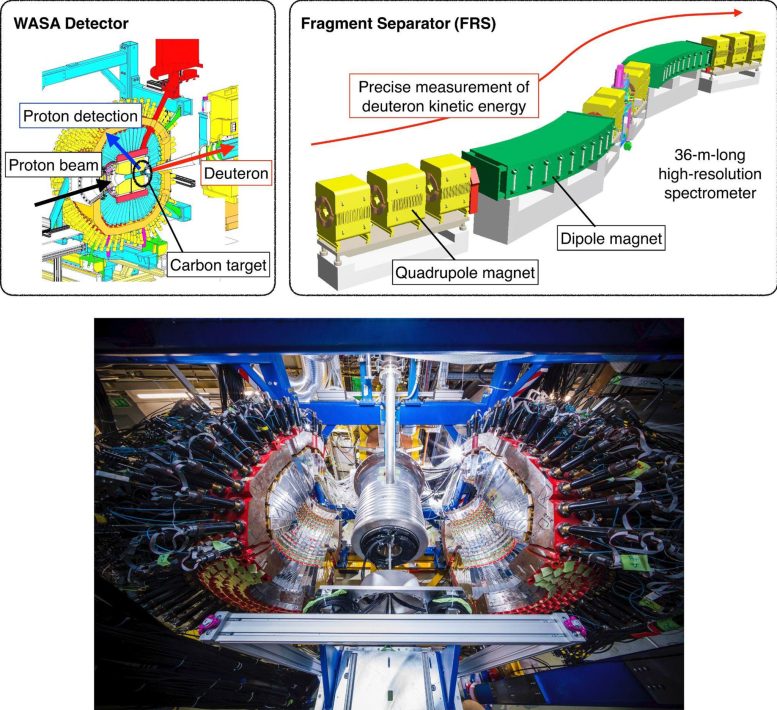
To investigate η′-mesic nuclei, the team conducted a high-precision experiment at the GSI Helmholtzzentrum für Schwerionenforschung in Germany. They directed a beam of high-energy protons at a carbon target. This interaction excited the carbon nuclei, producing η′ mesons that could form bound states with the nucleus.
Experimental Methods and Detection Techniques
The researchers measured the excitation energy of the carbon nuclei by analyzing deuterons, which consist of one proton and one neutron, emitted during the reaction. These measurements were carried out using a high-resolution instrument called the Fragment Separator (FRS).
‘They also used a detector known as WASA, originally built in Uppsala, Sweden, to track high-energy protons leaving the target and identify signals indicating that an η′ meson had been created and captured inside the nucleus.
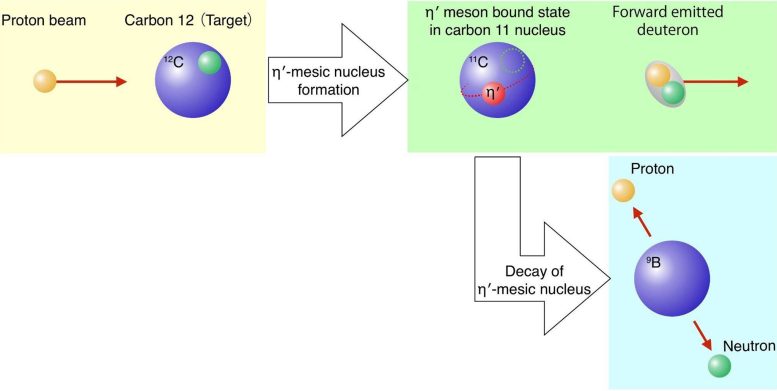
“With our new experimental setup combining the FRS and the WASA, we can identify structures in the data that match theoretical signatures of η′-mesic nuclei,” explains lead author Ryohei Sekiya. “Our analysis suggests that these bound states were indeed formed.”
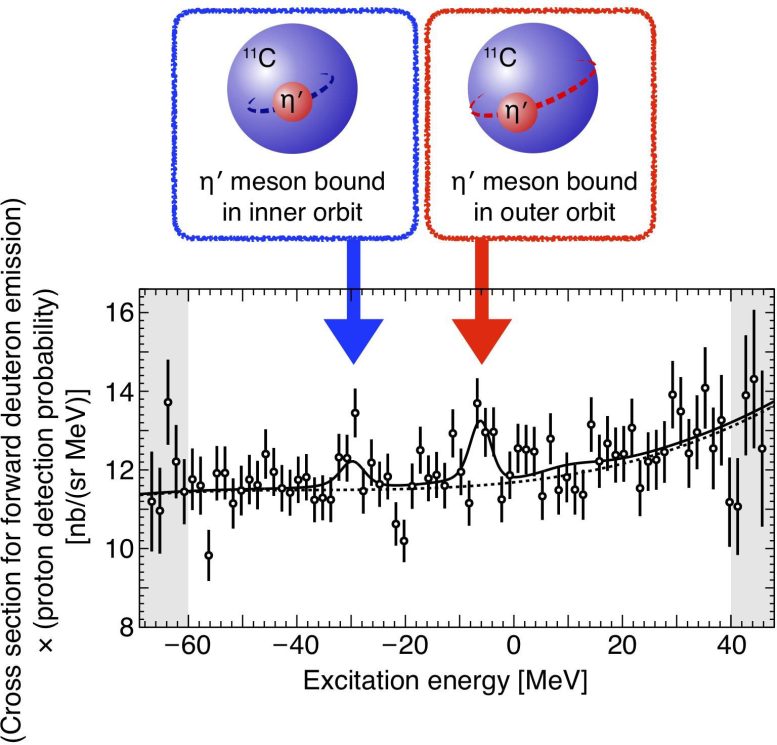
The excitation spectrum of the carbon nucleus points to the possible formation of η′-mesic nuclei. The results suggest that the mass of the η′ meson may decrease inside nuclear matter, which supports theoretical predictions and provides rare experimental evidence of how particle properties change in extremely dense conditions.
Implications for Mass Generation and Future Research
“Our measurements provide important new clues about how mesons behave in nuclear matter,” says Itahashi. “This brings us closer to answering deep, fundamental questions about how matter acquires mass, as well as how the vacuum structure changes inside atomic nuclei.”
Future experiments will aim to improve measurement precision and search for additional decay signals to confirm the existence of η′-mesic nuclei. Each new result helps refine our understanding of the fundamental laws that shape the universe.
Reference: “Excitation Spectra of the Reaction near the -Meson Emission Threshold Measured in Coincidence with High-Momentum Protons” by R. Sekiya, K. Itahashi, Y. K. Tanaka, S. Hirenzaki, N. Ikeno, V. Metag, M. Nanova, J. Yamagata-Sekihara, V. Drozd, V. Drozd, H. Ekawa, H. Geissel, E. Haettner, A. Kasagi, E. Liu, M. Nakagawa, S. Purushothaman, C. Rappold, T. R. Saito, H. Alibrahim Alfaki, F. Amjad, M. Armstrong, K.-H. Behr, J. Benlliure, Z. Brencic, T. Dickel, S. Dubey, S. Escrig, M. Feijoo-Fontán, H. Fujioka, Y. Gao, F. Goldenbaum, A. Graña González, M. N. Harakeh, Y. He, H. Heggen, C. Hornung, N. Hubbard, M. Iwasaki, N. Kalantar-Nayestanaki, M. Kavatsyuk, E. Kazantseva, A. Khreptak, B. Kindler, H. Kollmus, D. Kostyleva, S. Kraft-Bermuth, N. Kurz, B. Lommel, S. Minami, D. J. Morrissey, P. Moskal, I. Mukha, C. Nociforo, H. J. Ong, S. Pietri, E. Rocco, J. L. Rodríguez-Sánchez, P. Roy, R. Ruber, S. Schadmand, C. Scheidenberger, P. Schwarz, V. Serdyuk, M. Skurzok, B. Streicher, K. Suzuki, B. Szczepanczyk, X. Tang, N. Tortorelli, M. Vencelj, T. Weber, H. Weick, M. Will, K. Wimmer, A. Yamamoto, A. Yanai and J. Zhao, 7 April 2026, Physical Review Letters.
DOI: 10.1103/6vsl-ng7x
This study was funded by the Japan Society for the Promotion of Science, Jagiellonian University, Proyectos I+D+i 2020, the Community of Madrid, MCIN, GSI Helmholtzzentrum für Schwerionenforschung, Javna Agencija za Raziskovalno Dejavnost RS, RIKEN, Japan Science and Technology Agency, and the European Union.
Never miss a breakthrough: Join the SciTechDaily newsletter.
Follow us on Google and Google News.
4 Comments
The Newtonian concept of mass, that is, mass is a fundamental property of matter, is the real description of mass. Why complicate the simple concept. Anyway, we have to start from some arbitrary concept whether it is space with some hidden properties or matter having some known properties. The latter is the simplest, and in my opinion based on my independent research, that is capable of explaining everything. Let us go back to Newtonian paradigms, and abandon QM and GR.
Um, MASS cones from New Hampshire. Everyone knows that
Since the late 1980’s, I have been saying that mass is a measure of ether vaccum. Since, 1915 scientists dropped the idea of ether because the theories offered by A. Einstein did not require a background. This is fine because they are a mathematical representation of the effect of gravity and do not pertain to the physics of gravity.
Particles are eventually tight packs of pure energy that is light. When these packs combine in a non-breakable arrangements, it expels ether, therefore creating mass. So, mass is the vaccum of the ether. The more light energy is packed in predetermined arrangements (Particle’s masses), the more it creates vaccum of ether. We can’t measure ether because matter does not interact with it except in gravitational effects like mass, inertia, gravitational pull, etc.
More word salads backed up by absolutely nothing at all (not even a seething vacuum).