
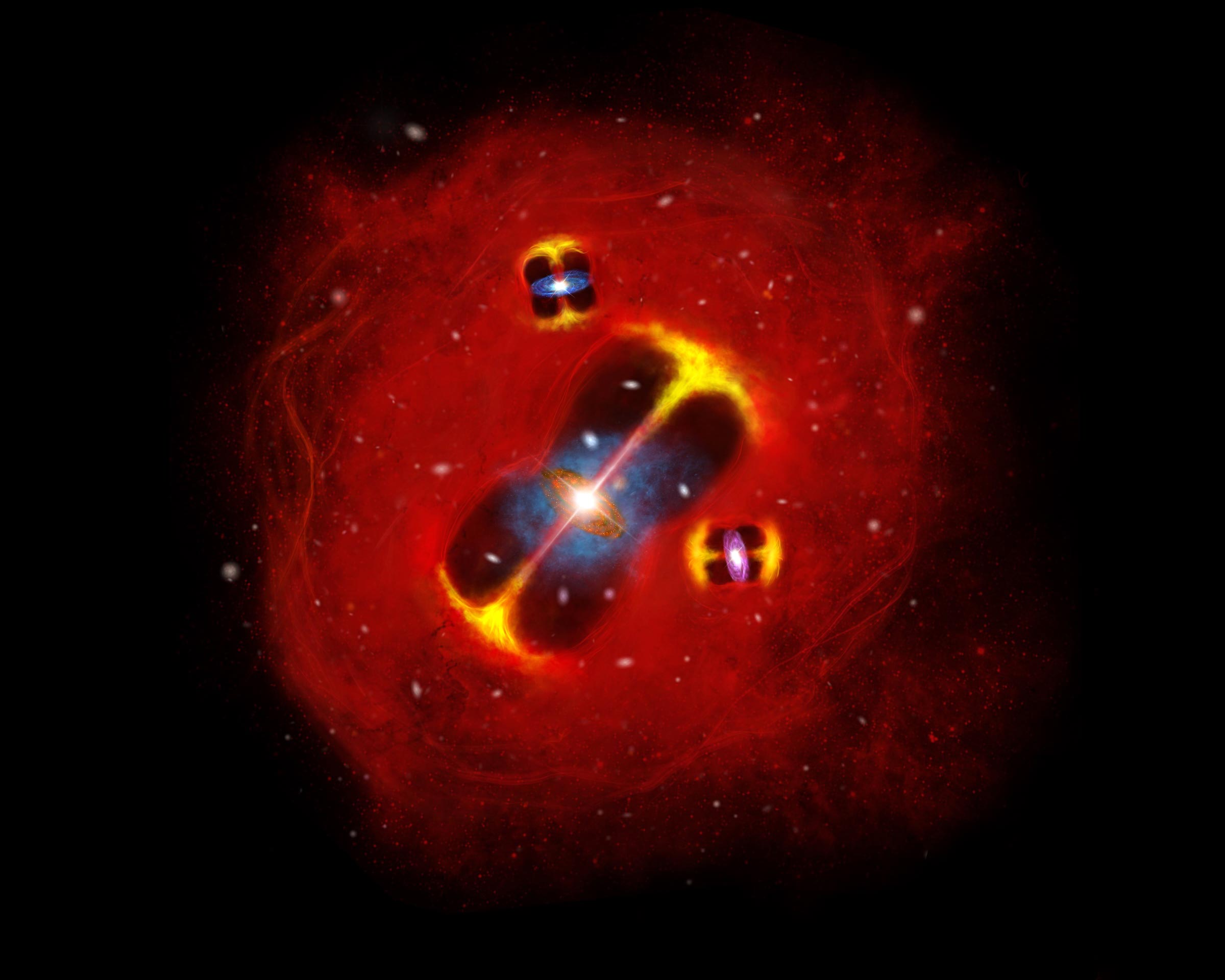
A massive young galaxy cluster has been found glowing with super-hot gas billions of years earlier than expected, defying current theories.
Scientists suspect powerful supermassive black holes triggered an explosive start, forcing a rethink of how galaxy clusters form.
An Unexpected Discovery in the Early Universe
A global team of astronomers led by researchers in Canada has uncovered a surprising cosmic find: a galaxy cluster filled with extremely hot gas that existed just 1.4 billion years after the Big Bang. According to current theories, conditions like this should not appear until much later in the universe’s history. The cluster is both far younger and far hotter than scientists expected.
The discovery, reported today (January 5) in Nature, challenges long-standing ideas about how galaxy clusters form and evolve. Existing models suggest that gas within clusters gradually heats up over time as the structures grow and stabilize. Finding such intense heat so early raises serious questions about whether those models are complete.
“We didn’t expect to see such a hot cluster atmosphere so early in cosmic history,” said lead author Dazhi Zhou, a PhD candidate in the UBC Department of Physics and Astronomy. “In fact, at first I was skeptical about the signal as it was too strong to be real. But after months of verification, we’ve confirmed this gas is at least five times hotter than predicted, and even hotter and more energetic than what we find in many present-day clusters.”
Dr. Scott Chapman, a co-author and professor at Dalhousie University who carried out the work while at the National Research Council of Canada (NRC), said the results point to powerful forces already at work in the young universe. “This tells us that something in the early universe, likely three recently discovered supermassive black holes in the cluster, were already pumping huge amounts of energy into the surroundings and shaping the young cluster, much earlier and more strongly than we thought.”
Studying a Rare Baby Galaxy Cluster
To explore this mystery, the team looked back roughly 12 billion years to observe a young galaxy cluster known as SPT2349-56. The observations were made using the Atacama Large Millimeter/submillimeter Array (ALMA), a network of radio telescopes that includes instruments designed, built, and tested by the NRC.
Despite its young age, SPT2349-56 is already enormous. Its central region spans about 500,000 light-years, similar in size to the halo that surrounds the Milky Way. More than 30 active galaxies are packed tightly inside, producing new stars at a rate over 5,000 times higher than that of our own galaxy.
To measure the extreme heat, the researchers relied on a technique known as the Sunyaev-Zeldovich effect. This method allows scientists to estimate the thermal energy of the intracluster medium:the gas that fills the space between galaxies inside a cluster.
“Understanding galaxy clusters is the key to understanding the biggest galaxies in the universe,” said Dr. Chapman, who is also a UBC affiliate professor. “These massive galaxies mostly reside in clusters, and their evolution is heavily shaped by the very strong environment of the clusters as they form, including the intracluster medium.”
Rethinking How Galaxy Clusters Form
Standard theories suggest that the vast gas reservoirs inside galaxy clusters slowly gather and heat up as gravity pulls an unstable cluster inward until it becomes settled and mature. The newly observed cluster does not follow that script. Instead, the findings suggest a far more intense and rapid beginning, driven by energetic processes early on.
Zhou and his colleagues now plan to investigate how the cluster’s different components influence one another. “We want to figure out how the intense star formation, the active black holes and this overheated atmosphere interact, and what it tells us about how present galaxy clusters were built,” Zhou said. “How can all of this be happening at once in such a young, compact system?”
Reference: “Sunyaev–Zeldovich detection of hot intracluster gas at redshift 4.3” by Dazhi Zhou, Scott C. Chapman, Manuel Aravena, Pablo Araya-Araya, Melanie Archipley, Jared Cathey, Roger P. Deane, Luca Di Mascolo, Raphael Gobat, Thomas R. Greve, Ryley Hill, Seonwoo Kim, Kedar A. Phadke, Vismaya R. Pillai, Ana C. Posses, Christian L. Reichardt, Manuel Solimano, Justin S. Spilker, Nikolaus Sulzenauer, Veronica J. Dike, Joaquin D. Vieira, David Vizgan, George C. P. Wang and Axel Weiß, 5 January 2026, Nature.
DOI: 10.1038/s41586-025-09901-3
Never miss a breakthrough: Join the SciTechDaily newsletter.
Follow us on Google and Google News.
2 Comments
As a layman doing research in theoretical physics, I would suggest that the expansion of the universe is due to internal-energy changing to speed. The previous contraction was the reverse process, speed changing to internal energy. This causes heating and nuclear fission of middle elements into helium and hydrogen. The cores of galaxies contain denser elements, and so just get heated up. So just before expansion, the clusters contain highly energetic hydrogen clouds, which are relatively cold and which subsequently become stars as a consequence of internal energy changing to speed and heat. The cores of galaxies on the other hand, would be very hot at the beginning itself. These get cooled due to internal-energy changing to speed, and become the first black holes. This model agrees with the reported observation.
The model is Newtonian. The only additional hypothesis in this model is that “motion at speed ‘c’ is a fundamental property of matter, and ‘forces of nature’ is reaction to that motion”. So G is proportional to the square of the speed.
What if you assume its only 6000 to 10,000 or so years old and was made to where all can see it as it was as if live but something broke that quantum lijd state and we see light thats technically as if seeing it live as newer light billions of years away still and a transition zone…
Would that account perfectly for how it looks?
I’m guessing yeah but they hate that idea… younger universe things will look more energetic than sight and math says they should.