
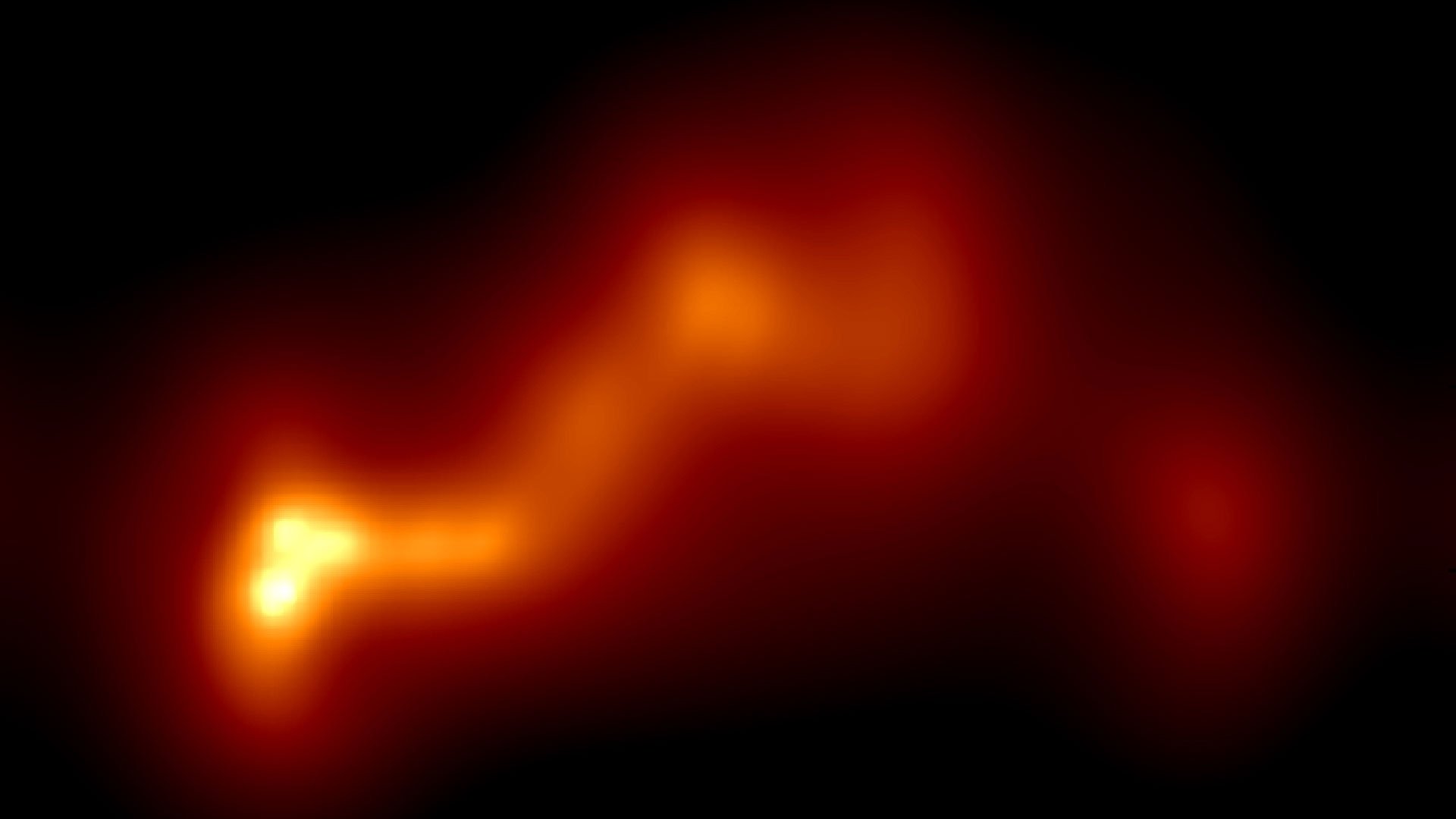
A detailed image reveals an unusual plasma jet structure, suggesting the presence of two merging supermassive black holes at the galaxy’s core.
For more than a century and a half, the distant galaxy OJ 287, located five billion light years from Earth, has intrigued scientists with its unusual changes in brightness. Astronomers have long suspected that the mystery lies in the presence of two supermassive black holes merging at the galaxy’s center.
A team of international researchers, led by Dr. Efthalia Traianou of Heidelberg University, has now achieved a breakthrough by capturing one of the most detailed images ever taken of the galaxy’s core.
Using a space-based radio telescope, the scientists discovered a previously unseen, sharply bent section of the plasma jet erupting from the center of OJ 287. This remarkable view is offering fresh perspectives on the extreme conditions surrounding supermassive black holes.
OJ 287 is classified as a blazar, a type of galaxy known for its extraordinary brightness and energetic activity. At the heart of such galaxies are black holes that draw in surrounding matter, then hurl part of it outward as vast plasma jets. These jets are composed of intense radiation, extreme heat, heavy particles, and powerful magnetic fields.
“We have never before observed a structure in the OJ 287 galaxy at the level of detail seen in the new image,” emphasizes Dr Traianou, a postdoctoral researcher in the team of Dr Roman Gold at the Interdisciplinary Center for Scientific Computing of Heidelberg University.
Extreme Energy and Shock Waves
The image, which penetrates deep into the galaxy’s center, reveals the sharply curved, ribbon-like structure of the jet; it also points to new insights into the composition and the behavior of the plasma jet. Some regions exceed temperatures of ten trillion degrees Kelvin – evidence of extreme energy and movement being released in close proximity to a black hole. The researchers also observed the formation, spread, and collision of a new shock wave along the jet and attributed it to an energy in the trillion-electron volt range from an unusual gamma ray measurement taken in 2017.
The image in the radio range was taken with a ground-space radio interferometer consisting of a radio telescope in Earth’s orbit – a ten-meter-long antenna of the RadioAstron mission on board the Spektr-R satellite – and a network of 27 ground observatories distributed across the Earth.
In this way, the researchers were able to create a virtual space telescope with a diameter five times greater than the diameter of the Earth; its high resolution stems from the distance of the individual radio observatories to one another. The image is based on a method of measurement that takes advantage of the wave nature of light and the associated overlapping waves.
The interferometric image underpins the assumption that a binary supermassive black hole is located inside galaxy OJ 287. It also provides important information on how the movements of such black holes influence the form and orientation of the plasma jets emitted. “Its special properties make the galaxy an ideal candidate for further research into merging black holes and the associated gravitational waves,” states Efthalia Traianou.
Reference: “Revealing a ribbon-like jet in OJ 287 with RadioAstron” by E. Traianou, J. L. Gómez, I. Cho, A. Chael, A. Fuentes, I. Myserlis, M. Wielgus, G. -Y. Zhao, R. Lico, K. Moriyama, L. Dey, G. Bruni, R. Dahale, T. Toscano, L. I. Gurvits, M. M. Lisakov, Y. Y. Kovalev, A. P. Lobanov, A. B. Pushkarev and K. V. Sokolovsky, 30 July 2025, Astronomy & Astrophysics.
DOI: 10.1051/0004-6361/202554929
Never miss a breakthrough: Join the SciTechDaily newsletter.
Follow us on Google and Google News.
1 Comment
“The interferometric image underpins the assumption that a binary supermassive black hole is located inside galaxy OJ 287. It also provides important information on how the movements of such black holes influence the form and orientation of the plasma jets emitted.”
Perhaps. Or the conclusion is based on sparse data combined with the bias of a point spread function in the inferencing process (which has not been uncommon in radio astronomy/interferometry).