
Close Menu
    Facebook X (Twitter) Instagram
    SciTechDaily
    • Biology
    • Chemistry
    • Earth
    • Health
    • Physics
    • Science
    • Space
    • Technology
    Facebook X (Twitter) Pinterest YouTube RSS
    SciTechDaily
    Home»Space»Hubble Image of the Week – Comet or Cluster?
    Space

    Hubble Image of the Week – Comet or Cluster?

    By ESA Hubble Space TelescopeApril 17, 20191 Comment2 Mins Read
    Facebook Twitter Pinterest Telegram LinkedIn WhatsApp Email Reddit
    Share
    Facebook Twitter LinkedIn Pinterest Telegram Email Reddit
    Amazing Hubble View of Messier 62
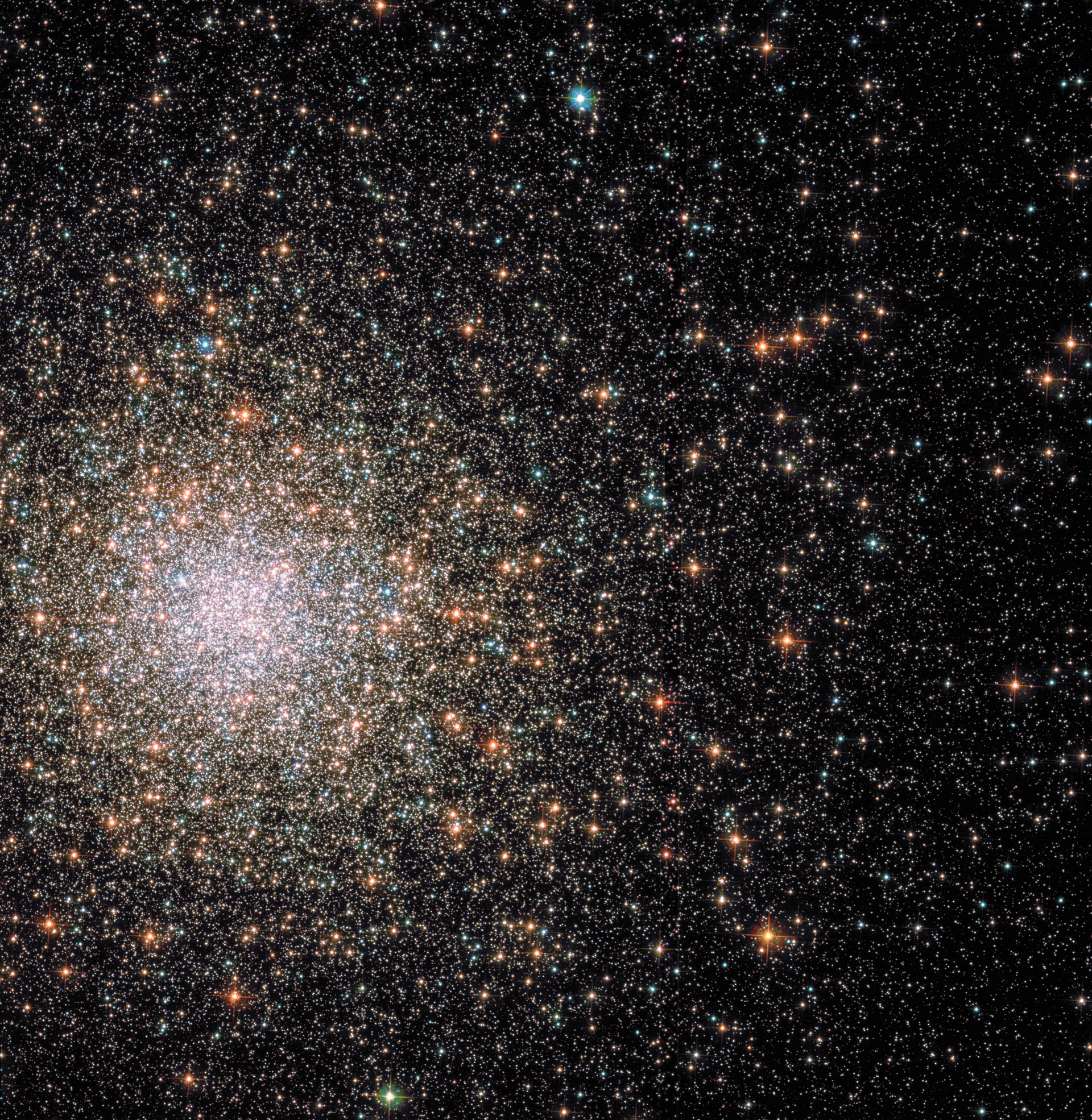
    Messier 62 is distorted, and stretches out on one side to form a comet-like shape with a bright head and extended tail. As one of the closest globular clusters to the center of our galaxy, Messier 62 is likely affected by strong tidal forces that displace many of its stars, resulting in this unusual shape. Credit: ESA/Hubble & NASA, S. Anderson et al.

    Most globular clusters are almost perfectly spherical collections of stars — but Messier 62 breaks the mold. The 12-billion-year-old cluster is distorted, and stretches out on one side to form a comet-like shape with a bright head and extended tail. As one of the closest globular clusters to the center of our galaxy, Messier 62 is likely affected by strong tidal forces that displace many of its stars, resulting in this unusual shape.

    When globular clusters form, they tend to be somewhat denser towards the center. The more massive the cluster, the denser the center is likely to be. With a mass with almost a million times that of the Sun, Messier 62 is one of the densest of them all. With so many stars at the center, interactions and mergers occur regularly. Huge stars form and run out of fuel quickly, exploding violently and their remains collapse to form white dwarfs, neutron stars, and even black holes!

    For many years, it was believed that any black holes that form in a globular cluster would quickly be kicked out due to the violent interactions taking place there. However, in 2013, a black hole was discovered in Messier 62 — the first ever to be found in a Milky Way globular cluster, giving astronomers a whole new hunting ground for these mysterious objects.

    This view comprises ultraviolet and visible light gathered by the NASA/ESA Hubble Space Telescope’s Advanced Camera for Surveys.

    Never miss a breakthrough: Join the SciTechDaily newsletter.
    Follow us on Google and Google News.

    Astronomy Hubble Space Telescope
    Share. Facebook Twitter Pinterest LinkedIn Email Reddit

    Related Articles

    A Morphing Spiral Galaxy Amongst Friends

    Hubble Views Magnificent Lopsided Galaxy NGC 2276

    Hubble Captures Fantastic Detail of Eponymous Spiral Galaxy NGC 691

    Spectacular Image Captured by Hubble Shows a Strangely Contorted Spiral Galaxy

    A Distant Spiral in Virgo: Extraordinary Detail Seen in a Galaxy 150 Million Light-Years Away From Earth

    Magnetic Monsters: Hubble Tracks Down Location of Mysterious Radio Signals From Intergalactic Space

    A Menagerie of Galaxies: Hubble Captures a Cluster With Galaxies of All Shapes and Sizes

    How Habitable Are Planets That Orbit Red Dwarfs – The Most Common Type of Stars in the Galaxy?

    Cosmic Silver Lining: Hubble Spots V565 Surrounded by Four Prominent Diffraction Spikes

    1 Comment

    1. Edward Gazsi on April 18, 2019 10:53 am

      How is it that these global clusters have not contracted due to gravity, despite astronomers telling us that they are about ten billion years old?

      Reply
    Leave A Reply Cancel Reply

    • Facebook
    • Twitter
    • Pinterest
    • YouTube

    Don't Miss a Discovery

    Subscribe for the Latest in Science & Tech!

    Trending News

    Invisible Black Holes Could Be Triggering Supernovae

    Scientists Discover the First Contagious Cancer in a Freshwater Animal

    THC-CBD Treatment Dramatically Reduces Agitation in Dementia Trial

    Scientists Say Love Follows Mathematical Patterns

    “Zombie Cells” Reveal a Hidden Weakness That Could Help Fight Aging

    Alien Signals May Be Hiding in a Radio Band SETI Has Barely Explored

    Earth’s Hidden Thermostat Has Regulated Climate for 60 Million Years

    This 518-Million-Year-Old Creature Reveals How Spiders Got Their Bite

    Follow SciTechDaily
    • Facebook
    • Twitter
    • YouTube
    • Pinterest
    • Newsletter
    • RSS
    SciTech News
    • Biology News
    • Chemistry News
    • Earth News
    • Health News
    • Physics News
    • Science News
    • Space News
    • Technology News
    Recent Posts
    • Scientists Reveal the Climate “Perfect Storm” Behind an Ancient Civilizational Collapse
    • Archaeology Students Discover Rare 400-Year-Old Intact Pot
    • Killer Whales Filmed Smashing Giant Sunfish Into Thousands of Pieces, Possibly for Fun
    • New Strategy Shows Promise Against the Deadliest Brain Cancer
    • Teen Walks Independently After Treatment Targets the Genetic Root of Epilepsy
    Copyright © 1998 - 2026 SciTechDaily. All Rights Reserved.
    • Science News
    • About
    • Contact
    • Editorial Board
    • Privacy Policy
    • Terms of Use

    Type above and press Enter to search. Press Esc to cancel.