
Close Menu
    Facebook X (Twitter) Instagram
    SciTechDaily
    • Biology
    • Chemistry
    • Earth
    • Health
    • Physics
    • Science
    • Space
    • Technology
    Facebook X (Twitter) Pinterest YouTube RSS
    SciTechDaily
    Home»Chemistry»The Fast Dance of Electron Spins – Spin-Flip Within Ten Femtoseconds
    Chemistry

    The Fast Dance of Electron Spins – Spin-Flip Within Ten Femtoseconds

    By University of ViennaOctober 5, 2019No Comments2 Mins Read
    Facebook Twitter Pinterest Telegram LinkedIn WhatsApp Email Reddit
    Share
    Facebook Twitter LinkedIn Pinterest Telegram Email Reddit
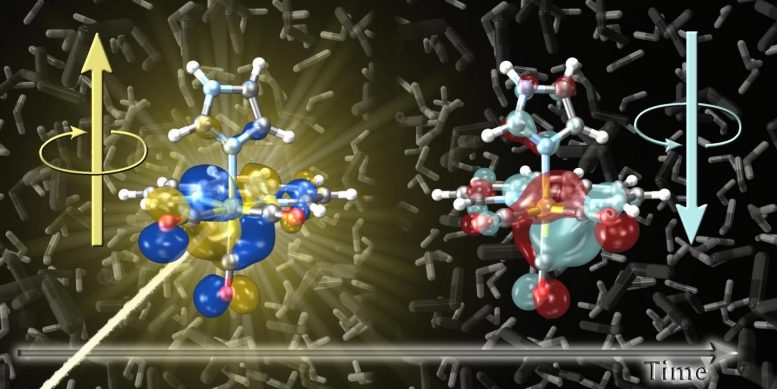
    Fast Dance of Electron Spins
    The extremely fast spin flip processes that are triggered by the light absorption of metal complexes were stimulated in the investigation. © Sebastian Mai

    Chemists investigate the interactions of metal complexes and light.

    When a molecule is hit by light, in many cases a so-called “photoinduced” reaction is initiated. This can be thought of as the interplay between electron motion and nuclear motion. First, the absorption of light energetically “excites” the electrons, which for instance can weaken some of the bonds. Subsequently, the much heavier nuclei start moving. If at a later point in time the nuclei assume a favorable constellation with respect to each other, the electrons can switch from one orbit to another one. Controlled by the physical effect of “spin-orbit coupling” the electron spin can flip in the same moment.

    This interplay of motion is the reason why spin-flip processes in molecules typically take quite long. However, computer simulations have shown that this is not the case in some metal complexes. For example, in the examined rhenium complex the spin-flip process already takes place within ten femtoseconds, even though in this short time the nuclei are virtually stationary–even light moves only three-thousandths of a millimeter within this time. This knowledge is particularly useful for the precise control of electron spins, e.g., in quantum computers.

    Investigation is based on enormous computer power

    One of the biggest difficulties during the investigation was the huge amount of computer power that was required for the simulations. Although for small organic molecules one can nowadays carry out very accurate simulations already with a modest amount of computational effort, metal complexes present a much bigger challenge. Among other reasons, this is due to the large number of atoms, electrons, and solvent molecules that need to be included in the simulations, but also because the electron spin can only be accurately described with equations from relativity theory. Altogether, the scientists from the Institute of Theoretical Chemistry spent almost one million computer hours at the Austrian supercomputer “Vienna Scientific Cluster” in the course of their study. This is equivalent to about 100 years of computer time on a typical personal computer.

    Reference: “Unconventional two-step spin relaxation dynamics of [Re(CO)3(im)(phen)]+ in aqueous solution” by Sebastian Mai and Leticia González, 27 September 2019, Chemical Science.
    DOI: 10.1039/C9SC03671G

    Never miss a breakthrough: Join the SciTechDaily newsletter.
    Follow us on Google and Google News.

    Electrons Particle Physics University of Vienna
    Share. Facebook Twitter Pinterest LinkedIn Email Reddit

    Related Articles

    Fundamental Nature of Chemical Bonding Unveiled by Groundbreaking Visualization of Valence Electrons

    Quantum Pioneers: How Magnetic Quivers Are Rewriting the Rules of Particle Physics

    Stanford’s Tiny Accelerator Promises Giant Leaps for Medical and Physics Breakthroughs

    Fractional Electrons: MIT’s New Graphene Breakthrough Is Shaping the Future of Quantum Computing

    Innovating the Impossible: Scientists Transmit First-Ever Redox Domino Reaction

    Unraveling the Secrets of the Early Universe – Ringing Protons Provide New Insight

    Demon Hunting: Strange 67-Year-Old Particle Physics Prediction Finally Confirmed

    “Extremely Surprising” – Nuclear Physicists Have a Groundbreaking Observation of “Strange Matter”

    A Radical New Approach in Synthetic Chemistry

    Leave A Reply Cancel Reply

    • Facebook
    • Twitter
    • Pinterest
    • YouTube

    Don't Miss a Discovery

    Subscribe for the Latest in Science & Tech!

    Trending News

    Giant Crocodylians Ruled South America’s Ancient Food Chain

    Breakthrough in a Bizarre Galaxy Could Help Unlock the Mystery of Dark Matter

    Just 4 Minutes of Daily Strength Training Can Quadruple Fitness in Older Adults

    Almost All Plant-Based Meat Alternatives Contain Mycotoxins, Study Finds

    Astronomers Detect a Record-Breaking “Cosmic Laser” From 8 Billion Light-Years Away

    A 47-Year-Old Scientist Tracked Himself for Months – His Biological Age Fell to 32

    Construction Crew Uncovers Giant 20-Meter Dinosaur in Brazil

    30 Years of Hurricane Data Reveal 4 Warning Signs Before Storms Strengthen

    Follow SciTechDaily
    • Facebook
    • Twitter
    • YouTube
    • Pinterest
    • Newsletter
    • RSS
    SciTech News
    • Biology News
    • Chemistry News
    • Earth News
    • Health News
    • Physics News
    • Science News
    • Space News
    • Technology News
    Recent Posts
    • Researchers Solve Two Major Problems Holding Back SiC Electronics
    • Physicists Hunted a Mysterious Particle – and Found Two Unexpected Structures Instead
    • Nanoscale “Defects” Unlock a Major Heat Transfer Breakthrough
    • World’s Largest Trial of Robotic Knee Surgery Delivers a Surprising Result
    • Scientists Develop an Implant That Could Help the Body Clock Recover From Jet Lag Faster
    Copyright © 1998 - 2026 SciTechDaily. All Rights Reserved.
    • Science News
    • About
    • Contact
    • Editorial Board
    • Privacy Policy
    • Terms of Use

    Type above and press Enter to search. Press Esc to cancel.