
Specific insulin-like peptide regulates how beetle ‘weapons’ grow, revealing how larval nutrition leads to differently sized mandibles in broad-horned flour beetles.
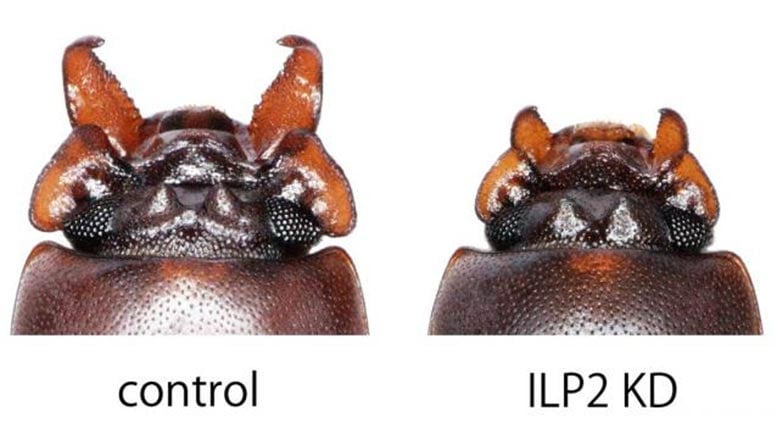
A scientist from Tokyo Metropolitan University and coworkers have discovered that a specific insulin-like peptide called ILP2 regulates the size of “weapons” in Gnatocerus cornutus beetles in different nutritional environments. They found diminished mandible size when expression of the peptide was suppressed, and that it was specifically expressed in the “fat body,” where beetles store nutrients. This has important implications for understanding how striking growth occurs in different environments for different organisms.
From deer antlers to beetle horns, the animal kingdom is full of examples of exaggerated ornaments and weapons which derive from sexual selection. Their growth and size may vary significantly from one specimen to another and give rise to distinct mating tactics like fighting, sneaking, or dispersing to areas with less competition. This variation is often correlated with body size or “condition” in a relationship known as positive allometry. Despite the importance of condition dependent growth of these features, the mechanism behind how the environment affects the complex development of these observable features remains poorly understood.
Insulin-like peptides (ILPs) and growth factors (IGFs) are found in a wide range of both invertebrates and vertebrates, like humans, and are thought to play common roles related to growth and metabolism. Recent work into the genetics of insects has revealed a wide variety of ILPs playing different functional roles. Examples include fruit flies which have 8, pea aphids with 10 and silkworms with over 40. Yet, despite some understanding of what ILPs do in model organisms like fruit flies, we know little about their function outside of the lab, in particular, how their molecular function contributes to phenotypic complexity, or the diversification of traits in a particular natural environment.
Thus, a team led by Yasukazu Okada from Tokyo Metropolitan University examined the broad-horned flour beetle, G. cornutus. Found in grain stores and factories, male flour beetles have exaggerated mandibles for male-male combat; large beetles have larger mandibles, and past work has found it is linked to better nutrition as a larva. This makes it ideal for studying the molecular basis for conditional growth. The team examined the beetle’s genome, and found five different ILP genes, labeled GcorILP1 to 5, all encoding for a different ILP (ILP1 to 5). Firstly, they found that sufficiently fed larger larvae showed an elevated expression of ILP2 at the pre-pupa stage, while “poorly” fed smaller larvae did not. They also found that the same peptide was specifically expressed in the fat body; smaller larvae expressed less of the peptide as a consequence of having less fat. Furthermore, by using a technique known as RNA interference to impede the expression of ILP2, they found a direct correlation between so-called GcorILP2 “knock-down” (KD) and diminished mandible size, not to mention less of a correlation with how well the larvae were fed.
This is the first discovery of how a specific ILP is connected to sexually selected exaggerated traits under different conditions. It clearly demonstrates how the functional diversity of ILPs has led to particular peptides playing very specific roles and is an important step in elucidating how the whole insulin/insulin-like growth factor signaling pathway affects complex development mechanisms and evolution.
Reference: “A specific type of insulin-like peptide regulates the conditional growth of a beetle weapon” by Yasukazu Okada, Masako Katsuki, Naoki Okamoto, Haruna Fujioka and Kensuke Okada, 27 November 2019, PLOS Biology.
DOI: 10.1371/journal.pbio.3000541
This work was supported by JSPS KAKENHI Grant Numbers 18H04815, 19H04913, 18K0641700, and the Yamada Science Foundation.
Never miss a breakthrough: Join the SciTechDaily newsletter.
Follow us on Google and Google News.
1 Comment
hi, notable blog on suety loss. such a person helped.