
Close Menu
    Facebook X (Twitter) Instagram
    SciTechDaily
    • Biology
    • Chemistry
    • Earth
    • Health
    • Physics
    • Science
    • Space
    • Technology
    Facebook X (Twitter) Pinterest YouTube RSS
    SciTechDaily
    Home»Technology»World’s Shortest Wavelength Laser Diode Emits Deep UV Light
    Technology

    World’s Shortest Wavelength Laser Diode Emits Deep UV Light

    By Nagoya UniversityJanuary 17, 2020No Comments3 Mins Read
    Facebook Twitter Pinterest Telegram LinkedIn WhatsApp Email Reddit
    Share
    Facebook Twitter LinkedIn Pinterest Telegram Email Reddit
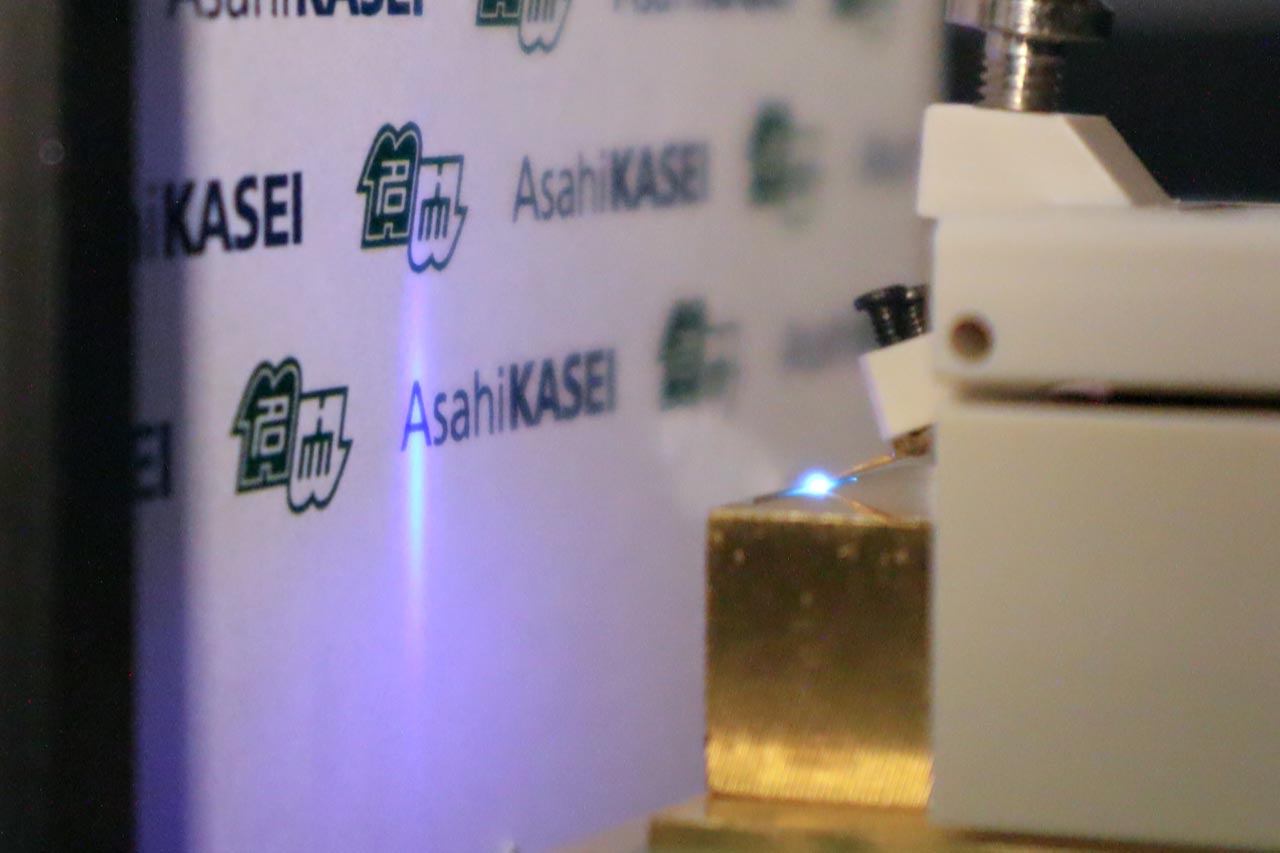
    UV-C Laser
    Far field pattern of UV-C laser projected onto a fluorescent screen. Credit: 2019 Asahi Kasei Corp. and Nagoya University

    Nagoya University researchers say they have designed a laser diode that emits the shortest-wavelength ultraviolet light to-date, with potential applications in disinfection, dermatology, and DNA analyses.

    Nagoya University scientists, in cooperation with Asahi Kasei Corporation, have succeeded in designing a laser diode that emits deep-ultraviolet light, according to research published in the journal Applied Physics Express.

    “Our laser diode emits the world’s shortest lasing wavelength, at 271.8 nanometers (nm), under pulsed [electric] current injection at room temperature,” says Professor Chiaki Sasaoka of Nagoya University’s Center for Integrated Research of Future Electronics.
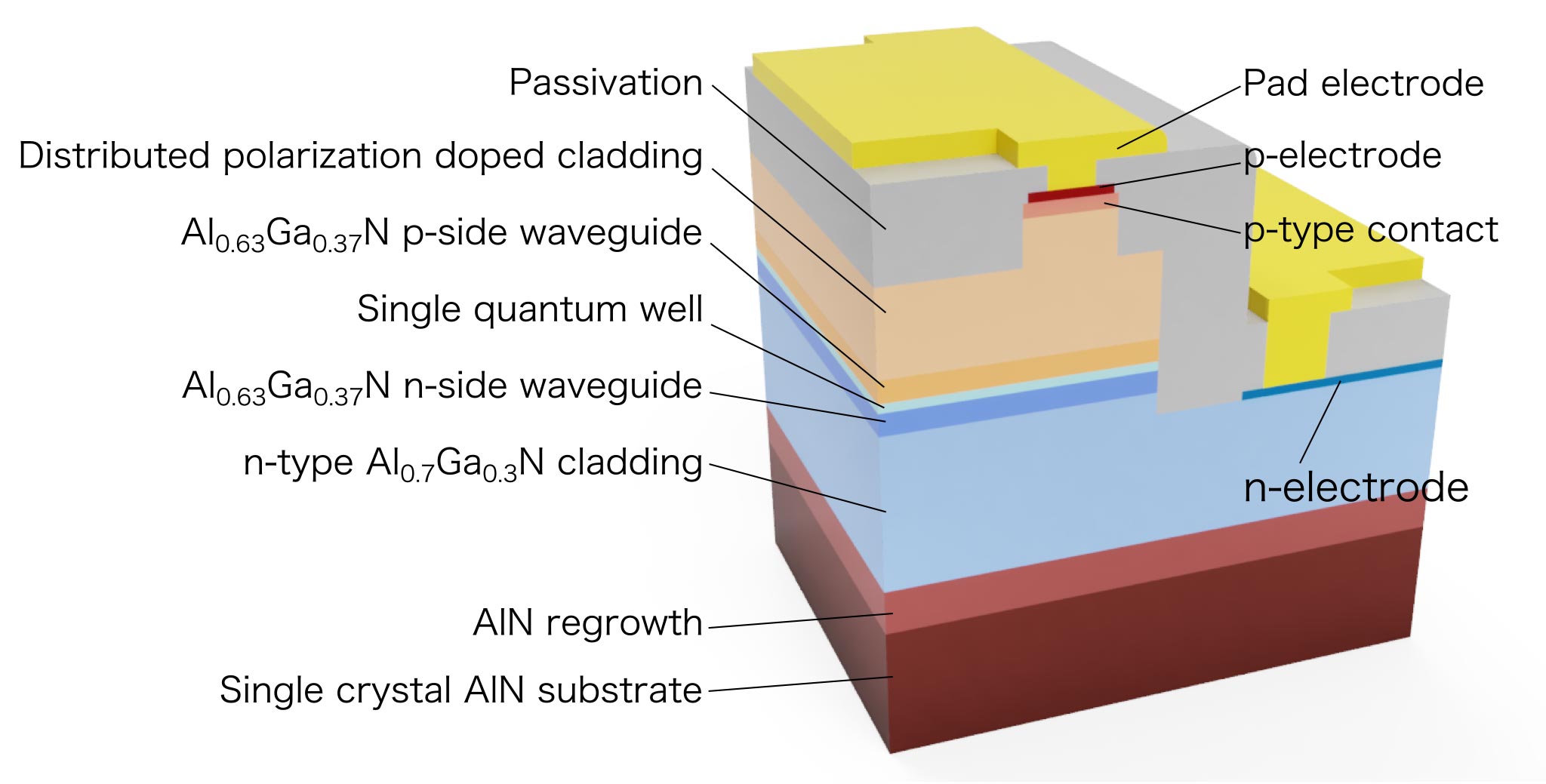
    Cross-Sectional Structure of the UV-C Semiconductor Laser Diode
    Cross-sectional structure of the UV-C semiconductor laser diode. Credit: 2019 Asahi Kasei Corp. and Nagoya University

    Previous efforts in the development of ultraviolet laser diodes had only managed to achieve emissions down to 336 nm, Sasaoka explains.

    Laser diodes that emit short-wavelength ultraviolet light, which is called UV-C and is in the wavelength region of 200 to 280 nm, could be used for disinfection in healthcare, for treating skin conditions such as psoriasis, and for analyzing gases and DNA.

    The Nagoya University deep-ultraviolet laser diode overcomes several issues encountered by scientists in their work toward the development of these semiconducting devices.

    The team used a high-quality aluminum nitride (AlN) substrate as their base for building up the layers of the laser diode. This, they say, is necessary, since lower quality AlN contains a large number of defects, which ultimately impact the efficiency of a laser diode’s active layer in converting electrical energy into light energy.
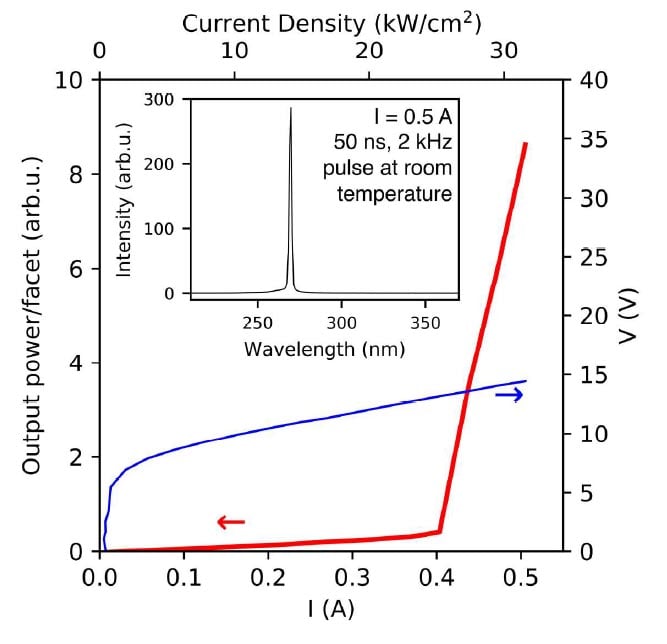
    Emission Characteristics Under Pulsed Operation
    Emission characteristics under pulsed operation. Credit: 2019 Asahi Kasei Corp. and Nagoya University

    In laser diodes, a ‘p-type’ and ‘n-type’ layers are separated by a ‘quantum well’. When an electric current is passed through a laser diode, positively charged holes in the p-type layer and negatively charged electrons in the n-type layer flow toward the center to combine, releasing energy in the form of light particles called photons.

    The researchers designed the quantum well so that it would emit deep UV light. The p- and n-type layers were made from aluminum gallium nitride (AlGaN). Cladding layers, also made from AlGaN, were placed on either side of the p- and n-type layers. The cladding below the n-type layer included silicon impurities, a process called doping. Doping is used as a technique to modify a material’s properties. The cladding above the p-type layer underwent distributed polarization doping, which dopes the layer without adding impurities. The aluminum content in the p-side cladding was designed so that it was highest at the bottom, decreasing towards the top. The researchers believe this aluminum gradient enhances the flow of positively charged holes. A top contact layer was finally added that was made from p-type AlGaN doped with magnesium.

    The researchers found that the polarization doping of the p-side cladding layer meant that a pulsed electric current of “remarkably low operating voltage” of 13.8V was needed for the emission of “the shortest wavelength reported so far.”

    The team is now conducting advanced joint research with Asahi Kasei Corporation to achieve continuous room temperature deep-UV lasing for the development of UV-C semiconductor laser products.

    Reference: “A 271.8 nm deep-ultraviolet laser diode for room temperature operation” by Ziyi Zhang, Maki Kushimoto, Tadayoshi Sakai, Naoharu Sugiyama, Leo J. Schowalter, Chiaki Sasaoka and Hiroshi Amano, 7 November 2019, Applied Physics Express.
    DOI: 10.7567/1882-0786/ab50e0

    Never miss a breakthrough: Join the SciTechDaily newsletter.
    Follow us on Google and Google News.

    Electrical Engineering Lasers Nagoya University
    Share. Facebook Twitter Pinterest LinkedIn Email Reddit

    Related Articles

    This Game-Changing Laser Is Smaller, Smarter, and Shockingly Powerful

    Quantum Revolution: Atoms Trapped on a Chip

    High Efficiency, Low Cost: New “All in One” Microcomb Lasers Could Transform Consumer Electronics

    Ultrafast Computers Are Coming: Laser Bursts Drive Fastest-Ever Logic Gates

    Laser Pulses for Ultrafast Signal Processing Could Make Computers a Million Times Faster

    A Laser Breakthrough: First Commercially Scalable Integrated Laser and Microcomb on a Single Chip

    Breaking the Power and Speed Limit of Lasers: New Fast, Powerful Compact Laser Invented

    Researchers Develop a Portable Terahertz Laser for Powerful Sensing and Imaging

    Multi-Watt Terahertz Semiconductor “Quantum-Cascade” Laser Breakthrough

    Leave A Reply Cancel Reply

    • Facebook
    • Twitter
    • Pinterest
    • YouTube

    Don't Miss a Discovery

    Subscribe for the Latest in Science & Tech!

    Trending News

    Scientists May Have Discovered How To Heal Damaged Kidneys

    Interstellar Visitor 3I/ATLAS Is Bursting With an Unexpected Chemical

    Scientists Just Found All 5 Genetic “Letters” of DNA and RNA on an Asteroid

    The 4,000-Year-Old City That Defied History’s Rules on Wealth and Power

    The World’s Biggest Population Fear Has Flipped – and It Could Change Everything

    This “Fake” Pill Improved Memory and Physical Performance in Just 3 Weeks

    Scientists Say Frequent Ejaculation May Improve Sperm Quality and Fertility

    Scientists Have Found “The Heaven Sword” After Years of Looking

    Follow SciTechDaily
    • Facebook
    • Twitter
    • YouTube
    • Pinterest
    • Newsletter
    • RSS
    SciTech News
    • Biology News
    • Chemistry News
    • Earth News
    • Health News
    • Physics News
    • Science News
    • Space News
    • Technology News
    Recent Posts
    • Scientists Create Tiny “Mini Livers” That Could One Day Replace Liver Transplants
    • This Surprising Factor May Predict Heart Disease Decades Before It Strikes
    • New Nonsurgical Knee Treatment Delivers Lasting Pain Relief
    • Scientists Discover Hidden Rule That Could Make Fuel Cells Cheaper and More Powerful
    • New Water-Harvesting Jacket Pulls up to 30 Ounces of Drinking Water From the Air Daily
    Copyright © 1998 - 2026 SciTechDaily. All Rights Reserved.
    • Science News
    • About
    • Contact
    • Editorial Board
    • Privacy Policy
    • Terms of Use

    Type above and press Enter to search. Press Esc to cancel.