
Close Menu
    Facebook X (Twitter) Instagram
    SciTechDaily
    • Biology
    • Chemistry
    • Earth
    • Health
    • Physics
    • Science
    • Space
    • Technology
    Facebook X (Twitter) Pinterest YouTube RSS
    SciTechDaily
    Home»Technology»Quantum Photon Gun Could Be Basis for Quantum Information Processing
    Technology

    Quantum Photon Gun Could Be Basis for Quantum Information Processing

    By SciTechDailyApril 25, 2012No Comments3 Mins Read
    Facebook Twitter Pinterest Telegram LinkedIn WhatsApp Email Reddit
    Share
    Facebook Twitter LinkedIn Pinterest Telegram Email Reddit
    quantum-photon-gun
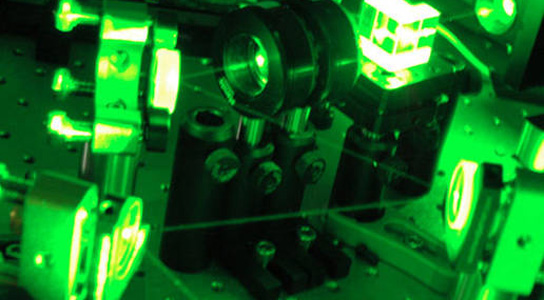
    Scientists have developed a photon emitter with a broader range, making it more efficient than any previously developed.

    The advent of a quantum internet, one based upon single photons used to encode and send information, which in turn is protected by quantum cryptography, has become more likely, thanks to the development of a photon gun that can fire pairs of photons on demand.

    The main reason why such a system is desirable is that it has vastly improved security compared to the computer architecture that’s available right now. If a photon gun fires photons in bunches, they can be intercepted and used to decode the data being transmitted.
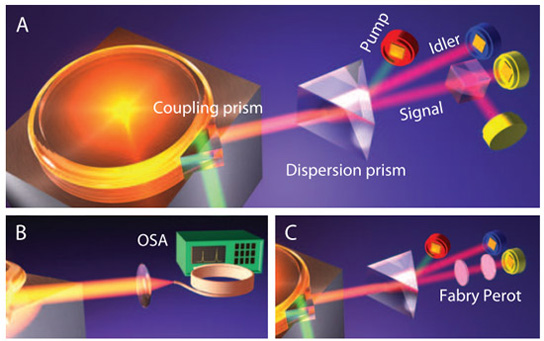
    (A) The whispering gallery mode resonator, a diamond prism allows for evanescent wave coupling to the resonator. (B) To verify coarse tuning of the signal and idler wavelengths, the output of the WGMR is analyzed with an optical spectrum analyzer.(C) Fine tuning of the wavelength

    Michael Fortsch, from the Max Planck Institute for Science of Light, Erlangen, Germany, and his colleagues developed a photon emitter that has a more flexible range, making it more efficient than any other that had been developed. They published their findings via arXiv.

    The gun is actually a disc-shaped crystal of lithium niobate, zapped with 582nm light from a neodymium-dope yttrium aluminum garnet laser. Lithium niobate is a nonlinear material, which causes single photons to spontaneously convert into photons, making it the material of choice for such a project. The 582nm photons ricochet around the disc and eventually emerge unchanged or as a pair of entangled photons with about twice the wavelength, 1060nm. While entangled, the photons don’t have exactly the same wavelength, so they can be easily separated. The pairs are used to transmit information.

    photons-emission

    The photon gun fires pairs, making it easy to detect that a photon has been emitted. The gun can emit 10 million pairs of photons per second per mW, which is two orders of magnitude more efficient than any other photon gun in existence.

    The wavelength of the photons can also be changed by heating or cooling the crystal, implying that the gun can be tuned to different atomic transitions, allowing the use of different atoms for quantum information storage.

    Reference: “A versatile source of single photons for quantum information processing” by Michael Förtsch, Josef U. Fürst, Christoffer Wittmann, Dmitry Strekalov, Andrea Aiello, Maria V. Chekhova, Christine Silberhorn, Gerd Leuchs and Christoph Marquardt, 7 May 2013, Nature Communications.
    DOI: 10.1038/ncomms2838

    Never miss a breakthrough: Join the SciTechDaily newsletter.
    Follow us on Google and Google News.

    Photons Quantum Physics Qubits
    Share. Facebook Twitter Pinterest LinkedIn Email Reddit

    Related Articles

    Quantum Computers Could Freeze Like Ordinary PCs

    Supercharged Qubits: How MIT’s Quarton Coupler Accelerates Quantum Computing

    MIT Engineers Discover a New Way To Control Atomic Nuclei As “Qubits”

    USC Study Validates Large-Scale Quantum Chip

    Quantum Computing Continues to Move Forward

    New Spin Technique Moves Quantum Computers a Step Closer

    Yale Physicists Observe Quantum Information While Preserving Its Integrity

    Molecules as Antennas Transmit Signals of Single Photons

    Quantum Computers to Arrive with Single-Atom-Sized Transistors

    Leave A Reply Cancel Reply

    • Facebook
    • Twitter
    • Pinterest
    • YouTube

    Don't Miss a Discovery

    Subscribe for the Latest in Science & Tech!

    Trending News

    Magnetic Bacterium Extends Lifespan by 43% in Surprising Anti-Aging Study

    Archaeologists Discover Evidence of “Brands” 3,200 Years Before Modern Capitalism

    The Rare Vision Side Effect of Ozempic and Wegovy You Should Know About

    Hidden Deep Beneath Mars, Scientists Find Evidence of a Vast Magmatic System

    Your Gut Microbiome May Be Contagious, Scientists Discover

    Scientists Find a Troubling Effect of Sitting That Exercise Couldn’t Prevent

    125-Million-Year-Old Crocodile Fossil Reveals Astonishing New Secrets

    Scientists Discover an “Impossible” Way Muscle Filaments Can Grow

    Follow SciTechDaily
    • Facebook
    • Twitter
    • YouTube
    • Pinterest
    • Newsletter
    • RSS
    SciTech News
    • Biology News
    • Chemistry News
    • Earth News
    • Health News
    • Physics News
    • Science News
    • Space News
    • Technology News
    Recent Posts
    • Archaeologists Discover 1,200-Year-Old Hairless Dog at Ancient Peruvian Site
    • The Human Family Tree May Need a Major Rewrite
    • “Lower-Risk” Childhood Cancer May Be More Dangerous Than It Appears
    • Scientists Warn a Common Eczema Remedy May Offer Little Relief
    • Scientists Find a Surprising Cancer-Fighting Effect in Dark Sweet Cherries
    Copyright © 1998 - 2026 SciTechDaily. All Rights Reserved.
    • Science News
    • About
    • Contact
    • Editorial Board
    • Privacy Policy
    • Terms of Use

    Type above and press Enter to search. Press Esc to cancel.