
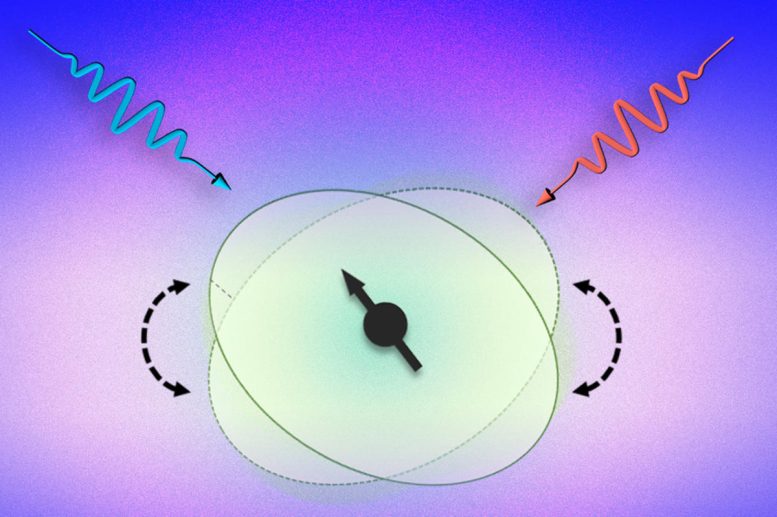
Researchers have discovered a way to control the spin property of nuclei, which can store quantum information, using lasers.
Quantum-based devices, including computers and sensors, have the potential to revolutionize the way we perform complex tasks by vastly outperforming traditional digital technologies. However, despite significant investments by tech companies, academic institutions, and government labs, the development of practical quantum-based devices remains a significant challenge.
The largest quantum computers available today are only equipped with a few hundred “qubits,” the quantum equivalents of digital bits.
Now, researchers at MIT have proposed a new approach to making qubits and controlling them to read and write data. The method, which is theoretical at this stage, is based on measuring and controlling the spins of atomic nuclei, using beams of light from two lasers of slightly different colors. The findings are described in a paper published in the journal Physical Review X, written by MIT doctoral student Haowei Xu, professors Ju Li and Paola Cappellaro, and four others.
Nuclear spins have long been recognized as potential building blocks for quantum-based information processing and communications systems, and so have photons, the elementary particles that are discreet packets, or “quanta,” of electromagnetic radiation. But coaxing these two quantum objects to work together was difficult because atomic nuclei and photons barely interact, and their natural frequencies differ by six to nine orders of magnitude.
Laser Control for Precise Nuclear Spin Manipulation
In the new process developed by the MIT team, the difference in the frequency of an incoming laser beam matches the transition frequencies of the nuclear spin, nudging the nuclear spin to flip a certain way.
“We have found a novel, powerful way to interface nuclear spins with optical photons from lasers,” says Cappellaro, a professor of nuclear science and engineering. “This novel coupling mechanism enables their control and measurement, which now makes using nuclear spins as qubits a much more promising endeavor.”
The process is completely tunable, the researchers say. For example, one of the lasers could be tuned to match the frequencies of existing telecom systems, thus turning the nuclear spins into quantum repeaters to enable long-distance- quantum communication.
Previous attempts to use light to affect nuclear spins were indirect, coupling instead to electron spins surrounding that nucleus, which in turn would affect the nucleus though magnetic interactions. But this requires the existence of nearby unpaired electron spins and leads to additional noise on the nuclear spins. For the new approach, the researchers took advantage of the fact that many nuclei have an electric quadrupole, which leads to an electric nuclear quadrupolar interaction with the environment. This interaction can be affected by light in order to change the state of the nucleus itself.
“Nuclear spin is usually pretty weakly interacting,” says Li. “But by using the fact that some nuclei have an electric quadrupole, we can induce this second-order, nonlinear optical effect that directly couples to the nuclear spin, without any intermediate electron spins. This allows us to directly manipulate the nuclear spin.”
Among other things, this can allow the precise identification and even mapping of isotopes of materials, while Raman spectroscopy, a well-established method based on analogous physics, can identify the chemistry and structure of the material, but not isotopes. This capability could have many applications, the researchers say.
Extended Coherence Times for Quantum Memory
As for quantum memory, typical devices presently being used or considered for quantum computing have coherence times — meaning the amount of time that stored information can be reliably kept intact — that tend to be measured in tiny fractions of a second. But with the nuclear spin system, the quantum coherence times are measured in hours.
Since optical photons are used for long-distance communications through fiber-optic networks, the ability to directly couple these photons to quantum memory or sensing devices could provide significant benefits in new communications systems, the team says. In addition, the effect could be used to provide an efficient way of translating one set of wavelengths to another. “We are thinking of using nuclear spins for the transduction of microwave photons and optical photons,” Xu says, adding that this can provide greater fidelity for such translation than other methods.
So far, the work is theoretical, so the next step is to implement the concept in actual laboratory devices, probably first of all in a spectroscopic system. “This may be a good candidate for the proof-of-principle experiment,” Xu says. After that, they will tackle quantum devices such as memory or transduction effects, he says.
Reference: “Two-Photon Interface of Nuclear Spins Based on the Optonuclear Quadrupolar Effect” by Haowei Xu, Changhao Li, Guoqing Wang, Hua Wang, Hao Tang, Ariel Rebekah Barr, Paola Cappellaro and Ju Li, 14 February 2023, Physical Review X.
DOI: 10.1103/PhysRevX.13.011017
Never miss a breakthrough: Join the SciTechDaily newsletter.
Follow us on Google and Google News.