
When we talk about “information technology,” we generally mean the technology part, like computers, networks, and software. But information itself, and its behavior in quantum systems, is a central focus for MIT’s interdisciplinary Quantum Engineering Group (QEG) as it seeks to develop quantum computing and other applications of quantum technology.
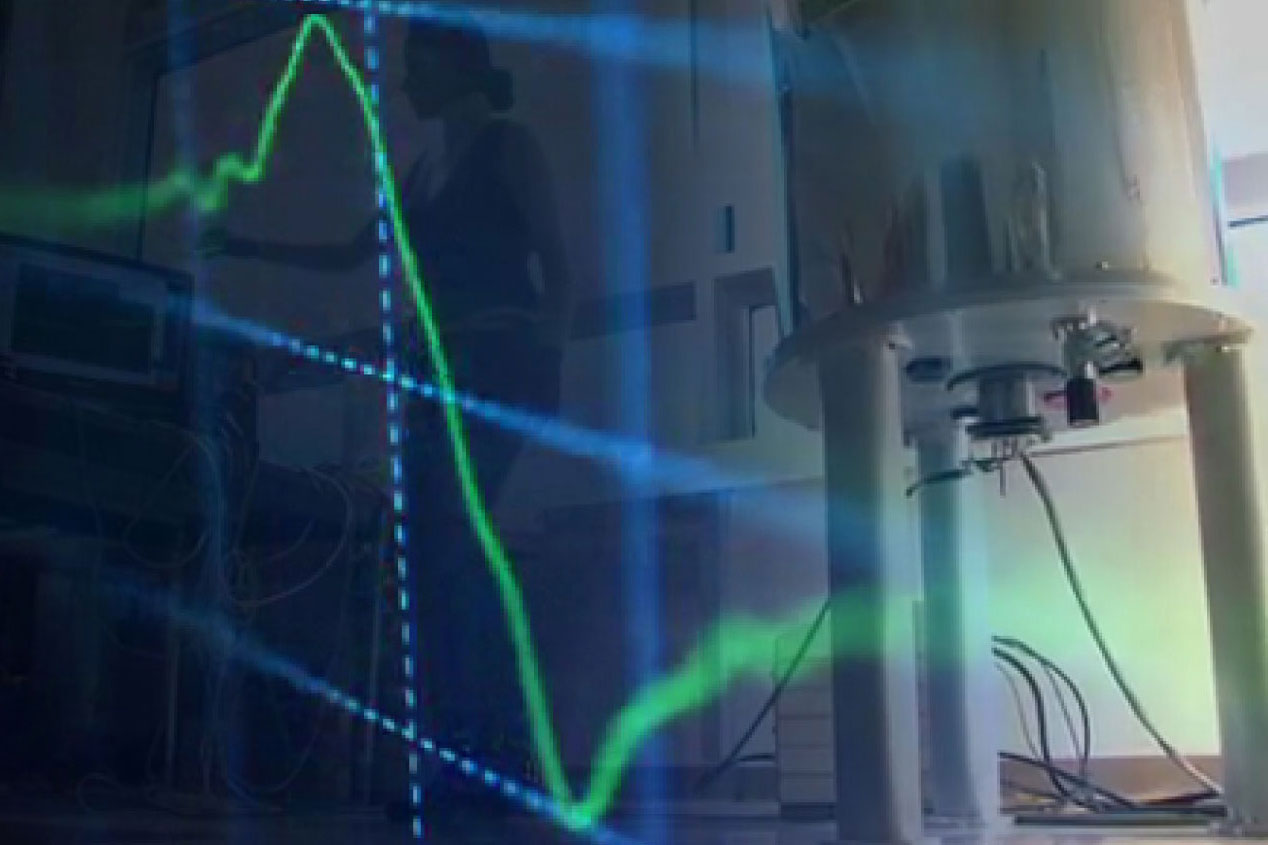
A QEG team has provided unprecedented visibility into the spread of information in large quantum mechanical systems, via a novel measurement methodology and metric described in a new article in Physics Review Letters. The team has been able, for the first time, to measure the spread of correlations among quantum spins in fluorapatite crystal, using an adaptation of room-temperature solid-state nuclear magnetic resonance (NMR) techniques.
Researchers increasingly believe that a clearer understanding of information spreading is not only essential to understanding the workings of the quantum realm, where classical laws of physics often do not apply, but could also help engineer the internal “wiring” of quantum computers, sensors, and other devices.
One key quantum phenomenon is a nonclassical correlation, or entanglement, in which pairs or groups of particles interact such that their physical properties cannot be described independently, even when the particles are widely separated.
That relationship is central to a rapidly advancing field in physics, quantum information theory. It posits a new thermodynamic perspective in which information and energy are linked — in other words, that information is physical, and that quantum-level sharing of information underlies the universal tendency toward entropy and thermal equilibrium, known in quantum systems as thermalization.
QEG head Paola Cappellaro, the Esther and Harold E. Edgerton Associate Professor of Nuclear Science and Engineering, co-authored the new paper with physics graduate student Ken Xuan Wei and longtime collaborator Chandrasekhar Ramanathan of Dartmouth College.
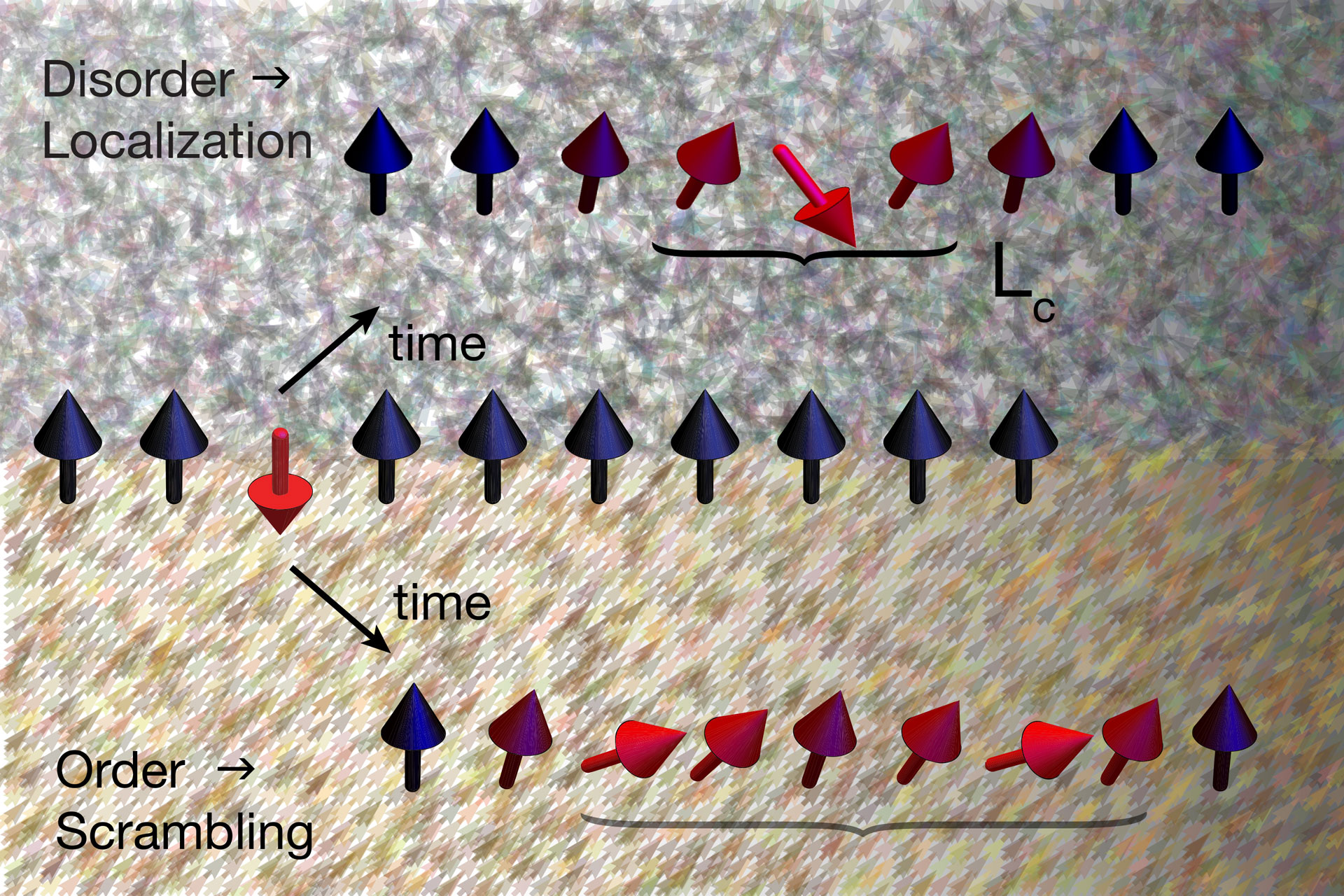
Cappellaro explains that a primary aim of the research was measuring the quantum-level struggle between two states of matter: thermalization and localization, a state in which information transfer is restricted and the tendency toward higher entropy is somehow resisted through disorder. The QEG team’s work centered on the complex problem of many-body localization (MBL) where the role of spin-spin interactions is critical.
The ability to gather this data experimentally in a lab is a breakthrough, in part because the simulation of quantum systems and localization-thermalization transitions is extremely difficult even for today’s most powerful computers. “The size of the problem becomes intractable very quickly, when you have interactions,” says Cappellaro. “You can simulate perhaps 12 spins using brute force but that’s about it — far fewer than the experimental system is capable of exploring.”
NMR techniques can reveal the existence of correlations among spins, as correlated spins rotate faster under applied magnetic fields than isolated spins. However, traditional NMR experiments can only extract partial information about correlations. The QEG researchers combined those techniques with their knowledge of the spin dynamics in their crystal, whose geometry approximately confines the evolution to linear spin chains.
“That approach allowed us to figure out a metric, average correlation length, for how many spins are connected to each other in a chain,” says Cappellaro. “If the correlation is growing, it tells you that interaction is winning against the disorder that’s causing localization. If the correlation length stops growing, the disorder is winning and keeping the system in a more quantum localized state.”
In addition to being able to distinguish between different types of localization (such as MBL and the simpler Anderson localization), the method also represents a possible advance toward the ability to control these systems through the introduction of disorder, which promotes localization, Cappellaro adds. Because MBL preserves information and prevents it from becoming scrambled, it has the potential for memory applications.
The research’s focus “addresses a very fundamental question about the foundation of thermodynamics, the question of why systems thermalize and even why the notion of temperature exists at all,” says former MIT postdoc Iman Marvian, who is now an assistant professor in Duke University’s departments of Physics and Electrical and Computer Engineering. “Over the last 10 years or so there’s been mounting evidence, from analytical arguments to numerical simulations, that even though different parts of the system are interacting with each other, in the MBL phase systems don’t thermalize. And it is very exciting that we can now observe this in an actual experiment.”
“People have proposed different ways to detect this phase of matter, but they’re difficult to measure in a lab,” Marvian explains. “Paola’s group studied it from a new point of view and introduced quantities that can be measured. I’m really impressed at how they’ve been able to extract useful information about MBL from these NMR experiments. It’s great progress, because it makes it possible to experiment with MBL on a natural crystal.”
The research was able to leverage NMR-related capabilities developed under a previous grant from the US Air Force, says Cappellaro, and some additional funding from the National Science Foundation. Prospects for this research area are promising, she adds. “For a long time, most many-body quantum research was focused on equilibrium properties. Now, because we can do many more experiments and would like to engineer quantum systems, there’s much more interest in dynamics, and new programs devoted to this general area. So hopefully we can get more funding and continue the work.”
Reference: “Exploring Localization in Nuclear Spin Chains” by Ken Xuan Wei, Chandrasekhar Ramanathan and Paola Cappellaro, 12 February 2018, Physical Review Letters.
DOI: 10.1103/PhysRevLett.120.070501
Never miss a breakthrough: Join the SciTechDaily newsletter.
Follow us on Google and Google News.