
Capturing images of our home planet from the perspective of faraway spacecraft has become a tradition at NASA, ever since Voyager, 28 years ago, displayed our “pale blue dot” in the vastness of space.
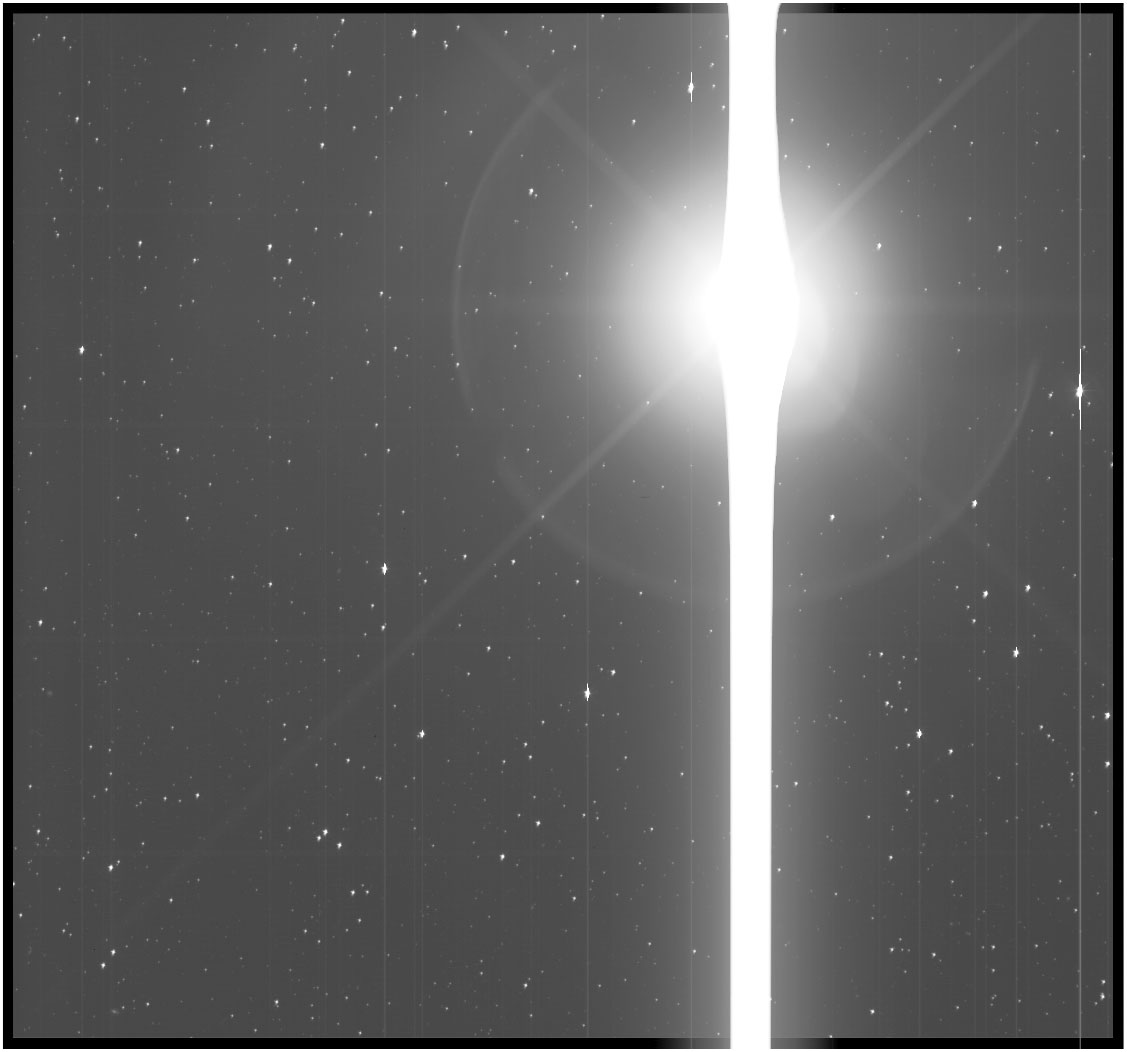
But the view of Earth from NASA’s Kepler Space Telescope is quite something else.
This Kepler image of Earth was recently beamed back home. Captured on December 10, 2017, after the spacecraft adjusted its telescope to a new field of view, Earth’s reflection as it slipped past was so extraordinarily bright that it created a saber-like saturation bleed across the instrument’s sensors, obscuring the neighboring Moon.
At 94 million miles (151 million kilometers) away, Kepler’s interpretation of Earth as a bright flashlight in a dark sea of stars demonstrates the capabilities of its highly sensitive photometer, which is designed to pick up the faint dips in the brightness of planets crossing distant stars. Some stars in this image are hundreds of light years away.
The scientific community celebrated Earth’s transit across Kepler’s field of view by using #WaveAtKepler on social media. As Kepler only takes pictures in black and white, some in the science community have taken the data and used color to highlight details in grayscale images.
The mission marks its nine-year anniversary in space on March 7. More than 2,500 planets have been found in the Kepler data so far, as well as many other discoveries about stars, supernovae, and other astrophysical phenomena. The mission is in its second extended operating phase and is known to have a limited lifetime. Its scientific success in discovering distant planets has paved the way for Transiting Exoplanet Survey Satellite (TESS), which is launching on April 16. TESS will monitor more than 200,000 of the brightest and nearest stars outside our solar system for transiting planets.
Never miss a breakthrough: Join the SciTechDaily newsletter.
Follow us on Google and Google News.
2 Comments
The other objects aglow not to far in the distance what are they? Look very much like radiation sobers or “spiked Stars” oh we all forgot that discovery many years back going through those “Planets too” far father but same as our lovely planet earth’s so quasar looking effect? Ever see the Black Hole Movie? Ever see the gints of bw silver going up from the astronaughts thith a few pop up moon walks lifting them back to there feet? Yea the earth is so bright it blotted the moon out by its sonoluminessess. One man calim he knows what happened before creation too. What issue of Sci-Fi Science is this edition. If I had to give money to research like this or buying a Xerox copy of a blank piece of paper or a e-ckeck to NASA. Oh creation it’s not GOD its CGI. And the stories keep getting better on down the line. Give a Turkey at Christmas rather then a 2 million dollar annuity check that cannot be touched or cashed by the repentance as long as they require it in this stimulation guaranteeing a burden off the economy plus keeping housing maintained too no more GARYINAZATION of the USA! GEE that’s a though thing to do my friends vs this other things like these wonder images of Planet Earth and current Obama care that could covered by this idea without communists, socialist RIGHT WING OR LEFT WING just be like a Real eagle Minded solution with TWO wings and it fly’s the correct way. This bumble bee can actually can FLY I DON’T BELIEVE IT! Its Beautiful! Lives and Economy in Motion. The earth has just blinded me with WISDOM! You better think before it stays too late!
King James Bible
Wilt thou set thine eyes upon that which is not? for riches certainly make themselves wings; they fly away as an eagle toward heaven.
NASA WE HAVE A PROBLEM “THE EAGLE AS LANDED” but the earths so bright where are we again? Beep
Silver Glints, straight up or down from dull to saber bright and wide light intensity against those stage wires is hard to hide! Your idea of taking care of people with an annuity that is non-touchable and pays a steady income to the needy so long as needed is the FIRST WORTHY IDEA I HAVE EVER SEEN! Brovo! Plus business will boom and lives of the follow up generations with seek out new work and self worth indeed. The taxes for NASA to wacky heath care that can be all removed and replaced. Another tax is not needed this fix between the wings problems that’s heading no place being to lopsided and not flapping together to a real solution or long term goal! Space is not the final frontier. We have enough problems here on earth without sticking our heads into a as you call a “Science Fiction SCIENCE PROJECT” black holes in space and make them go way the way the current system is now.