
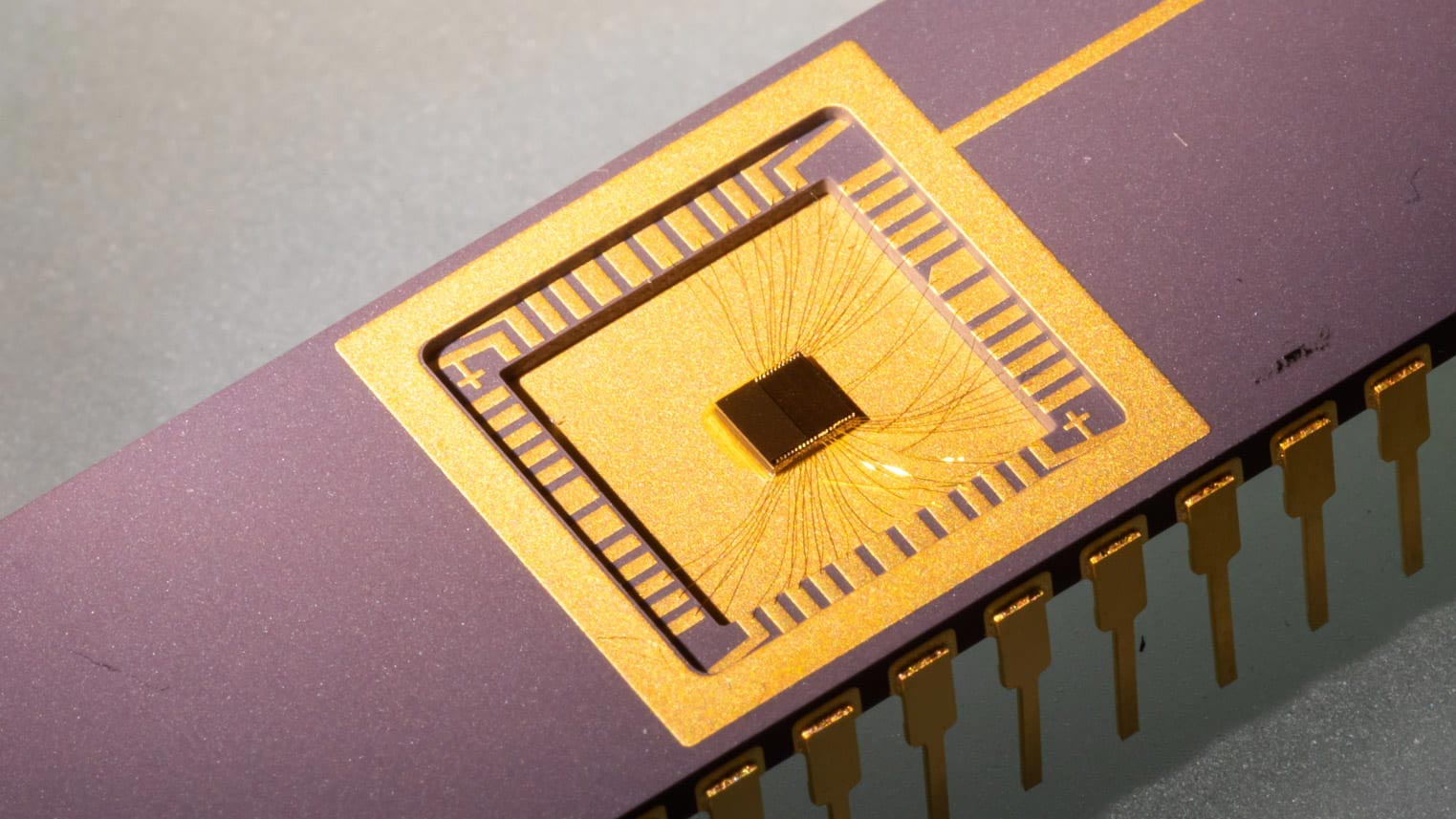
Researchers build circuit that harnessed the atomic motion of graphene to generate an electrical current that could lead to a chip to replace batteries.
A team of University of Arkansas physicists has successfully developed a circuit capable of capturing graphene’s thermal motion and converting it into an electrical current.
“An energy-harvesting circuit based on graphene could be incorporated into a chip to provide clean, limitless, low-voltage power for small devices or sensors,” said Paul Thibado, professor of physics and lead researcher in the discovery.
The findings, published in the journal Physical Review E, are proof of a theory the physicists developed at the U of A three years ago that freestanding graphene — a single layer of carbon atoms — ripples and buckles in a way that holds promise for energy harvesting.
The idea of harvesting energy from graphene is controversial because it refutes physicist Richard Feynman’s well-known assertion that the thermal motion of atoms, known as Brownian motion, cannot do work. Thibado’s team found that at room temperature the thermal motion of graphene does in fact induce an alternating current (AC) in a circuit, an achievement thought to be impossible.
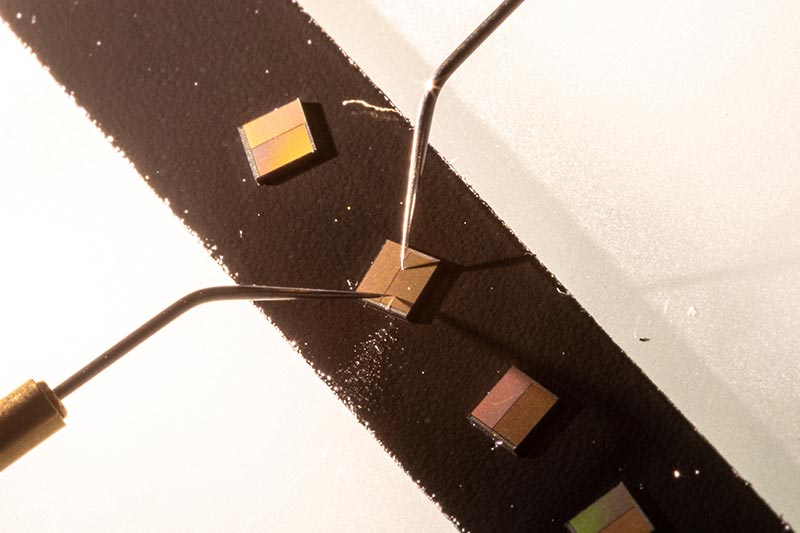
In the 1950s, physicist Léon Brillouin published a landmark paper refuting the idea that adding a single diode, a one-way electrical gate, to a circuit is the solution to harvesting energy from Brownian motion. Knowing this, Thibado’s group built their circuit with two diodes for converting AC into a direct current (DC). With the diodes in opposition allowing the current to flow both ways, they provide separate paths through the circuit, producing a pulsing DC current that performs work on a load resistor.
Additionally, they discovered that their design increased the amount of power delivered. “We also found that the on-off, switch-like behavior of the diodes actually amplifies the power delivered, rather than reducing it, as previously thought,” said Thibado. “The rate of change in resistance provided by the diodes adds an extra factor to the power.”
The team used a relatively new field of physics to prove the diodes increased the circuit’s power. “In proving this power enhancement, we drew from the emergent field of stochastic thermodynamics and extended the nearly century-old, celebrated theory of Nyquist,” said coauthor Pradeep Kumar, associate professor of physics and coauthor.
According to Kumar, the graphene and circuit share a symbiotic relationship. Though the thermal environment is performing work on the load resistor, the graphene and circuit are at the same temperature and heat does not flow between the two.
Thibado’s energy-harvesting circuit uses the atomic motion of graphene to generate an electrical current that can perform work. Credit: Illustration by Ashley Acord.
That’s an important distinction, said Thibado, because a temperature difference between the graphene and circuit, in a circuit producing power, would contradict the second law of thermodynamics. “This means that the second law of thermodynamics is not violated, nor is there any need to argue that ‘Maxwell’s Demon’ is separating hot and cold electrons,” Thibado said.
The team also discovered that the relatively slow motion of graphene induces current in the circuit at low frequencies, which is important from a technological perspective because electronics function more efficiently at lower frequencies.
“People may think that current flowing in a resistor causes it to heat up, but the Brownian current does not. In fact, if no current was flowing, the resistor would cool down,” Thibado explained. “What we did was reroute the current in the circuit and transform it into something useful.”
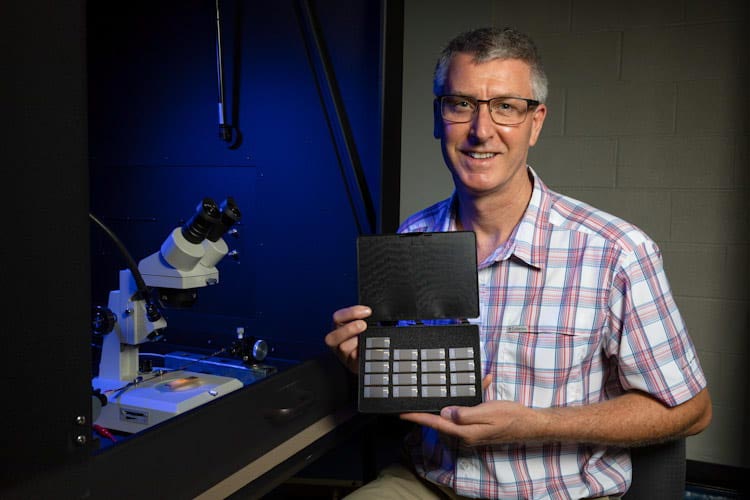
The team’s next objective is to determine if the DC current can be stored in a capacitor for later use, a goal that requires miniaturizing the circuit and patterning it on a silicon wafer, or chip. If millions of these tiny circuits could be built on a 1-millimeter by 1-millimeter chip, they could serve as a low-power battery replacement.
Reference: “Fluctuation-induced current from freestanding graphene” by P. M. Thibado, P. Kumar, Surendra Singh, M. Ruiz-Garcia, A. Lasanta and L. L. Bonilla, 2 October 2020, Physical Review E.
DOI: 10.1103/PhysRevE.102.042101
The University of Arkansas holds several patents pending in the U.S. and international markets on the technology and has licensed it for commercial applications through the university’s Technology Ventures division. Researchers Surendra Singh, a University Professor of Physics; Hugh Churchill, associate professor of physics; and Jeff Dix, assistant professor of engineering, contributed to the work, which was funded by the Chancellor’s Commercialization Fund supported by the Walton Family Charitable Support Foundation.
Never miss a breakthrough: Join the SciTechDaily newsletter.
Follow us on Google and Google News.
9 Comments
yeah but if you put enough of those small chips on a motherboard say for a computer or laptop and they had it an ability to have an onboard AC DC power converter in a PSU or in a power brick for a laptop going from DC to AC then you can not only have wireless once the thing is charged up in theory all you need to do is turn it on and itself charges because every chip is a battery in and of itself including the CPU the GPU ssds ram everything cuz everything that has a chip set acts like a small battery and if one goes down another one keeps the thing running the only thing that makes the b side possible on any electronic device say a smartphone or gaming laptop or a desktop or smart TV is post first quick charge with a barrel Port from an AC DC converter box is the OS software alone on set devices the question is how many chips can you put on that are all so cooling yet can also act a small batteries with inside a motherboard itself along with the CPU acting like a battery the GPU also acting like a battery the SSD acting like a battery the ram acting like batteries and other chipsets that control things such as the sound the heat the chipsets northbridge southbridge for instance acting as batteries as well due to the voltage they put in and out? in theory you can make every single transition transistor capacitor into a mini battery and a power supply a motherboard and also a CPU and GPU all you need to do is give it one quick gel to say 10 minutes from power cord from an AC DC converter box and then all of a sudden the thing is wireless is a zombie PC it doesn’t need or a zombie phone it doesn’t need to be charged again the only thing that makes it kill it is the software and the battery itself meaning the board.
A remarkable design. Inevitably, the harvested energy must come from the chip’s environment, presumably causing a cooling effect.Will heating the chip”s environment increase the output?
Way over hyped! “Limitless”, etc. As a physicist, this might be to me academically interesting but not deserving of such hyperbole. Just an interesting notation.
Poorly written. Entropy rules here folks. This is not news really.
Nothing in our universe is infinite, including the universe. So this title of “limitless” is just poor writing.
Poor writing? How about John-Paul Hunt’s ungrammatic stream of consciousness projectile vomiting? Was he asleep in grammar school when they did grammar? No doubt he thinks it’s cool, but shows laziness and disrespect for the reader.
OMG -agree, what a mess!
🙂
This article is almost incoherent, and the explanation of the phenomena and results is almost exactly the opposite of the referenced paper.
A thermal differential, in this case, a thermal bath, is REQUIRED for the circuit to generate power, as would be expected.
In addition, the power dissipated by the resistor is EXACTLY THE SAME as the power generated by the graphene.
I presume scitechdaily can no longer afford to compensate competent technical editors?
This isn’t just hype, this report has clearly lied. I am now blocking Scitechdaily on all my devices.