
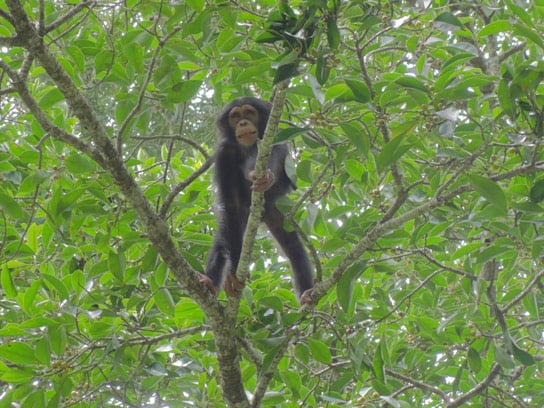
New research from the Max Planck Institute for Evolutionary Anthropology shows that wild chimpanzees plan their breakfast time, type, and location when food supplies are short.
How do our close relatives, the chimpanzees, acquire sufficient food when times are lean? By studying wild chimpanzees in the Taï National Park in Côte d’Ivoire researchers of the Max Planck Institute for Evolutionary Anthropology in Leipzig, Germany, provide a clear example of how great apes can acquire extra energy needed to maintain large, costly brains. They show that chimpanzees make their sleeping nests more en route to breakfast sites containing fruits that are more competed for by other daytime fruit-eaters than other fruits. Moreover, the researchers found that they leave their nest earlier (and often in the dark when leopards are more likely to attack) for these fruits in order to arrive before others, especially when the breakfast sites were far away.
Not all tropical fruits are equally desired by rainforest foragers and some fruit trees get depleted more quickly and carry fruit for shorter periods than others. Researchers from the Max Planck Institute for Evolutionary Anthropology have now investigated whether a ripe-fruit specialist, the chimpanzee, arrived earlier at breakfast sites with very ephemeral and highly sought-after fruit, like figs, than sites with less short-lived fruit that can be more predictably obtained throughout the entire day.
To this aim, Karline Janmaat and her colleagues recorded when and where five adult female chimpanzees spent the night and acquired food for a total of 275 full days during three fruit-scarce periods in the west-African Taï National Park in Côte d’Ivoire. The researchers found that chimpanzees left their sleeping nests earlier (often before sunrise when the forest is still dark) when breakfasting on very ephemeral fruits, especially when they were further away. “It was thrilling to see chimpanzee mums and their young carefully treading the forest floor during twilight, behaving skittish and on guard while moving towards their early morning breakfast figs. One-fifth of these mornings they left before sunrise and the rest of the forest seemed sound asleep”, says Karline Janmaat. “It got even more exciting when our analyses indicated that they were departing earlier when the figs were far away and that the females were likely making up for travel time to arrive before competitors!”
Furthermore, the researchers found that the females positioned their sleeping nests more in the direction of the next day’s breakfast sites with ephemeral fruit compared to breakfast sites with other fruit. By analyzing departure times and nest positioning as a function of fruit type and location, while controlling for more parsimonious explanations such as weather conditions, they found evidence that wild chimpanzees flexibly plan their breakfast time, type, and location after weighing multiple disparate pieces of information. “When following chimpanzees in the forest, I have always had the feeling they know much more than me. This study helps to clarify some parts of this feeling; chimpanzees before making their night nests to sleep were as well planning for their breakfast tree the next morning!”, says Christophe Boesch, director of the Department of Primatology at the Max Planck Institute for Evolutionary Anthropology.
The study reveals a cognitive mechanism by which large-brained primates can buffer the effects of seasonal declines in food availability and increased inter-specific competition to facilitate first access to nutritious food. This may have been particularly important for hominoids, like early humans, that specialized on stationary, energy-rich, and highly ephemeral food, such as ripe fruit, abandoned meat carcasses, or aquatic fauna trapped in receding waters. “Long-term, detailed information from the field can reveal the value of high levels of cognition and behavioral flexibility for efficiently obtaining critical food resources in complex environments. Being able to reveal how environmental complexity can shape cognitive-based behavior is especially exciting”, says co-author Leo Polansky.
Reference: “Wild chimpanzees plan their breakfast time, type and location” by Karline R. L. Janmaat, Leo Polansky, Simone Dagui Ban and Christophe Boesch, 27 October 2014, PNAS.
DOI: 10.1073/pnas.1407524111
Never miss a breakthrough: Join the SciTechDaily newsletter.
Follow us on Google and Google News.