
MIT and Yale researchers have developed a new framework for understanding how growing entities like bacteria adapt their shapes when confined, revealing significant implications for biofilm behavior and material deformation.
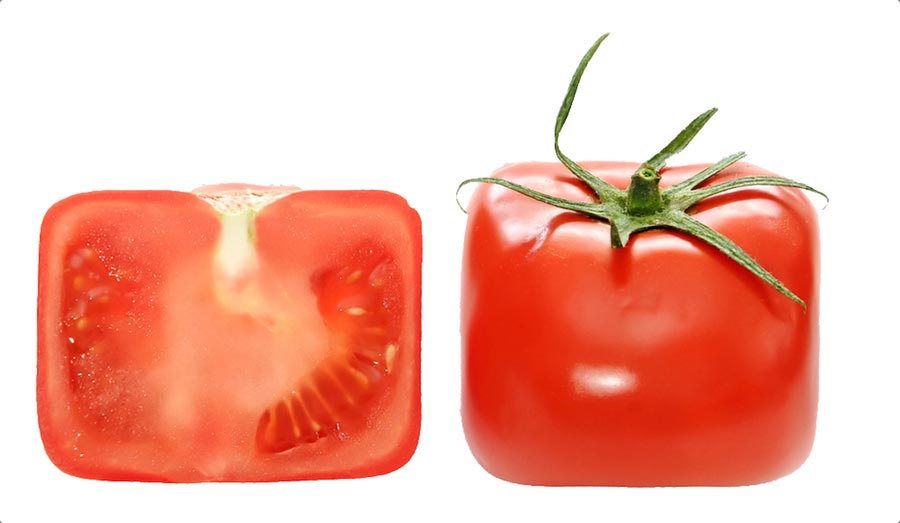
Grow a tomato inside a square box, and you’ll end up with a square tomato. It’s an experiment that shows clearly how confinement can influence a body’s evolving shape.
Now, MIT and Yale University researchers have developed a theoretical framework to explain the mechanics of how growing bodies respond to confinement. To test their theory, a research team led by Tal Cohen, MIT associate professor of civil and environmental engineering and of mechanical engineering, grew cholera bacteria inside a soft gel, observing the architecture of the expanding bacterial biofilms at single-cell resolution as they grew 10,000 times larger.
Following the theory, the biofilms adopt growth paths that optimize their shape in response to confinement and to damage in the surrounding gel as it deforms to contain the biofilm, according to the study published in the Journal of the Mechanics and Physics of Solids.
The study of inclusion problems was revolutionized in the 1950s by British scientist John Eshelby, but the work by Cohen and colleagues is a significant step forward, says Pradeep Sharma, the M.D. Anderson Chair Professor of Mechanical Engineering at the University of Houston.
“One of the key limitations of Eshelby’s work is that it is restricted to materials that deform only slightly. However, we routinely encounter contexts where the deformations are hardly ‘slight,’” explains Sharma, who was not part of the MIT-Yale study. “Cohen and co-workers have ingeniously solved the Eshelby’s inclusion problem for large deformations. Inclusion problems in soft matter like gels, elastomers used in soft robotics, biological membranes, how cells interact in tissues are now accessible thanks to Cohen’s paper.”
Researchers would like to learn more about how biofilms grow, since they can contribute to antibiotic resistance and mechanical fouling of boats and water filtration systems. But the findings by Cohen and colleagues also apply to a variety of confined growth scenarios, from a precipitate forming inside a metallic alloy to a tumor growing in the lung.
Smooshed Spheres
Scientists have studied the interplay between growth and environmental stress for confined bodies or inclusions for 70 years. These studies use a linear framework to understand the relationship — the more force the growing body placed on its confining boundaries, the more displacement those boundaries experienced.
But the behavior of materials in the real world is much more complicated, Cohen explains. Pushed by a growing body, the confining boundaries might resist displacement, or might break down. The relationship is always evolving as the changing shape of the inclusion interacts with the changing responses of its enclosing material. Cohen’s lab specializes in studying these nonlinear effects in solid materials. The nonlinear inclusion theory developed by the researchers predicted significant differences in inclusion shapes depending on their growing environments. In the case of the biofilms, bacteria formed an oblate or “smooshed” sphere instead of a regular sphere when the surrounding material was stiffer.
The biofilm experimental system was important for refining their theory, says Cohen. “Actually observing these enormous deformations happening internally in a material in a very controlled way would have been very hard without it.”
The experiments and theory are a starting point, Cohen adds. For instance, the researchers are also curious about how their theory could account for the way nutrients diffuse in a growing system, and whether “that could explain to us even better the coupling between the constraints and the growth itself,” she says.
Understanding how inclusions grow — and maybe how and why they stop growing, or how they cause damage in their surrounding body — could be important for addressing tumor growth, she suggests. The theory could also be applied to metal processing, to better control the growth and stresses created by a precipitate in metal to create alloys with different features.
Different Approach to Growth
The extreme example of a bacterial biofilm growing 10,000 times bigger is at the heart of what Cohen’s lab works on. She and her students are interested in what happens to materials when they are pushed to their limits. The push could come from extreme loading, or a shock wave, or the stresses related to growth.
Cohen says her lab looks at growth in a different way than most, however. Most people start with an observation. They see a tree, for example, they hypothesize about how it grows, and then create a theory that reproduces the observation.
Cohen and her colleagues instead begin by examining the basics of growth itself. “We dissect a system and try to understand it microscopically,” she says, “and ask, ‘what are the basic mechanisms that are generating growth here?’ And hopefully, we can find the physical principles that induce different morphologies.”
The researchers then ask what a system with these principles could grow into. This open-ended approach, Cohen says, makes their theories useful across a variety of problems in biology and physical systems.
Reference: “Nonlinear inclusion theory with application to the growth and morphogenesis of a confined body” by Jian Li, Mrityunjay Kothari, S. Chockalingam, Thomas Henzel, Qiuting Zhang, Xuanhe Li, Jing Yan and Tal Cohen, 17 November 2021, Journal of the Mechanics and Physics of Solids.
DOI: 10.1016/j.jmps.2021.104709
This work required a team effort to combine advanced analytical, computational, and experimental tools. The lead authors, Jian Li and Mrityunjay Kothari, both MIT postdocs, spearheaded the computational and analytical efforts, respectively. MIT PhD students Chockalingam Senthilnathan, Thomas Henzel, and Xuanhe Li contributed to the theoretical effort. The experiments were conducted by Qiuting Zhang, a postdoc at Yale University in the group of Assistant Professor Jing Yan.
The research was supported by the Office of Naval Research and the National Science Foundation.
Never miss a breakthrough: Join the SciTechDaily newsletter.
Follow us on Google and Google News.