
Close Menu
    Facebook X (Twitter) Instagram
    SciTechDaily
    • Biology
    • Chemistry
    • Earth
    • Health
    • Physics
    • Science
    • Space
    • Technology
    Facebook X (Twitter) Pinterest YouTube RSS
    SciTechDaily
    Home»Technology»New Camouflage System Automatically Mimics Its Surroundings
    Technology

    New Camouflage System Automatically Mimics Its Surroundings

    By Jeannie Kever, University of HoustonAugust 20, 2014No Comments3 Mins Read
    Facebook Twitter Pinterest Telegram LinkedIn WhatsApp Email Reddit
    Share
    Facebook Twitter LinkedIn Pinterest Telegram Email Reddit
    New Camouflage Technology Mimics Its Surroundings
    Researchers have developed a technology that allows a material to automatically read its environment and adapt to mimic its surroundings.

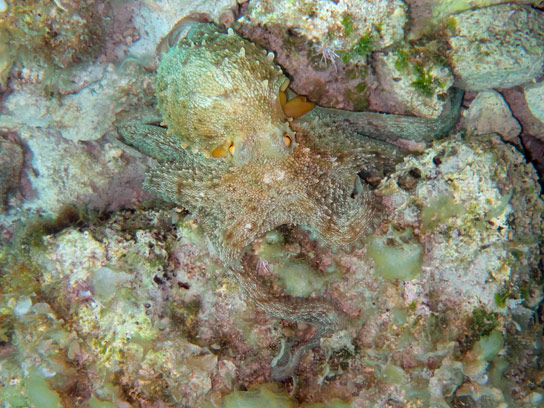
    A new optoelectronic camouflage system inspired by the skins of cephalopods automatically reads its environment and adapts to mimic its surroundings.

    It could be a fun party trick – put your cell phone down on a table and watch it fade into the woodwork – or part of a lifesaving technology used by industry or the military.

    Researchers have developed a technology that allows a material to automatically read its environment and adapt to mimic its surroundings. The technology is described in a paper published this week in the Proceedings of the National Academy of Sciences.

    Cunjiang Yu, assistant professor of mechanical engineering at the University of Houston and lead author of the paper, said the optoelectronic camouflage system was inspired by the skins of cephalopods, a class of marine animals including octopuses, squid and cuttlefish, which can change coloration quickly, both for camouflage and as a form of warning.

    Other researchers on the project include John A. Rogers of the University of Illinois at Urbana-Champaign and Yonggang Huang of Northwestern University.

    Earlier camouflage systems didn’t automatically adapt, he said. “Our device sees color and matches it. It reads the environment using thermochromatic material.”

    The prototype developed by the researchers works in black and white, with shades of gray, but Yu said it could be designed to work in the full-color spectrum. Similarly, he said while the prototype is less than one-inch square, it can be easily scaled up for manufacturing.

    The flexible skin of the device is comprised of ultrathin layers, combining semiconductor actuators, switching components, and light sensors with inorganic reflectors and organic color-changing materials in such a way to allow autonomous matching to background coloration.

    The researchers describe their work as including pixelated devices that include analogs to each of the key elements included in the skin of cephalopods, with two exceptions, the iridophores and central ocular organs.

    While the most valuable applications would be for defense or industry, Yu said consumer applications such as toys and wearable electronics also could offer a market for such a technology.

    Another possibility? Luxury carmakers now try to give a car’s occupants the sensation that the car has disappeared by deploying cameras to shoot videos on the passenger side of the car and using LED mats to display the view. Yu said this technology could be incorporated for a similar purpose.

    Reference: “Adaptive optoelectronic camouflage systems with designs inspired by cephalopod skins” by Cunjiang Yu, Yuhang Li, Xun Zhang, Xian Huang, Viktor Malyarchuk, Shuodao Wang, Yan Shi, Li Gao, Yewang Su, Yihui Zhang, Hangxun Xu, Roger T. Hanlon, Yonggang Huang and John A. Rogers, 18 August 2014, PNAS.
    DOI: 10.1073/pnas.1410494111

    Never miss a breakthrough: Join the SciTechDaily newsletter.
    Follow us on Google and Google News.

    Camouflage Materials Science University of Houston
    Share. Facebook Twitter Pinterest LinkedIn Email Reddit

    Related Articles

    Organic Semiconductor Nanotubes Used To Create High-Performance Electrochemical Actuator

    Machine Learning Boosts the Search for New “Superhard” Materials

    Solid-Oxide Fuel Cell That Converts Hydrogen Into Electricity Also Capable of Battery-Like Storage

    Spray Paint Battery Can be Painted on Virtually Any Surface

    Nano-Sandwich Design Results in Slimmer Solar Cells With Decreased Costs

    SLIPS Prevents Ice From Sticking on Metal Surfaces

    3D Self-Assembling Polymer Materials Could Lead to New Microchips

    Elastomeric “Soft” Robots Running on Pneumatic Actuators

    Researchers Develop World’s Lightest Material

    Leave A Reply Cancel Reply

    • Facebook
    • Twitter
    • Pinterest
    • YouTube

    Don't Miss a Discovery

    Subscribe for the Latest in Science & Tech!

    Trending News

    Popular Supplement Ingredient Linked to Shorter Lifespan in Men

    Scientists May Have Found a Way To Repair Nerve Damage in Multiple Sclerosis

    “Totally Unexpected” – Scientists Discover Pancreatic Cancer’s Fatal Addiction

    A Strange Quantum Effect May Explain One of Biology’s Greatest Mysteries

    James Webb Telescope Reveals the Universe’s Hidden Cosmic Web in Stunning Detail

    Scientists Identify Simple Supplement That Greatly Reduces Alzheimer’s Damage

    You May Have a Dangerous Type of Cholesterol Even if Your Tests Look Normal

    Your Blood Pressure Reading Could Be Wrong Because of One Simple Mistake

    Follow SciTechDaily
    • Facebook
    • Twitter
    • YouTube
    • Pinterest
    • Newsletter
    • RSS
    SciTech News
    • Biology News
    • Chemistry News
    • Earth News
    • Health News
    • Physics News
    • Science News
    • Space News
    • Technology News
    Recent Posts
    • Scientists Discover Hidden “Switch” That Burns Fat and Could Treat Bone Disease
    • Deadly Hantavirus Outbreak on Cruise Ship Sparks Global Health Alert
    • New Research Reveals Certain Fats Can Either Trigger or Suppress Cancer
    • After 50 Years of Mystery, Researchers Identify New Human Blood Group
    • Leading Climate Scientist Rebuts “Factually Incorrect” US Government Climate Claims
    Copyright © 1998 - 2026 SciTechDaily. All Rights Reserved.
    • Science News
    • About
    • Contact
    • Editorial Board
    • Privacy Policy
    • Terms of Use

    Type above and press Enter to search. Press Esc to cancel.