
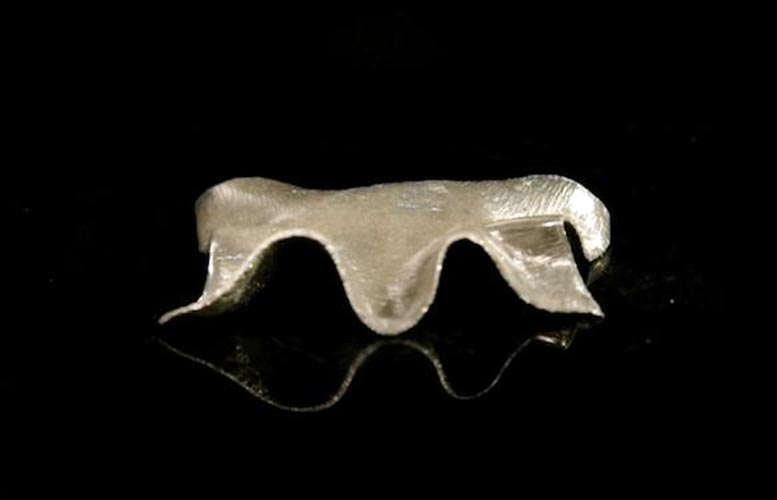
Advances in the fields of soft robotics, wearable technologies, and human/machine interfaces require a new class of stretchable materials that can change shape adaptively while relying only on portable electronics for power. Researchers at Carnegie Mellon University have developed such a material that exhibits a unique combination of high electrical and thermal conductivity with actuation capabilities that are unlike any other soft composite.
In findings published in Proceedings of the National Academy of Sciences on October 7, 2019, the researchers report on this intelligent new material that can adapt its shape in response to its environment. The paper is titled “A multifunctional shape-morphing elastomer with liquid metal inclusions.”
“It is not only thermally and electrically conductive, it is also intelligent,” said Carmel Majidi, an associate professor of mechanical engineering who directs the Soft Machines Lab at Carnegie Mellon. “Just like a human recoils when touching something hot or sharp, the material senses, processes, and responds to its environment without any external hardware. Because it has neural-like electrical pathways, it is one step closer to artificial nervous tissue.”
Majidi is a pioneer in developing new classes of materials for use in soft matter engineering and soft robotics. His research team has previously created advanced material architectures using deformable liquid metal micro- and nano-droplets of gallium indium. This is the first time that his lab has combined this technique with liquid crystal elastomers (LCEs), a type of shape-morphing rubber. Majidi and his research team collaborated with LCE expert Taylor Ware, a professor of bioengineering at the University of Texas, Dallas, and his graduate student, Cedric Ambulo.
LCEs are like liquid crystals used in flat-panel displays but linked together like rubber. Because they move when they are exposed to heat, they hold promising functionality as a shape-morphing material; unfortunately, they lack the electrical and thermal conductivity needed for shape memory activation. Although rigid fillers can be incorporated to enhance conductivity, these cause the mechanical properties and the shape-morphing capabilities of LCEs to degrade. The researchers overcame these challenges by combining the liquid metal gallium indium with the LCEs to create a soft, stretchable composite with unprecedented multifunctionality.
Another key feature of the material is its resilience and response to significant damage.
“We observed both electrical self-healing and damage detection capabilities for this composite, but the damage detection went one step further than previous liquid metal composites,” explained Michael Ford, a postdoctoral research associate in the Soft Machines Lab and the lead author of the study. “Since the damage creates new conductive traces that can activate shape-morphing, the composite uniquely responds to damage.”
The material’s high electrical conductivity allows the composite to interface with traditional electronics, respond dynamically to touch, and change shape reversibly. It could be used in any application that requires stretchable electronics: healthcare, clothing, wearable computing, assistance devices and robots, and space travel.
###
Reference: “A multifunctional shape-morphing elastomer with liquid metal inclusions” by Michael J. Ford, Cedric P. Ambulo, Teresa A. Kent, Eric J. Markvicka, Chengfeng Pan, Jonathan Malen, Taylor H. Ware and Carmel Majidi, 7 October 2019, Proceedings of the National Academy of Sciences.
DOI: 10.1073/pnas.1911021116
Majidi also holds a courtesy appointment in the Department of Materials Science and Engineering and the Robotics Institute at Carnegie Mellon University. Other Carnegie Mellon authors include Jonathan Malen, a professor of mechanical engineering, graduate students Teresa Kent and Chengfeng Pan, and alumnus Eric Markvicka, now an assistant professor at the University of Nebraska-Lincoln.
The work was funded by a grant by the Army Research Office.
Never miss a breakthrough: Join the SciTechDaily newsletter.
Follow us on Google and Google News.
1 Comment
Wow this is really cool I hope this goes in further in investment