
Close Menu
    Facebook X (Twitter) Instagram
    SciTechDaily
    • Biology
    • Chemistry
    • Earth
    • Health
    • Physics
    • Science
    • Space
    • Technology
    Facebook X (Twitter) Pinterest YouTube RSS
    SciTechDaily
    Home»Science»Our Brains Encode Musical Predictions Even When Music Doesn’t Play
    Science

    Our Brains Encode Musical Predictions Even When Music Doesn’t Play

    By Society for NeuroscienceAugust 2, 2021No Comments2 Mins Read
    Facebook Twitter Pinterest Telegram LinkedIn WhatsApp Email Reddit
    Share
    Facebook Twitter LinkedIn Pinterest Telegram Email Reddit
    Brain Activity Concept
    Researchers have found that the brain continues to make predictions even when music is not playing.

    Imagined Music and Silence Trigger Similar Brain Activity

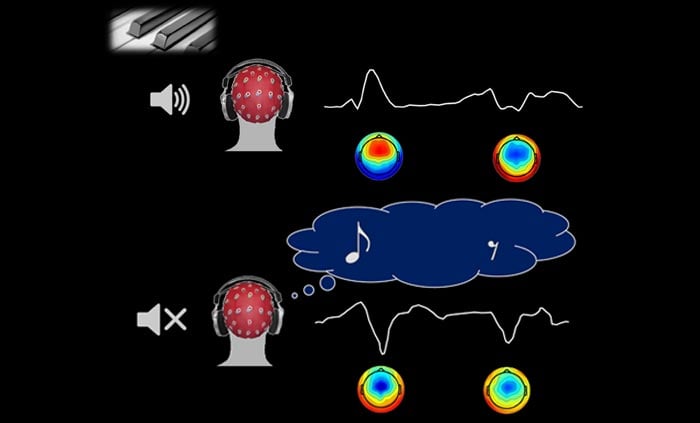
    Imagining a song triggers similar brain activity as moments of silence in music, according to a pair of studies recently published in JNeurosci. The results reveal how the brain continues responding to music, even when none is playing.

    When we listen to music, the brain attempts to predict what comes next. A surprise, such as a loud note or disharmonious chord, increases brain activity. Yet it is difficult to isolate the brain’s prediction signal because it also responds to the actual sensory experience.
    Imagined Music and Silence Trigger Similar Brain Activity
    Silence and imagined music triggered brain activity with an inverted polarity to activity from listening to music. Credit: Di Liberto, Marion, and Shamma, JNeurosci 2021

    Di Liberto, Marion, and Shamma used EEG to measure the brain activity of musicians while they listened to or imagined Bach piano melodies. Activity while imagining music had the opposite polarity of activity while listening to music, meaning when one was positive, the other was negative. The same type of activity occurred in silent moments of the songs when statistically there could have been a note, but there wasn’t.

    There is no sensory input during silence and imagined music, so this activity comes from the brain’s predictions. The research team also decoded the brain activity to determine which song someone was imagining.

    The researchers find music is more than a sensory experience for the brain. Instead, the brain keeps making predictions even when music is not playing.

    References:

    “The Music of Silence. Part I: Responses to Musical Imagery Encode Melodic Expectations and Acoustics” by Guilhem Marion, Giovanni M. Di Liberto and Shihab A. Shamma, 2 August 2021, JNeurosci.
    DOI: 10.1523/JNEUROSCI.0183-21.2021

    “The music of silence. Part II: Music Listening Induces Imagery Responses” by Giovanni M. Di Liberto, Guilhem Marion and Shihab A. Shamma, 2 August 2021, JNeurosci.
    DOI: 10.1523/JNEUROSCI.0184-21.2021

    Never miss a breakthrough: Join the SciTechDaily newsletter.
    Follow us on Google and Google News.

    Acoustics Brain Music Neuroscience Perception Society for Neuroscience
    Share. Facebook Twitter Pinterest LinkedIn Email Reddit

    Related Articles

    Nostalgia Can Relieve Pain: Viewing Images From Childhood Reduces Pain Perception

    Neuroscientists Uncover Why the Brain Enjoys Music

    “Area 32” – How the Brain Balances Emotion and Reason

    Contradicting Previous Theories, Neuroscientists Find Overlap Between Fear and Anxiety Brain Circuits

    Why Time Sometimes Flies or Drags: How the Brain Creates the Experience of Time

    Scientists Can See the Bias in Your Brain – Even Before You Make Your Decision

    The Science of a Hit Song – Unlocking the Secrets of Musical Pleasure

    Watching Music Move Through the Brain

    Listening to Mozart Can Make You Smarter but No More Than Justin Bieber

    Leave A Reply Cancel Reply

    • Facebook
    • Twitter
    • Pinterest
    • YouTube

    Don't Miss a Discovery

    Subscribe for the Latest in Science & Tech!

    Trending News

    JWST Finds a “Star” 100 Billion Times Brighter Than Any Star Should Be

    Scientists Find a Hidden Biological Link Across Different Forms of Autism

    Astronomers Discover a Ghostly River of Stars That Could Reveal Dark Matter

    Why Is Colorectal Cancer Rising in People Under 50? New Clues Point to the Environment

    Quantum Fluctuations Break a Crystal’s Symmetry Rules

    Why Does an Irregular Heartbeat Strike 40 Years Early in Some People?

    Scientists Reveal How ADHD Could Fuel Creative Thinking

    Scientists Find Just 3 Minutes of Sprinting Can Transform Blood Chemistry

    Follow SciTechDaily
    • Facebook
    • Twitter
    • YouTube
    • Pinterest
    • Newsletter
    • RSS
    SciTech News
    • Biology News
    • Chemistry News
    • Earth News
    • Health News
    • Physics News
    • Science News
    • Space News
    • Technology News
    Recent Posts
    • A 150-Million-Year-Old Dinosaur Flight Mystery May Finally Have an Answer
    • Giant Crocodylians Ruled South America’s Ancient Food Chain
    • 236-Million-Year-Old Fossil Reveals a Stunning Secret About the Origins of Mammal Birth
    • This Suitcase-Sized Spacecraft Could Detect a Signal From Before Stars Existed
    • Three Supermassive Black Holes Found in a Galaxy From the Dawn of the Universe
    Copyright © 1998 - 2026 SciTechDaily. All Rights Reserved.
    • Science News
    • About
    • Contact
    • Editorial Board
    • Privacy Policy
    • Terms of Use

    Type above and press Enter to search. Press Esc to cancel.