

Close Menu
    Facebook X (Twitter) Instagram
    SciTechDaily
    • Biology
    • Chemistry
    • Earth
    • Health
    • Physics
    • Science
    • Space
    • Technology
    Facebook X (Twitter) Pinterest YouTube RSS
    SciTechDaily
    Home»Science»Why Time Sometimes Flies or Drags: How the Brain Creates the Experience of Time
    Science

    Why Time Sometimes Flies or Drags: How the Brain Creates the Experience of Time

    By Society for NeuroscienceSeptember 14, 20203 Comments2 Mins Read
    Facebook Twitter Pinterest Telegram LinkedIn WhatsApp Email Reddit
    Share
    Facebook Twitter LinkedIn Pinterest Telegram Email Reddit
    Time Concept Illustration
    Neurons in the supramarginal gyrus (SMG) respond to specific time durations, but repetitive stimuli of the same length lead to neuron fatigue, causing a skewed perception of time.

    Time-sensitive neurons fatigue and skew our perception of time.

    On some days, time flies by, while on others it seems to drag on. A new study from JNeurosci reveals why: time-sensitive neurons get worn out and skew our perceptions of time.

    Neurons in the supramarginal gyrus (SMG) fire in response to a specific length of time. If repeatedly exposed to a stimulus of a fixed duration, the neurons fatigue. Since other neurons continue firing normally, our subjective perception of time becomes skewed.
    SMG Activity Time
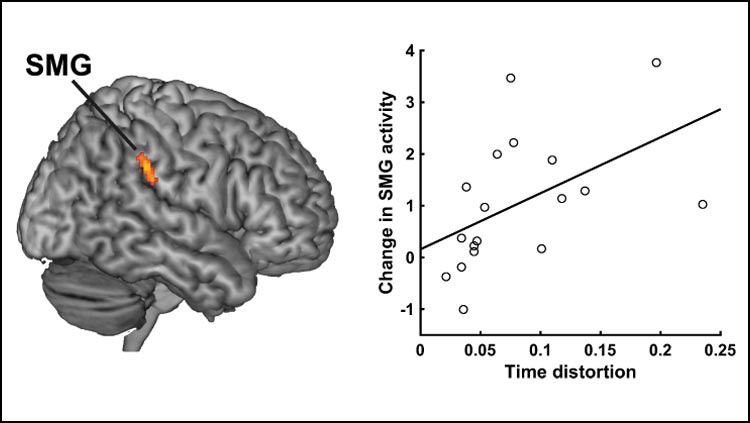
    SMG that exhibited decrease in the activity following duration adaptation (left). Correlation between the magnitude of time distortion and the change in SMG activity (right). Credit: Hayashi and Ivry, JNeurosci 2020

    Hayashi and Ivry measured brain activity with fMRI as human participants engaged in a time comparison task. Healthy adult participants viewed a visual adaptor (a grey circle) for a set length of time, 30 times in a row. After this adaptation period, they were shown a test stimulus and indicated its duration. If the adaptor duration was long, the participants underestimated time; if the adaptor duration was short, they overestimated time. Activity in the SMG decreased when the adaptor and test stimulus were similar in length, indicating neuron fatigue. The extent of skewed time perception correlated with how much the activity in the SMG decreased — greater fatigue led to greater time distortion.

    Reference: “Duration-Selectivity in Right Parietal Cortex Reflects the Subjective Experience of Time” by Masamichi J. Hayashi and Richard B. Ivry, 14 September 2020, Journal of Neuroscience.
    DOI: 10.1523/JNEUROSCI.0078-20.2020

    Never miss a breakthrough: Join the SciTechDaily newsletter.
    Follow us on Google and Google News.

    Behavioral Science Brain Neuroscience Perception Society for Neuroscience Time
    Share. Facebook Twitter Pinterest LinkedIn Email Reddit

    Related Articles

    A Mathematical Equation Can Uncover Your Preferences via Brain Activity and Mood

    Our Brains Encode Musical Predictions Even When Music Doesn’t Play

    Special “Time Neurons” in the Human Brain Encode Specific Moments in Time

    Brain Activity Reveals When White Lies Are Selfish

    Neuroscientists Track How Bad Moods Develop and Persist in the Brain

    Musicians Have Brains With Stronger Connections Than Non-musicians

    Infant Brain Circuitry Shaped by Language Exposure

    “Area 32” – How the Brain Balances Emotion and Reason

    Scientists Can See the Bias in Your Brain – Even Before You Make Your Decision

    3 Comments

    1. Deborah Wheeler Morales on September 14, 2020 10:06 am

      I wonder how they factored in the element of interest + time to/toward fatigue?
      Maybe they didn’t due to fatigue………..loll (literally loll)

      Reply
    2. Bonnie Davis on September 16, 2020 3:56 pm

      Deborah Wheeler Morales, good one!

      I have been interested in the perception of time passing as it related to one particular experience I had. Riding down a local paved road that riders use to accustom young horses to payment and the rare truck we were surprised by a runaway beefalo bull. Part cow and part buffalo it was very large. Very large. And it was a pet and very spoiled. It was about 2 miles from home and the riders behind me shoosed it home again.

      The time thing came up when Cheyenne, the horse I was on, exploded in 360 degrees. This is a phrase that means you have the impression of every muscle you are touching on the horse contracts and then releases without any net movement being achieved. However, the fact that he stopped abruptly and I did not, meant that I slid down his golden neck. I will never forget that long, long spell of time as I slowly drifted past his neck and on to the pavement. We were doing about 30mph at the time and I hit very hard. I broke 4 ribs and did not chase the beefalo back home. Nope, I had to chase myself home and it was a very long ride. Just getting back up with broken ribs was a feat of determination. I always wondered how it happens that time can slow or speed up without our apparent encouragement. Now I think I have a clue.

      Reply
    3. xABBAAA on September 23, 2020 8:32 am

      … The time flies when you trow the watch out of the window or one is approaching the speed of light.
      However, I wonder how Quantum entanglement works. What is the mechanism that enables that mechanism to work its wonders. Could the time exist at that phenomenon, or it is a glitch.

      Reply
    Leave A Reply Cancel Reply

    • Facebook
    • Twitter
    • Pinterest
    • YouTube

    Don't Miss a Discovery

    Subscribe for the Latest in Science & Tech!

    Trending News

    289-Million-Year-Old Reptile Mummy Reveals Origin of Human Breathing System

    New Brain Discovery Challenges Long-Held Theory of Teenage Brain Development

    Scientists Discover Plants “Scream” – We Just Couldn’t Hear Them Until Now

    Scientists Discover a Surprising Reason Intermittent Fasting Extends Life

    This Simple Fruit Wash Could Make Produce Safer and Last Days Longer

    Scientists Say Adding This Unusual Seafood to Your Diet Could Reverse Signs of Aging

    Scientists Say a Hidden Structure May Exist Inside Earth’s Core

    Doctors Surprised by the Power of a Simple Drug Against Colon Cancer

    Follow SciTechDaily
    • Facebook
    • Twitter
    • YouTube
    • Pinterest
    • Newsletter
    • RSS
    SciTech News
    • Biology News
    • Chemistry News
    • Earth News
    • Health News
    • Physics News
    • Science News
    • Space News
    • Technology News
    Recent Posts
    • Breakthrough Bowel Cancer Trial Leaves Patients Cancer-Free for Nearly 3 Years
    • New Immune Pathway Could Supercharge mRNA Cancer Vaccines
    • Natural Compound Shows Powerful Potential Against Rheumatoid Arthritis
    • 100,000-Year-Old Neanderthal Fossils in Poland Reveal Unexpected Genetic Connections
    • Unexpected Hormone Discovery Could Change How We Treat Arthritis
    Copyright © 1998 - 2026 SciTechDaily. All Rights Reserved.
    • Science News
    • About
    • Contact
    • Editorial Board
    • Privacy Policy
    • Terms of Use

    Type above and press Enter to search. Press Esc to cancel.