
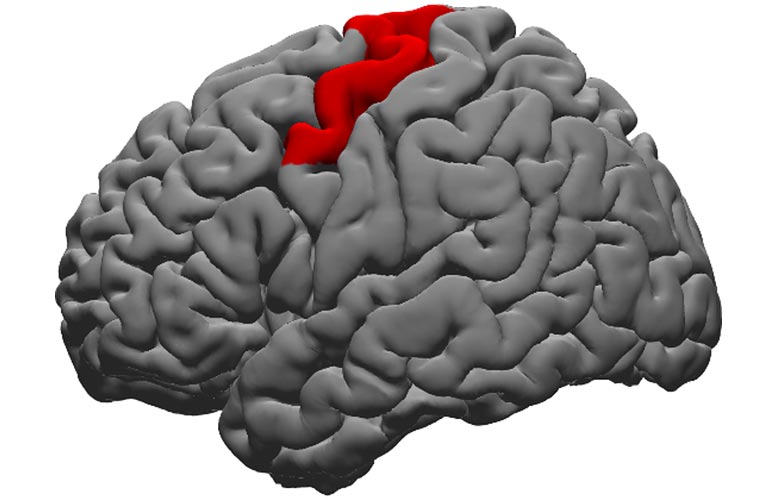
The dorsal precentral gyrus in the brain helps control speech by using voice feedback. This finding may aid in treating speech-related conditions.
A region crossing the folded surface of the top of the brain, called the dorsal precentral gyrus, plays an essential role in how people use the sound of their voices to control how they want the words to sound, a new study shows.
The ability to take cues from one’s own voice while talking, researchers say, has long been recognized as essential to fluent speech. Also recognized is each person’s ability to make possible near-immediate adaptations based on these cues, such as slowing down speech to better articulate multi-syllable words, or raising the voice to overcome loud background noise.
Led by researchers at NYU Grossman School of Medicine, the new study focuses on the half-dozen subregions of the brain’s surface layer, or cerebral cortex, because they are known to control how people move their mouth, lips, and tongue to form words, and to have a role in processing what they hear themselves saying. But the precise role of each subregion in real-time speech feedback has until now remained unclear, in part, because of the difficulties in directly accessing the brain for study while people are alive and talking.
Dominant Role of the Dorsal Precentral Gyrus
Published in the journal PLOS Biology online on February 3, 2022, results of the new investigation revealed that while three cortical regions were primarily involved in correcting errors in speech, including the superior temporal gyrus and supramarginal gyrus, only one, the dorsal precentral gyrus, dominated when delays in speech, meant to signify feedback errors, were maximized. These brief feedback delays ranged from 0 milliseconds to more than 200 milliseconds and were designed to mimic real-life slurring of speech.
“Our study confirms for the first time the critical role of the dorsal precentral gyrus in maintaining control over speech as we are talking and to ensure that we are pronouncing our words as we want to,” says study senior investigator and neuroscientist Adeen Flinker, PhD.
Dr. Flinker says the team plans further studies into the brain’s feedback mechanisms for controlling speech. In particular, the team seeks to explain whether the dorsal precentral gyrus is responsible for generating the brain’s initial memory for how spoken words are “supposed” to sound and noticing any errors in how those words were actually spoken after the “base signal” is turned into the muscle movements needed to form words.
Potential for Targeted Treatments
“Now that we believe we know the precise role of the dorsal precentral gyrus in controlling for errors in speech, it may be possible to focus treatments on this region of the brain for such conditions as stuttering and Parkinson’s disease, which both involve problems with delayed speech processing in the brain,” says Dr. Flinker, an assistant professor in the Department of Neurology at NYU Grossman School of Medicine.
For the study, researchers analyzed thousands of recordings from upwards of 200 electrodes placed in each of the brains of 15 people with epilepsy already scheduled to have routine surgery to pinpoint the source of their seizures. All patients, mostly men, and women in their 30s and 40s, were recorded in 2020 at NYU Langone, which also funded the research.
Patients volunteered to perform standardized reading tests during a planned break in their surgery, saying aloud words and short statements. All wore headphones so what they said could be recorded and played back to them as they spoke.
Researchers then recorded electrical activity inside most subregions of the patients’ brains as the patients heard themselves talking and as this feedback was increasingly delayed by milliseconds. Such audio feedback tests have been developed to safely study how the human brain learns and processes speech. By introducing errors in normal speech, researchers say they can then compare and contrast the electrical signals to determine how various parts of the brain function and control speech.
Reference: “A cortical network processes auditory error signals during human speech production to maintain fluency” by Muge Ozker, Werner Doyle, Orrin Devinsky and Adeen Flinker, 3 February 2022, PLOS Biology.
DOI: 10.1371/journal.pbio.3001493
Besides Dr. Flinker, other NYU Langone researchers involved in the study are study lead investigator Muge Ozker, PhD, and study co-investigators Werner K. Doyle, MD, and Orrin Devinsky, MD.
Never miss a breakthrough: Join the SciTechDaily newsletter.
Follow us on Google and Google News.