
Study by the University of Bonn and the TU Darmstadt suggests errors in the interpretation of older measurements.
A few years ago, a novel measurement technique showed that protons are probably smaller than had been assumed since the 1990s. The discrepancy surprised the scientific community; some researchers even believed that the Standard Model of particle physics would have to be changed. Physicists at the University of Bonn and the Technical University of Darmstadt have now developed a method that allows them to analyze the results of older and more recent experiments much more comprehensively than before. This also results in a smaller proton radius from the older data. So there is probably no difference between the values — no matter which measurement method they are based on. The study appeared in Physical Review Letters.
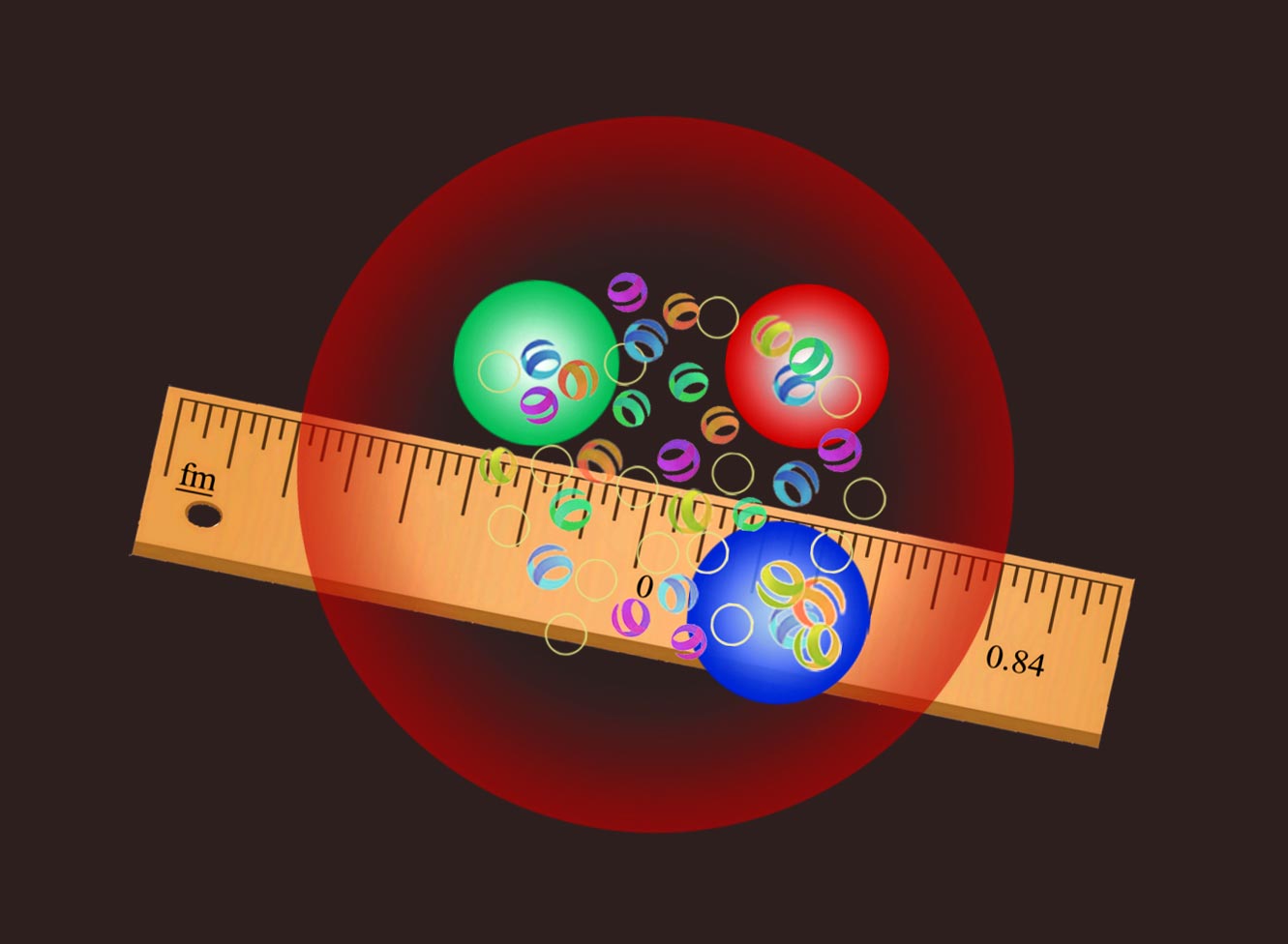
Our office chair, the air we breathe, the stars in the night sky: they are all made of atoms, which in turn are composed of electrons, protons and neutrons. Electrons are negatively charged; according to current knowledge, they have no expansion, but are point-like. The positively charged protons are different — according to current measurements, their radius is 0.84 femtometers (a femtometer is a quadrillionth of a meter).
Until a few years ago, however, they were thought to be 0.88 femtometers — a tiny difference that caused quite a stir among experts. Because it was not so easy to explain. Some experts even considered it to be an indication that the Standard Model of particle physics was wrong and needed to be modified. “However, our analyses indicate that this difference between the old and new measured values does not exist at all,” explains Prof. Dr. Ulf Meißner from the Helmholtz Institute for Radiation and Nuclear Physics at the University of Bonn. “Instead, the older values were subject to a systematic error that has been significantly underestimated so far.”
Playing Billiards in the Particle Cosmos
To determine the radius of a proton, one can bombard it with an electron beam in an accelerator. When an electron collides with the proton, both change their direction of motion — similar to the collision of two billiard balls. In physics, this process is called elastic scattering. The larger the proton, the more frequently such collisions occur. Its expansion can therefore be calculated from the type and extent of the scattering.
The higher the velocity of the electron beam, the more precise the measurements. However, this also increases the risk that the electron and proton will form new particles when they collide. “At high velocities or energies, this happens more and more often,” explains Meißner, who is also a member of the Transdisciplinary Research Areas “Mathematics, Modeling and Simulation of Complex Systems” and “Building Blocks of Matter and Fundamental Interactions.” “In turn, the elastic scattering events are becoming rarer. Therefore, for measurements of the proton size, one has so far only used accelerator data in which the electrons had a relatively low energy.”
In principle, however, collisions that produce other particles also provide important insights into the shape of the proton. The same is true for another phenomenon that occurs at high electron beam velocities — so-called electron-positron annihilation. “We have developed a theoretical basis with which such events can also be used to calculate the proton radius,” says Prof. Dr. Hans-Werner Hammer of TU Darmstadt. “This allows us to take into account data that have so far been left out.”
Five Percent Smaller Than Assumed 20 Years
Using this method, the physicists reanalyzed readings from older, as well as very recent, experiments — including those that previously suggested a value of 0.88 femtometers. With their method, however, the researchers arrived at 0.84 femtometers; this is the radius that was also found in new measurements based on a completely different methodology.
So the proton actually appears to be about 5 percent smaller than was assumed in the 1990s and 2000s. At the same time, the researchers’ method also allows new insights into the fine structure of protons and their uncharged siblings, neutrons. So it’s helping us to understand a little better the structure of the world around us — the chair, the air, but also the stars in the night sky.
Reference: “New Insights into the Nucleon’s Electromagnetic Structure” by Yong-Hui Lin, Hans-Werner Hammer and Ulf-G. Meißner, 3 February 2022, Physical Review Letters.
DOI: 10.1103/PhysRevLett.128.052002
The study was funded by the German Research Foundation (DFG), the National Natural Science Foundation of China (NSFC), the Volkswagen Foundation, the EU Horizon 2020 program, and the German Federal Ministry of Education and Research (BMBF).
Never miss a breakthrough: Join the SciTechDaily newsletter.
Follow us on Google and Google News.
5 Comments
We know better In this Kosmos what about another?!
This is a good vale to accept as previous value.
L’univers est très bien organisé. Pourqoi les scientifiques physiciens éxpérimentaux n’arrivent pas détécter les particules élémentaires fondamentales bien organisées?. Selon ma théorie
physique classique très simple, j’arrive à poser la première carte atomique (Regardez mon Facebook). Les particules sont très bien organisées. Elles témoignent que l’univers est organisé. Je pense que les scientifiques ne sont pas sur la bonne route depuis la pose de l’ équation des neutrons (N=A-Z) ils ont ajoutés (-?). Et jusqu’à présent cette fausse équation est encore inclue dedans de leurs équations avancés actuels. C’est pour cette raison que les équations de la théorie (QCD) des quarks est déviée de 1/3 des tailles du train de la physique des particules. La structure du neutron au niveau des nombres quantiques (Baryon du neutron), qui est (U=+1/3, d’1=-1/3 et D2=-1/3=0), n’est pas vraie car le neutron n’est pas en dans ce modèl, mais il est nul, c’est à dire qu’il n’a pas de masse chargée d’éléctricité, mais il a une masse non chargée comme un isolant, tandis que la structure baryonique du proton (U1=+2/3, U2=+2/3 et d=-1/3=+1), celle-ci, est juste. La vraie neutralisation universelle des particules ordinaires de fait avec:”l’éléctron”. Celui-ci, est une éxtraordinaire particule élémentaire, elle es entrée à la constitution des trois forces (Standards), et elle a neutralisée: les neutrinos éléctroniques, les quarks U2, U2 (U1=U2), lesprotons il a neutralisée tous les atomes et l’univers tout-entier, son opposée est le positron (e+), mais ce dernier n’est pas l’anti-matière de l’élévation (C’est une autre chose). Donc le neutron n’a pas la même structure que celle du proton, c’est pour cette raison que les particules élémentaires de la physique moderne, ne sont pas ordonnée. (Regardez les deux structures, de la force faible et de la force forte à mon Facebook. Il y’a donc proton et cousin du prton. Il y’a aussi quark U1=U3, et “d” est neutralisée par l’élévation de charge négative (-). Je onclu que les valeurs de masses du proton, de son cousin, du neutrino légé, des deux quarks U1, U2 et le proton, ont toutes des mêmes chiffres: 6,7,2,6,5, derrière la vergule. Le neutrino légé, lui, il contient un “0” juste après la vérgule. Et toutes ont un “0” devant la vérgule comme nombe entier naturel), tandi- qu le nombre entier naturel du proton est un “1”. Regardez bien icci, le quark “d”, lui, est aussi une particule éxtraordinaire spéciale, il est commun à toutes les trois forces Standards, aux quarks U1 et U2 et aussi aux atomes.
!!! C’est donc de la magie de l’univers et de miracle de l’univers. Aidez mois à améliorer ma théorie classique, moi aussi je vous aide pour que vous arriverez à organiser vos particules élémentaires fondamentales. Mes présents écrits, sont envoyés aux scientifiques éxpérimentaux concernés et au directeur de cette page. Merci.
Once again, the scientists have to backtrack because they were wrong, even on the basics. I’m getting more skeptical of science and “scientists” the older I get.
The scientific method inherently involves publishing results to allow the results to be checked.
If and when discrepancies are found and verified scientists update everything connected to the updated measurements. That is a feature of the scientific method – not a bug – as you would know if you knew anything about the scientific method, scientists or even science itself. Sadly your comment indicates that you don’t.