
A study reveals that dogs can differentiate between speech and non-speech and recognize languages they are familiar with versus those they are not.
Dog brains can detect speech, and show different activity patterns to a familiar and an unfamiliar language, a new brain imaging study finds. This is the first demonstration that a non-human brain can differentiate two languages. This work has been published in the journal NeuroImage.
“Some years ago I moved from Mexico to Hungary to join the Neuroethology of Communication Lab at the Department of Ethology, Eötvös Loránd University for my postdoctoral research. My dog, Kun-kun, came with me. Before, I had only talked to him in Spanish. So I was wondering whether Kun-kun noticed that people in Budapest spoke a different language, Hungarian.” — says Laura V. Cuaya, first author of the study. “We know that people, even preverbal human infants, notice the difference. But maybe dogs do not bother. After all, we never draw our dogs’ attention to how a specific language sounds. We designed a brain imaging study to find this out.”

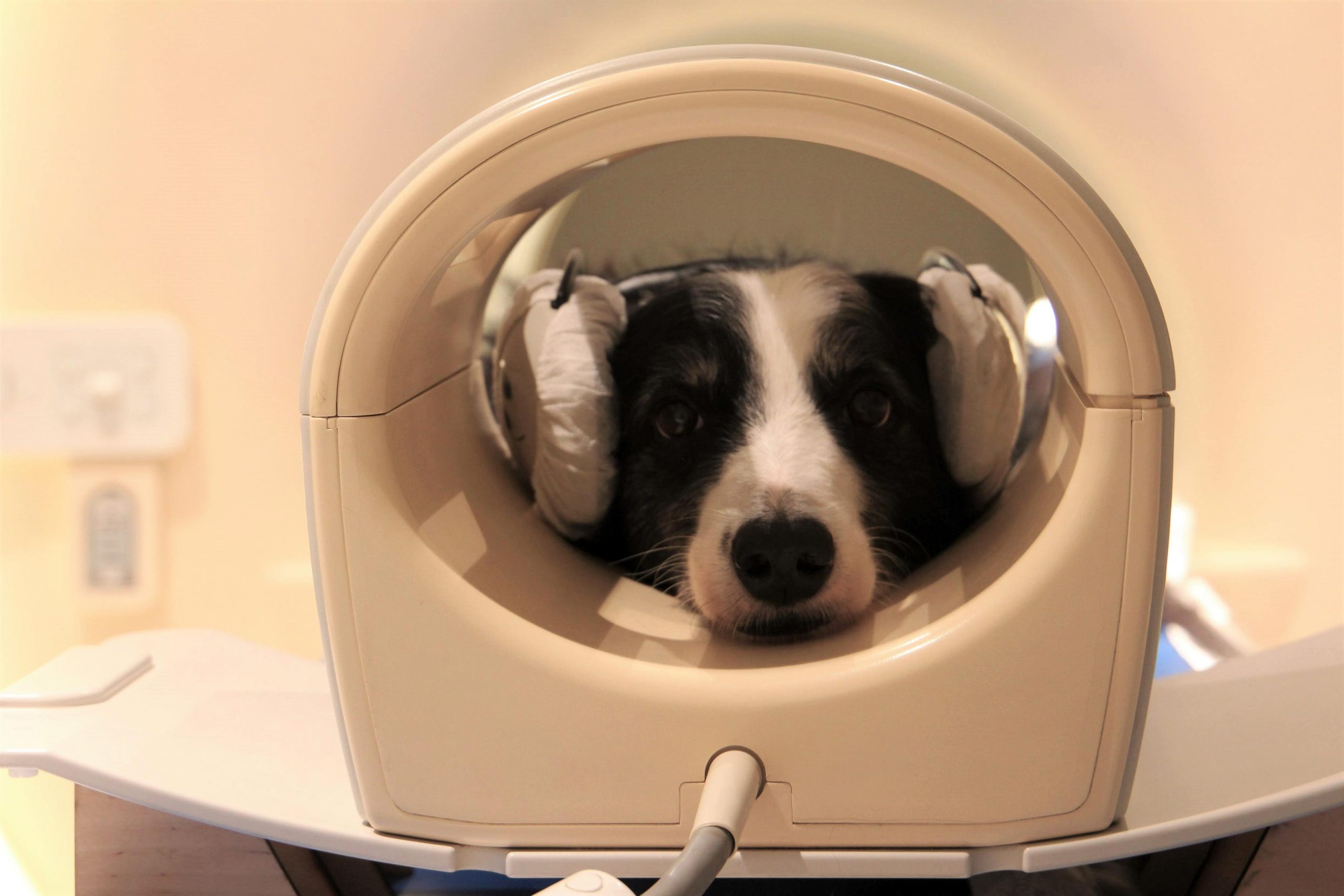
Kun-kun and 17 other dogs were trained to lay motionless in a brain scanner, where we played them speech excerpts of The Little Prince in Spanish and Hungarian. All dogs had heard only one of the two languages from their owners, so this way we could compare a highly familiar language to a completely unfamiliar one. We also played dogs scrambled versions of these excerpts, which sound completely unnatural, to test whether they detect the difference between speech and non-speech at all.”
When comparing brain responses to speech and non-speech, researchers found distinct activity patterns in dogs’ primary auditory cortex. This distinction was there independently from whether the stimuli originated from the familiar or the unfamiliar language. There was, however, no evidence that dog brains would have a neural preference for speech over non-speech.
“Dog brains, like human brains, can distinguish between speech and non-speech.”
But the mechanism underlying this speech detection ability may be different from speech sensitivity in humans: whereas human brains are specially tuned to speech, dog brains may simply detect the naturalness of the sound,” explains Raúl Hernández-Pérez, coauthor of the study.
In addition to speech detection, dog brains could also distinguish between Spanish and Hungarian.

These language-specific activity patterns were found in another brain region, the secondary auditory cortex. Interestingly, the older the dog was, the better their brain distinguished between the familiar and the unfamiliar language. “Each language is characterized by a variety of auditory regularities. Our findings suggest that during their lives with humans, dogs pick up on the auditory regularities of the language they are exposed to,” says Hernández-Pérez.
“This study showed for the first time that a non-human brain can distinguish between two languages.”
It is exciting, because it reveals that the capacity to learn about the regularities of a language is not uniquely human. Still, we do not know whether this capacity is dogs’ specialty, or general among non-human species. Indeed, it is possible that the brain changes from the tens of thousand years that dogs have been living with humans have made them better language listeners, but this is not necessarily the case. Future studies will have to find this out” — concludes Attila Andics, senior author of the study.
“And if you wonder how Kun-kun is doing after moving to Budapest: he leaves just as happily as he lived in Mexico City – he saw snow for the first time and he loves swimming in the Danube. We hope that he and his friends will continue to help us uncover the evolution of speech perception,” says Cuaya.
Reference: “Speech naturalness detection and language representation in the dog brain” by Laura V. Cuaya, Raúl Hernández-Pérez, Marianna Boros, Andrea Deme and Attila Andics, 12 December 2021, NeuroImage.
DOI: 10.1016/j.neuroimage.2021.118811
This research was funded by the Hungarian Academy of Sciences (Lendület program, Bolyai János Research Scholarship), the Mexican National Council of Science and Technology (CONACYT), the European Research Council (ERC), the Ministry for Innovation and Technology of Hungary (ÚNKP), the Eötvös Loránd Research Network and the Eötvös Loránd University.
Never miss a breakthrough: Join the SciTechDaily newsletter.
Follow us on Google and Google News.
2 Comments
This research is interesting, but misses a vital fact. We think at the speed of light, and our brain automatically chooses the language to use to express a thought in words. I have noted, with a witness in attendance, several examples of telepathy between myself and at least one of my dogs. He knew what I was thinking before I voiced the thought, and leaped into action to comply. This could be the explanation why dogs seem to understand different languages, when in fact they are responding to our underlying thought process.
I agree with the above comment. Dogs are well known for their psychic capacities amongst many aboriginal/indigenous peoples, just like dolphins, horses, elephants, and whales,
AND
there is a typo in the last paragraph. *leaves should me *lives