
Close Menu
    Facebook X (Twitter) Instagram
    SciTechDaily
    • Biology
    • Chemistry
    • Earth
    • Health
    • Physics
    • Science
    • Space
    • Technology
    Facebook X (Twitter) Pinterest YouTube RSS
    SciTechDaily
    Home»Biology»Mapping the Human Brain’s Facial Recognition System
    Biology

    Mapping the Human Brain’s Facial Recognition System

    By SciTechDailyOctober 24, 2012No Comments2 Mins Read
    Facebook Twitter Pinterest Telegram LinkedIn WhatsApp Email Reddit
    Share
    Facebook Twitter LinkedIn Pinterest Telegram Email Reddit
    fusiform-gyrus-facial-recognition
    Fusiform Gyrus is highlighted in pink above.

    Humans have evolved an ability to recognize faces, and this ability is so important that there is an area in the brain, the fusiform gyrus, solely dedicated to this task. Brain imaging studies have consistently shown that this region of the temporal lobe becomes active when people look at faces.

    A new study provides the first cause-and-effect evidence that neurons in this area can help humans to recognize only faces, not body parts or objects. The scientists published their findings in The Journal of Neuroscience.
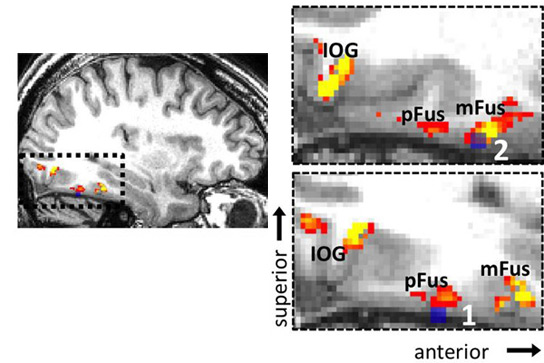
    functional-mri-scan-fusiform-gyrus
    Two locations in the brain’s fusiform gyrus respond to faces (red) but not to other objects (yellow). Credit: J. Parvizi et al., J. Neurosci, Advance Online Edition (2012)

    This feat was accomplished by the unusual collaboration between a researcher and an epilepsy patient, Ron Blackwell, an engineer in Santa Clara, California, who came to Stanford University in Palo Alto, California, in 2011 seeking a better treatment. He had been suffering seizures since his teens, and his medication was becoming less effective. Stanford neurologist Josef Parvizi suggested some tests to determine the source of the seizures. He also suggested that it might be possible to eliminate the seizures by surgically destroying a tiny area of the patient’s brain.

    Parvizi used electrodes to trace the seizures to the temporal lobe. Surgeons then placed electrodes on the surface of Blackwell’s brain to stimulate specific areas of the temporal lobe in order to determine exactly where the seizures stemmed from. Electrodes placed on the fusiform gyrus changed the facial recognition ability of Blackwell. While being stimulated, he reported seeing Parvizi’s whole face just sort of metamorphose and the electrode stimulation affected only Blackwell’s perception of faces of people he could see in person. The stimulation produced no change in Parvizi’s suit, tie, or skin color, or in other objects around the room and Parvizi’s face returned to normal when stimulation ceased.

    The scientists scanned Blackwell’s brain using functional magnetic resonance imaging (fMRI) and confirmed that the two electrodes that influenced Blackwell’s perception of faces were points in the fusiform gyrus.

    Reference: “Electrical Stimulation of Human Fusiform Face-Selective Regions Distorts Face Perception” by Josef Parvizi, Corentin Jacques, Brett L. Foster, Nathan Withoft, Vinitha Rangarajan, Kevin S. Weiner and Kalanit Grill-Spector, 24 October 2012, The Journal of Neuroscience.
    DOI: 10.1523/JNEUROSCI.2609-12.2012

    Never miss a breakthrough: Join the SciTechDaily newsletter.
    Follow us on Google and Google News.

    Brain Activity Facial Recognition Fusiform Gyrus Neurology Neuroscience
    Share. Facebook Twitter Pinterest LinkedIn Email Reddit

    Related Articles

    Stem Cells in Hippocampus React by “Listen in” on Nearby Neurons

    Images of Brain Connectivity Help Predict Intelligence

    Imbalance Between Neuronal Excitation and Inhibition May Account for Seizure Susceptibility in Angelman Syndrome

    Life Long Learning and Experiences Are Good for the Brain

    Von Economo Neuron Discovered in the Insula of Macaque Monkeys

    DRD2 May Protect Brain Regions from Alcohol-Induced Brain Damage

    Researchers Use FDDNP–PET Scanning to Predict Cognitive Decline

    Neuroscientists Create Model to Study Burst Suppression and Brain States

    Researchers Use fMRI to Study How Humor Activates Kids’ Brain Regions

    Leave A Reply Cancel Reply

    • Facebook
    • Twitter
    • Pinterest
    • YouTube

    Don't Miss a Discovery

    Subscribe for the Latest in Science & Tech!

    Trending News

    Artificial Sweeteners May Harm Future Generations, Study Suggests

    Splashdown! NASA Artemis II Returns From Record-Breaking Moon Mission

    What If Consciousness Exists Beyond Your Brain

    Scientists Finally Crack the 100-Million-Year Evolutionary Mystery of Squid and Cuttlefish

    Beyond “Safe Levels”: Study Challenges What We Know About Pesticides and Cancer

    Researchers Have Found a Dietary Compound That Increases Longevity

    Scientists Baffled by Bizarre “Living Fossil” From 275 Million Years Ago

    Your IQ at 23 Could Predict Your Wealth at 27, Study Finds

    Follow SciTechDaily
    • Facebook
    • Twitter
    • YouTube
    • Pinterest
    • Newsletter
    • RSS
    SciTech News
    • Biology News
    • Chemistry News
    • Earth News
    • Health News
    • Physics News
    • Science News
    • Space News
    • Technology News
    Recent Posts
    • Researchers Expose Hidden Chemistry of “Ore-Forming” Elements in Biology
    • Geologists Reveal the Americas Collided Earlier Than We Thought
    • 20x Difference: Study Reveals True Source of Airborne Microplastics
    • Scientists Uncover Hidden Force Powering Yellowstone’s Supervolcano
    • This Metal Melts in Your Hand – and Scientists Just Discovered Something Strange
    Copyright © 1998 - 2026 SciTechDaily. All Rights Reserved.
    • Science News
    • About
    • Contact
    • Editorial Board
    • Privacy Policy
    • Terms of Use

    Type above and press Enter to search. Press Esc to cancel.