
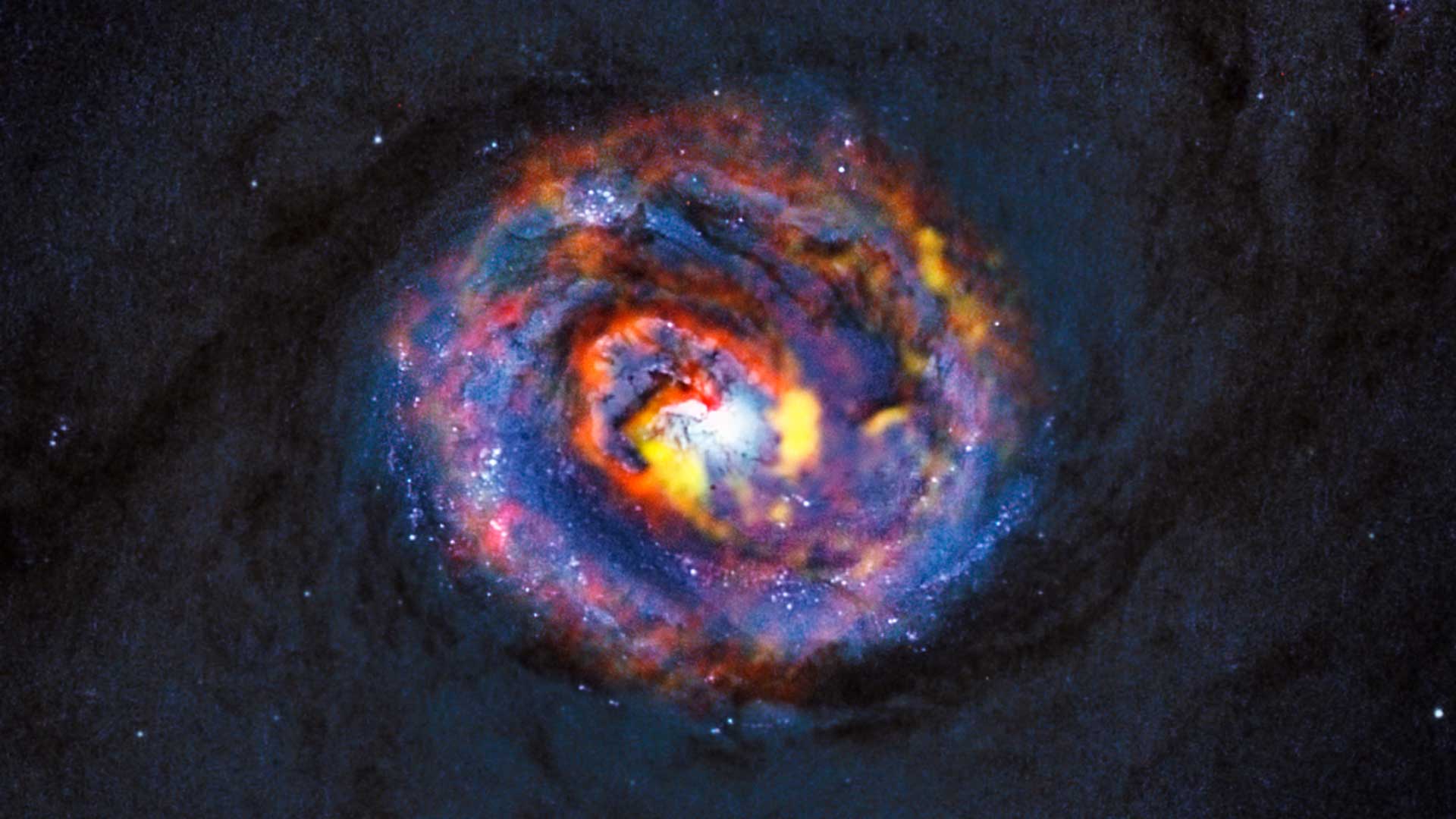
Using data from Atacama Large Millimeter/submillimeter Array, two newly published studies probe black hole jets at very different scales: a nearby and relatively quiet black hole in the galaxy NGC 1433 and a very distant and active object called PKS 1830-211.
Two international teams of astronomers have used the power of the Atacama Large Millimeter/submillimeter Array (ALMA) to focus on jets from the huge black holes at the centers of galaxies and observe how they affect their surroundings. They have respectively obtained the best view yet of the molecular gas around a nearby, quiet black hole and caught an unexpected glimpse of the base of a powerful jet close to a distant black hole.
There are supermassive black holes — with masses up to several billion solar masses — at the hearts of almost all galaxies in the Universe, including our own galaxy, the Milky Way. In the remote past, these bizarre objects were very active, swallowing enormous quantities of matter from their surroundings, shining with dazzling brilliance, and expelling tiny fractions of this matter through extremely powerful jets. In the current Universe, most supermassive black holes are much less active than they were in their youth, but the interplay between jets and their surroundings is still shaping galaxy evolution.
Two new studies, both published today in the journal Astronomy & Astrophysics, used ALMA to probe black hole jets at very different scales: a nearby and relatively quiet black hole in the galaxy NGC 1433 and a very distant and active object called PKS 1830-211.
A cosmic indigestion in the blazar PKS 1830-211, as seen by ALMA. Marti-Vidal et al.
“ALMA has revealed a surprising spiral structure in the molecular gas close to the center of NGC 1433,” says Françoise Combes (Observatoire de Paris, France), who is the lead author of the first paper. “This explains how the material is flowing in to fuel the black hole. With the sharp new observations from ALMA, we have discovered a jet of material flowing away from the black hole, extending for only 150 light-years. This is the smallest such molecular outflow ever observed in an external galaxy.”
The discovery of this outflow, which is being dragged along by the jet from the central black hole, shows how such jets can stop star formation and regulate the growth of the central bulges of galaxies [1].
In PKS 1830-211, Ivan Martí-Vidal (Chalmers University of Technology, Onsala Space Observatory, Onsala, Sweden) and his team also observed a supermassive black hole with a jet, but a much brighter and more active one in the early Universe [2]. It is unusual because its brilliant light passes a massive intervening galaxy on its way to Earth, and is split into two images by gravitational lensing [3].
From time to time, supermassive black holes suddenly swallow a huge amount of mass [4], which increases the power of the jet and boosts the radiation up to the very highest energies. And now ALMA has, by chance, caught one of these events as it happens in PKS 1830-211.
“The ALMA observation of this case of black hole indigestion has been completely serendipitous. We were observing PKS 1830-211 for another purpose, and then we spotted subtle changes of color and intensity among the images of the gravitational lens. A very careful look at this unexpected behavior led us to the conclusion that we were observing, just by a very lucky chance, right at the time when fresh new matter entered into the jet base of the black hole,” says Sebastien Muller, a co-author of the second paper.
The team also looked to see whether this violent event had been picked up with other telescopes and were surprised to find a very clear signal in gamma rays, thanks to monitoring observations with NASA’s Fermi Gamma-ray Space Telescope. The process that caused the increase of radiation at ALMA’s long wavelengths was also responsible of boosting the light in the jet dramatically, up to the highest energies in the Universe [5].
“This is the first time that such a clear connection between gamma rays and submillimeter radio waves has been established as coming from the real base of a black hole’s jet,” adds Sebastien Muller.
The two new observations are just the start of ALMA’s investigations into the workings of jets from supermassive black holes, near and far. Combes’s team is already studying other nearby active galaxies with ALMA and the unique object PKS 1830-211 is expected to be the focus of much future research with ALMA and other telescopes.
“There is still a lot to be learned about how black holes can create these huge energetic jets of matter and radiation,” concludes Ivan Martí-Vidal. “But the new results, obtained even before ALMA was completed, show that it is a uniquely powerful tool for probing these jets — and the discoveries are just beginning!”
This artist’s representation shows the gravitationally-lensed black hole PKS1830-211 and the sudden flaring seen with ALMA when material enters the base of the jet, close to the black hole itself. Orange indicates the jet seen in radio waves; green, blue, and red are the (changing) images seen with ALMA and the white flashes represent gamma rays. Credit: ALMA (ESO/NAOJ/NRAO)/I. Martí-Vidal/MERLIN (University of Manchester, Jodrell Bank Observatory, STFC)
Notes
- This process, called feedback, may explain the mysterious relationship between the mass of a black hole at the center of a galaxy and the mass of the surrounding bulge. The black hole accretes gas and grows more active, but then produces jets that clear out gas from the surrounding regions and stop star formation.
- PKS 1830-211 has a redshift of 2.5, meaning that its light had to travel for about 11 billion years before reaching us. The light we see was emitted when the Universe was just 20% of its current age. By comparison, the light from NGC 1433 takes only about 30 million years to reach the Earth, a very short time in galactic terms.
- Einstein’s theory of general relativity predicts that light rays will be deflected as they pass a massive object such as a galaxy. This effect is called gravitational lensing and, since the first find in 1979, numerous such gravitational lenses have been discovered. The lensing can create multiple images as well as distort and magnify the background light sources.
- The infalling material could be a star or a molecular cloud. Such an infalling cloud has been observed at the center of the Milky Way (eso1151, eso1332).
- This energy is emitted as gamma rays, the shortest wavelength and highest energy form of electromagnetic radiation.
References:
“Probing the jet base of the blazar PKS 1830−211 from the chromatic variability of its lensed images – Serendipitous ALMA observations of a strong gamma-ray flare” by I. Martí-Vidal, S. Muller, F. Combes, S. Aalto, A. Beelen, J. Darling, M. Guélin, C. Henkel, C. Horellou, J. M. Marcaide, S. Martín, K. M. Menten, Dinh V-Trung and M. Zwaan, 16 October 2013, Astronomy & Astrophysics.
DOI: 10.1051/0004-6361/201322131
arXiv:1309.0638
“ALMA observations of feeding and feedback in nearby Seyfert galaxies: an AGN-driven outflow in NGC 1433” by F. Combes, S. García-Burillo, V. Casasola, L. Hunt, M. Krips, A. J. Baker, F. Boone, A. Eckart, I. Marquez, R. Neri, E. Schinnerer and L. J. Tacconi, 16 October 2013, Astronomy & Astrophysics.
DOI: 10.1051/0004-6361/201322288
arXiv:1309.7486
Never miss a breakthrough: Join the SciTechDaily newsletter.
Follow us on Google and Google News.
1 Comment
How about a nice, sensible, account of what is going on with regard to the phenomenon under investigation here, one that fills in all of the blanks in our understanding:
Instead of accepting the current posit that our universe came from a ‘Singularity from Nothing’… We adopt ‘My’ approach to, ‘Creation’ which is that; EE=E=I (Electromagnetic Energy = Everything = Infinity)and that a strand of Infinity snapped and began to coil up which, over the ensuing billions of years broke down under the heat and pressure to form Neutrons/Protons and all other particles. Given that, we are well aware, EE is integral to all of what is around us then the concept of an ‘Electromagnetic Universe’ is irrefutable.