
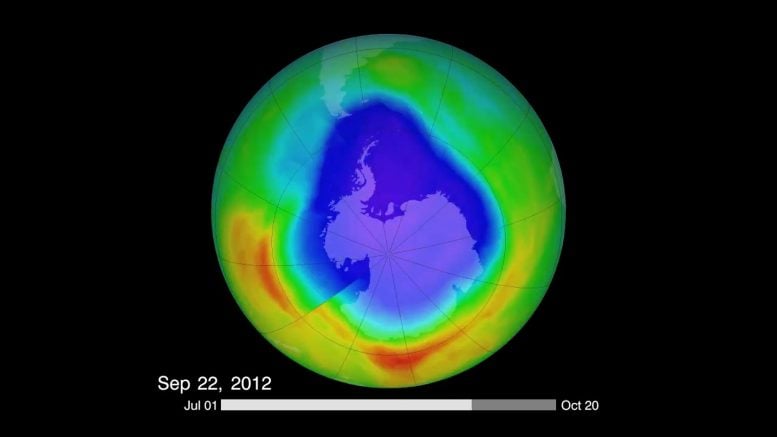
Data from NASA and NOAA satellites show that the average area covered by the Antarctic ozone hole this year was the second smallest in the last 20 years. Scientists believe natural fluctuations in weather patterns played a role in this change.
The average area covered by the Antarctic ozone hole this year was the second smallest in the last 20 years, according to data from NASA and National Oceanic and Atmospheric Administration (NOAA) satellites. Scientists attribute the change to warmer temperatures in the Antarctic lower stratosphere.
The ozone hole reached its maximum size on September 22, covering 8.2 million square miles (21.2 million square kilometers), or the area of the United States, Canada and Mexico combined. The average size of the 2012 ozone hole was 6.9 million square miles (17.9 million square kilometers). The September 6, 2000 ozone hole was the largest on record at 11.5 million square miles (29.9 million square kilometers).
This video shows the status of the ozone hole between July 1, 2012, and October 19, 2012. The hole reached its maximum on September 22, 2012. Credit: NASA/Goddard Space Flight Center
“The ozone hole mainly is caused by chlorine from human-produced chemicals, and these chlorine levels are still sizable in the Antarctic stratosphere,” said NASA atmospheric scientist Paul Newman of NASA’s Goddard Space Flight Center in Greenbelt, Maryland. “Natural fluctuations in weather patterns resulted in warmer stratospheric temperatures this year. These temperatures led to a smaller ozone hole.”
The ozone layer acts as Earth’s natural shield against ultraviolet radiation, which can cause skin cancer. The ozone hole phenomenon began making a yearly appearance in the early 1980s. The Antarctic ozone layer likely will not return to its early 1980s state until about 2065, Newman said. The lengthy recovery is because of the long lifetimes of ozone-depleting substances in the atmosphere. Overall atmospheric ozone no longer is declining as concentrations of ozone-depleting substances decrease. The decrease is the result of an international agreement regulating the production of certain chemicals.
This year also marked a change in the concentration of ozone over the Antarctic. The minimum value of total ozone in the ozone hole was the second highest level in two decades. Total ozone, measured in Dobson units (DU) reached 124 DU on October 1. NOAA ground-based measurements at the South Pole recorded 136 DU on October 5. When the ozone hole is not present, total ozone typically ranges from 240-500 DU.
This is the first year growth of the ozone hole has been observed by an ozone-monitoring instrument on the Suomi National Polar-orbiting Partnership (NPP) satellite. The instrument, called the Ozone Mapping Profiler Suite (OMPS), is based on previous instruments, such as the Total Ozone Mapping Spectrometer (TOMS) and the Solar Backscatter Ultraviolet instrument (SBUV/2). OMPS continues a satellite record dating back to the early 1970s.
The Montreal Protocol is an international treaty designed to protect the ozone layer. This video takes a look back at how scientists, industry leaders, and policymakers came together to regulate CFCs.
In addition to observing the annual formation and extent of the ozone hole, scientists hope OMPS will help them better understand ozone destruction in the middle and upper stratosphere with its Nadir Profiler. Ozone variations in the lower stratosphere will be measured with its Limb Profiler.
“OMPS Limb looks sideways, and it can measure ozone as a function of height,” said Pawan K. Bhartia, a NASA atmospheric physicist and OMPS Limb instrument lead. “This OMPS instrument allows us to more closely see the vertical development of Antarctic ozone depletion in the lower stratosphere where the ozone hole occurs.”
NASA and NOAA have been monitoring the ozone layer on the ground and with a variety of instruments on satellites and balloons since the 1970s. Long-term ozone monitoring instruments have included TOMS, SBUV/2, Stratospheric Aerosol and Gas Experiment series of instruments, the Microwave Limb Sounder, the Ozone Monitoring Instrument, and the OMPS instrument on Suomi NPP. Suomi NPP is a bridging mission leading to the next-generation polar-orbiting environmental satellites called the Joint Polar Satellite System, will extend ozone monitoring into the 2030s.
NASA and NOAA have a mandate under the Clean Air Act to monitor ozone-depleting gases and stratospheric depletion of ozone. NOAA complies with this mandate by monitoring ozone via ground and satellite measurements. The NOAA Earth System Research Laboratory in Boulder, Colorado, performs the ground-based monitoring. The Climate Prediction Center performs the satellite monitoring.
To monitor the state of the ozone layer above Antarctica, visit: https://ozonewatch.gsfc.nasa.gov/
Never miss a breakthrough: Join the SciTechDaily newsletter.
Follow us on Google and Google News.
2 Comments
“The ozone hole mainly is caused by chlorine from human-produced chemicals,…” Actually, it’s main cause is the lack of UV radiation over the south pole during the Antarctic winter. UV rays generate ozone which is naturally unstable and will breakdown. The CFC’s were causing a problem, but the scientific journalists are purposefully omitting key facts to further the environmentalist’s agenda. They want the average person to think that humans are the sole cause of this issue. They don’t want them knowing that to ozone hole is a naturally occurring phenomenon every antarctic winter.
“The ozone hole phenomenon began making a yearly appearance in the early 1980s.” This is not just misdirection, but complete bovine feces. There has been a ozone hole in that spot, that that time of year, for as long as the Earth has been spinning on a tilted axis.
Of course, if people are allowed to know the true facts they might stop funding the environmentalist industry are the “researchers” might have to get a real job.
Something else that is never mentioned, but is quite evident (red and yellow) in the picture above, is that stratospheric ozone from the tropics migrates towards the poles with what is called the Brewer-Dobson circulation. During the Winter, the ozone is unable to cross the circumpolar vortex and builds up outside, reaching concentrations greater than found in the tropical source area. When it starts to warm in the Spring and the vortex breaks up, that ozone diffuses into the interior and replaces the depleted ozone.