
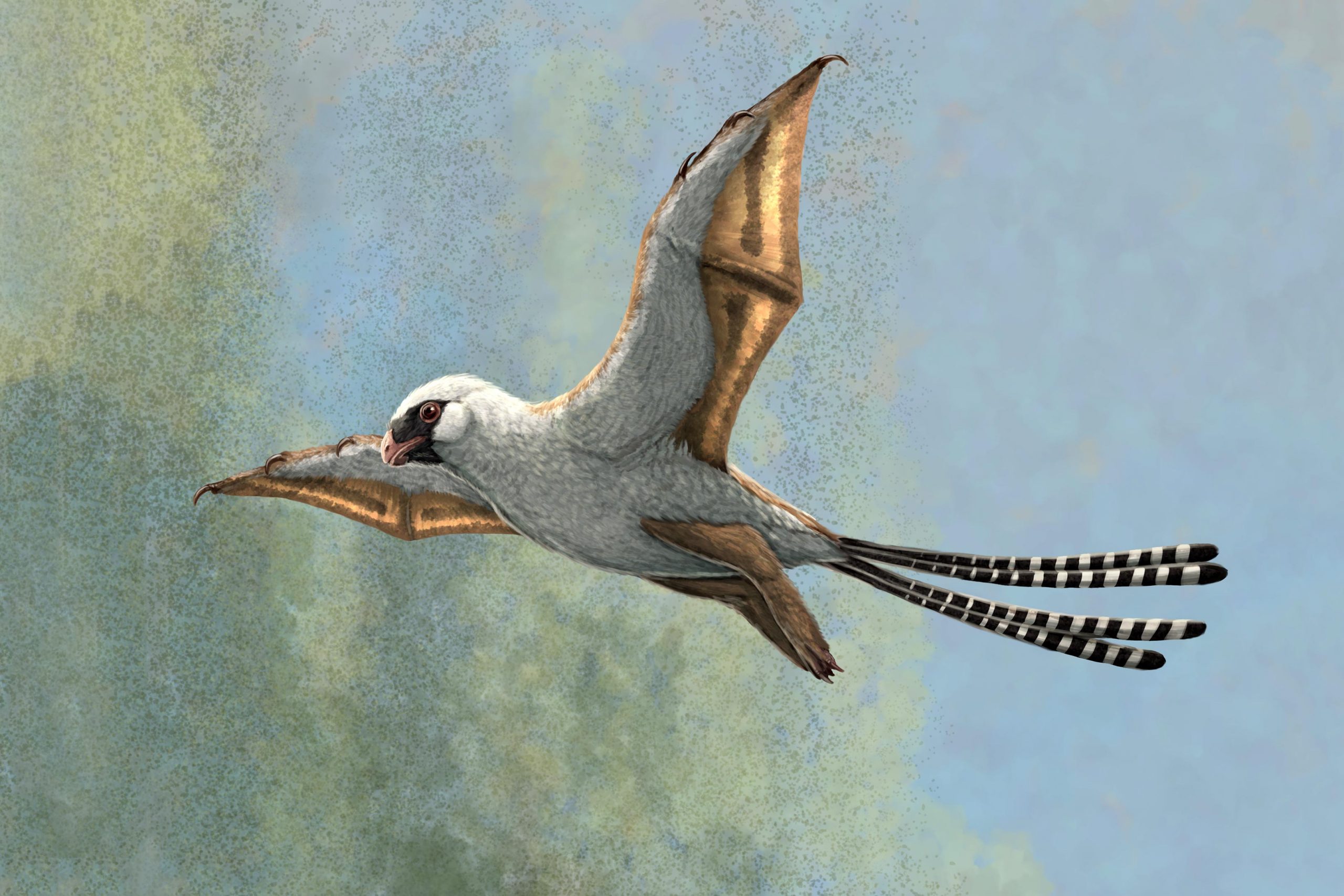
Despite having bat-like wings, two small dinosaurs, Yi and Ambopteryx, struggled to fly, only managing to glide clumsily between the trees where they lived, researchers report today (October 22, 2020) in the journal iScience. Unable to compete with other tree-dwelling dinosaurs and early birds, they went extinct after just a few million years. The findings support that dinosaurs evolved flight in several different ways before modern birds evolved.
“Once birds got into the air, these two species were so poorly capable of being in the air that they just got squeezed out,” says first author Thomas Dececchi, Assistant Professor of Biology at Mount Marty University. “Maybe you can survive a few million years underperforming, but you have predators from the top, competition from the bottom, and even some small mammals adding into that, squeezing them out until they disappeared.”
Yi and Ambopteryx were small animals from Late Jurassic China, living about 160 million years ago. Weighing in at less than two pounds, they are unusual examples of theropod dinosaurs, the group that gave rise to birds. Most theropods were ground-loving carnivores, but Yi and Ambopteryx were at home in the trees and lived on a diet of insects, seeds, and other plants.
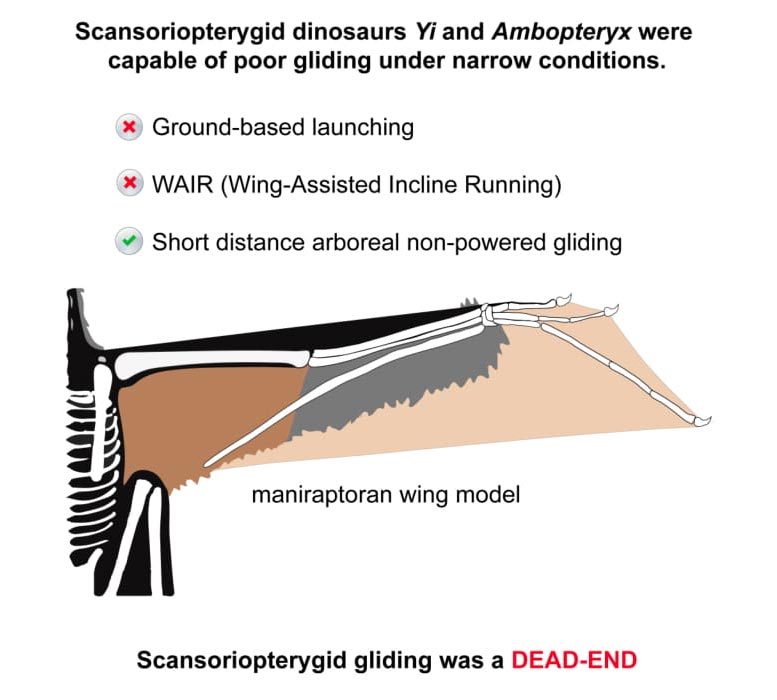
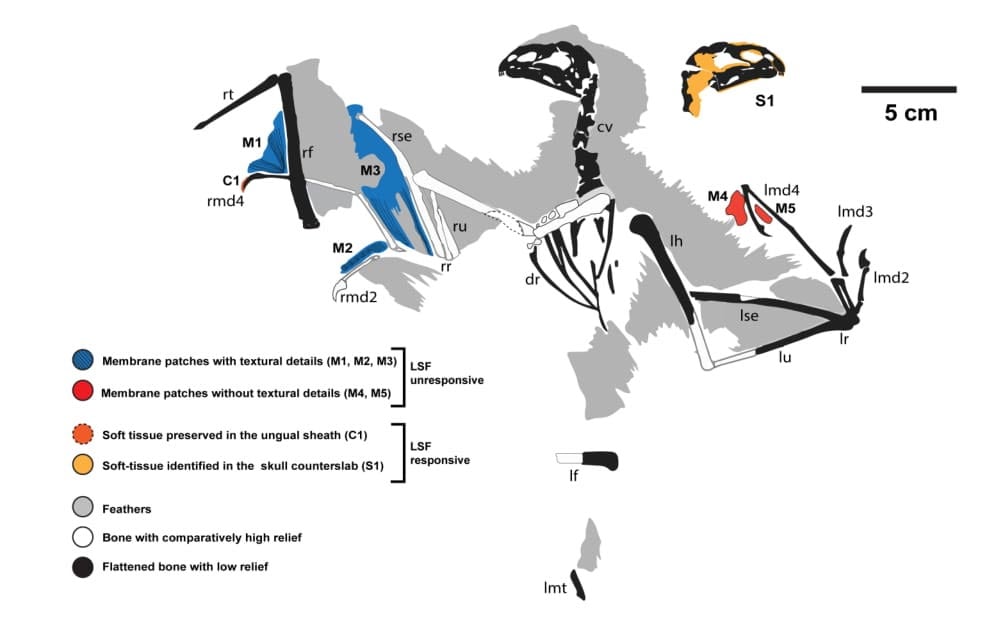
Curious about how these animals fly, Dececchi and his collaborators scanned fossils using laser-stimulated fluorescence (LSF), a technique that uses laser light to pick up soft-tissue details that can’t be seen with standard white light. Later, the team used mathematical models to predict how they might have flown, testing many different variables like weight, wingspan, and muscle placement.
“They really can’t do powered flight. You have to give them extremely generous assumptions in how they can flap their wings. You basically have to model them as the biggest bat, make them the lightest weight, make them flap as fast as a really fast bird, and give them muscles higher than they were likely to have had to cross that threshold,” says Dececchi. “They could glide, but even their gliding wasn’t great.”
While gliding is not an efficient form of flight, since it can only be done if the animal has already climbed to a high point, it did help Yi and Ambopteryx stay out of danger while they were still alive.
“If an animal needs to travel long distances for whatever reason, gliding costs a bit more energy at the start, but it’s faster. It can also be used as an escape hatch. It’s not a great thing to do, but sometimes it’s a choice between losing a bit of energy and being eaten,” says Dececchi. “Once they were put under pressure, they just lost their space. They couldn’t win on the ground. They couldn’t win in the air. They were done.”
The researchers are now looking at the muscles that powered Yi and Ambopteryx to construct an accurate image of these bizarre little creatures. “I’m used to working with the earliest birds, and we sort of have an idea of what they looked like already,” Dececchi says. “To work where we’re just trying to figure out the possibilities for a weird creature is kind of fun.”
Reference: “Aerodynamics Show Membrane-Winged Theropods Were a Poor Gliding Dead-end” by T. Alexander Dececchi, Arindam Roy, Michael Pittman, Thomas G. Kaye, Xing Xu, Michael B. Habib, Hans C.E. Larsson, Xiaoli Wang and Xiaoting Zheng, 22 October 2020, iScience.
DOI: 10.1016/j.isci.2020.101574
The authors were supported by Mount Marty University and The University of Hong Kong.
Never miss a breakthrough: Join the SciTechDaily newsletter.
Follow us on Google and Google News.
11 Comments
Unsubscribe me
“…, they went extinct …”
It is grammatically correct to say someone “went fishing,” or “went skiing.” However, “extinct” is a state-of-being, rather than an activity. Therefore, one should say “became extinct,” or “experienced extinction.” Is it any wonder that today’s scientists don’t have the prestige or respect accorded previous generations of scientists when they can’t even write grammatically correct sentences? It makes one wonder what other academic skills they haven’t mastered. Maybe some day some historian will remark about the period of time when scientists “went extincting.”
Someone “went” all pedantic.
correction … became extinct
Clyde “went” insane when he realized he was wrong. A quick Google search could have saved this epic fail at trying to look smart.
Of course, some may think that “went extinct” or “went insane” should be wrong, but consistent grammar is not a hallmark of the English language.
Yet they evolved wings which gave them a huge advantage or they wouldn’t have. This ain’t no failed experiment, no such thing in evolution, only in human notion.
What a lousy article. Journalist should not be allowed to report on science topics.
It seems as though these possibly accurate scientific observations should be tempered by human perspective. It is rather comical that the authors are discussing two million years of species survival as though that represented a form of evolutionary futility.
I fear humans might fail by comparison.
Scientists find ancient bees and claim they can’t fly
Aboat this article,I thank its moot when the english language is taught by Donald Trumpf. Think yoo.
Two million years is already much longer than the presence of Homo Sapiens. We can judge they failed much later on when human celebrate 2 million years jubile of their existance.