
Close Menu
    Facebook X (Twitter) Instagram
    SciTechDaily
    • Biology
    • Chemistry
    • Earth
    • Health
    • Physics
    • Science
    • Space
    • Technology
    Facebook X (Twitter) Pinterest YouTube RSS
    SciTechDaily
    Home»Chemistry»Molecular Nano-Machine Assembly Mimics Human Muscle Movement
    Chemistry

    Molecular Nano-Machine Assembly Mimics Human Muscle Movement

    By SciTechDailyOctober 25, 2012No Comments2 Mins Read
    Facebook Twitter Pinterest Telegram LinkedIn WhatsApp Email Reddit
    Share
    Facebook Twitter LinkedIn Pinterest Telegram Email Reddit
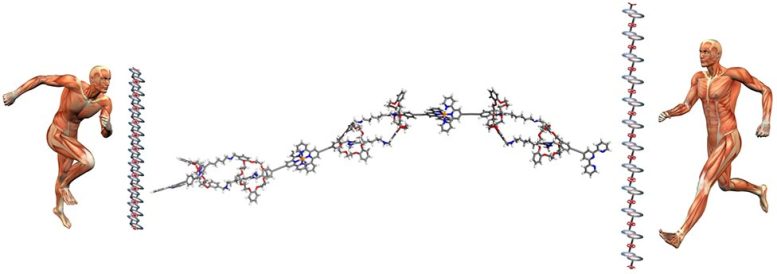
    Artificial Molecular Muscle Movement
    Artificial molecular muscle movement. Credit: Angewandte Chemie International Edition, N. Giuseppone

    An assembly of thousands of nano-machines has been put together to produce a coordinated contraction movement, extending up to ten centimeters, akin to the movement of muscular fibers. They were synthesized by a CNRS research team from the Institut Charles Sadron.

    The researchers published their findings in the journal Angewandte Chemie. Nicolas Guiseppone, Université de Strasbourg, as well as researchers from the Laboratoire de Matière Systèmes Complexes (CNRS/Université Paris Diderot) used a biomimetic approach to provide the experimental validation.
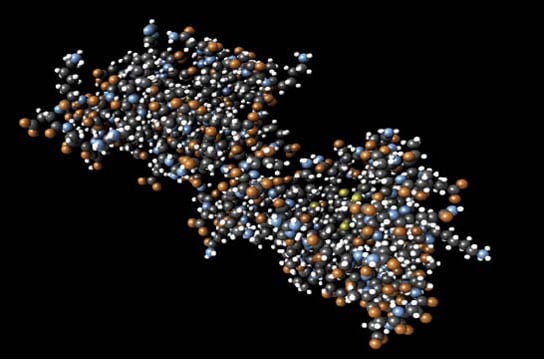
    molecular-nano-machines
    Molecular nano-machines. Credit: Monica Zoppe

    This discovery has a number of applications in nanotechnology and the field of synthesis of artificial muscles. Human muscles are controlled by the coordinated movement of thousands of proteins, which function individually only over distances of a few nanometers. When combined, these movements are amplified telescopically until they reach a normal scale.

    Synthetic chemists have made progresses in the manufacturing of nano-machines, but the coordination of these in space and time has remained an unresolved problem. Guiseppone’s team has succeeded in synthesizing long polymer chains incorporating thousands of nano-machines via supramolecular bonds. Each of these machines is able to produce linear motion of around a nanometer. The simultaneous movement allows the whole polymer chain to contract or extend over about 10 cm (4 in), amplifying the movement by a factor of 10,000.

    These results could lead to numerous applications in the design of artificial muscles, micro-robots, or new materials that incorporate nano-machines.

    Reference: “Muscle-like Supramolecular Polymers: Integrated Motion from Thousands of Molecular Machines” by Guangyan Du, Dr. Emilie Moulin, Dr. Nicolas Jouault, Prof. Dr. Eric Buhler and Prof. Dr. Nicolas Giuseppone, 18 October 2012, Angewandte Chemie.
    DOI: 10.1002/ange.201206571

    Never miss a breakthrough: Join the SciTechDaily newsletter.
    Follow us on Google and Google News.

    Bionanotechnology Cybernetics Nano-machine Nanotechnology Synthetic Chemistry
    Share. Facebook Twitter Pinterest LinkedIn Email Reddit

    Related Articles

    Unlocking the Mysteries of the Bio/Nano Interface

    New Detection System Could Dramatically Improve Early Disease Diagnosis

    Luminescent Carbon Nanoparticles Exhibit Reversible Switching in Cancer Cells

    Artificial System Models Light-Capturing Method Used by Deep-Sea Bacteria

    Zeolite Catalyst Creates P-Xylene From Biomass

    Gold Nanorods Shaped as Starfruit Deliver Impressive Results

    Gold Improves the Performance of Nanoparticle Fuel-Cell Reactions

    Researchers Develop DNA Nanorobot to Seek Specific Cell Targets

    Researchers Study the Use of Photosystem-I as Photovoltaic Panels

    Leave A Reply Cancel Reply

    • Facebook
    • Twitter
    • Pinterest
    • YouTube

    Don't Miss a Discovery

    Subscribe for the Latest in Science & Tech!

    Trending News

    Quantum Gravity May Be Far Less Quantum Than Physicists Expected

    New Tool Supercharges Immunotherapy Against Prostate Cancer

    The Hidden Cancer Risk of Ketogenic Diets

    One Asteroid Collision May Have Rocked Earth, Mars, and the Moon

    New Study Reveals Herpesvirus Infection May Accelerate Alzheimer’s Disease

    Microplastics Found in 84% of Serious Heart Attack Patients

    Why Are Bees Struggling To Survive This Summer?

    New Metal Alloy Is up to 10 Times Stronger Than Structural Steel

    Follow SciTechDaily
    • Facebook
    • Twitter
    • YouTube
    • Pinterest
    • Newsletter
    • RSS
    SciTech News
    • Biology News
    • Chemistry News
    • Earth News
    • Health News
    • Physics News
    • Science News
    • Space News
    • Technology News
    Recent Posts
    • Long COVID Brain Scans Reveal Damage to Dopamine Neurons
    • Scientists Say Eating One Avocado a Day May Lower Heart Disease Risk
    • Scientists Are Turning Empty Roadsides Into Butterfly Habitats
    • The Hotspot Beneath Hawaii Is Getting Hotter, Defying a Long-Held Geological Theory
    • Scientists Warn a Silent Oxygen Crisis Is Spreading Through Earth’s Waters
    Copyright © 1998 - 2026 SciTechDaily. All Rights Reserved.
    • Science News
    • About
    • Contact
    • Editorial Board
    • Privacy Policy
    • Terms of Use

    Type above and press Enter to search. Press Esc to cancel.