
Close Menu
    Facebook X (Twitter) Instagram
    SciTechDaily
    • Biology
    • Chemistry
    • Earth
    • Health
    • Physics
    • Science
    • Space
    • Technology
    Facebook X (Twitter) Pinterest YouTube RSS
    SciTechDaily
    Home»Biology»New Data on the Mechanism of Action of Plitidepsin in Tumor Cells
    Biology

    New Data on the Mechanism of Action of Plitidepsin in Tumor Cells

    By Paula Fernandez, PharmaMarApril 17, 2018No Comments2 Mins Read
    Facebook Twitter Pinterest Telegram LinkedIn WhatsApp Email Reddit
    Share
    Facebook Twitter LinkedIn Pinterest Telegram Email Reddit
    New Data on Plitidepsin in Tumor Cells
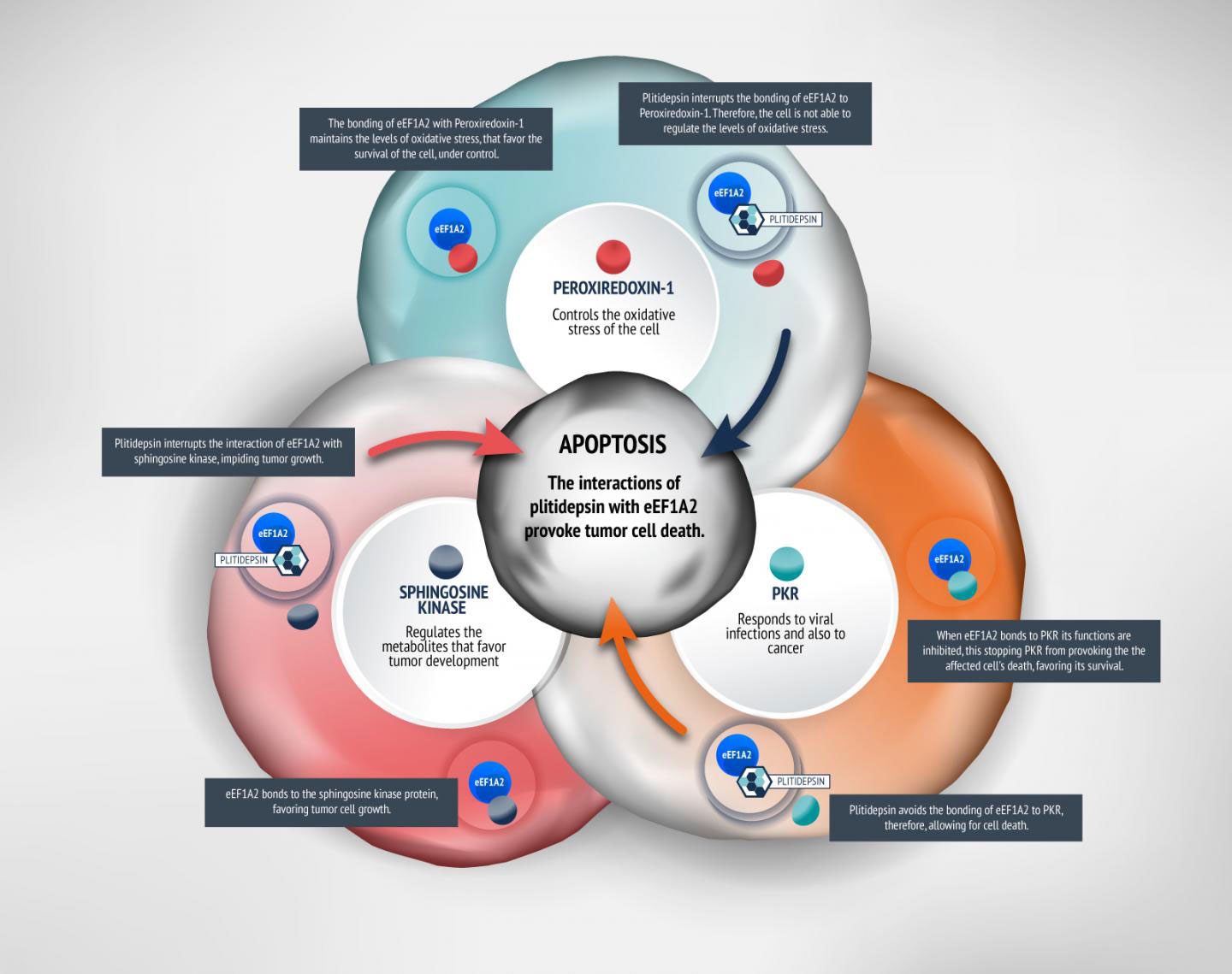
    Mechanism of action of plitidepsin. @PharmaMar 2018

    PharmaMar (MSE: PHM) has presented during the AACR meeting (American Association for Cancer Research) in Chicago new data about how plitidepsin works on the tumor cells.

    Under the title “eEF1A2 interacts with and inhibits PKR to enhance cancer cell survival”, the Company has presented the newly discovered oncogenic properties of eEF1A2, the target of plitidepsin. PharmaMar has discovered that this protein bond to the enzyme favoring in this way tumor growth. Plitidepsin inhibits this interaction obtaining the induction of cell death.

    Indeed, this is one step more in the understanding of the mechanism of action of plitidepsin. Up to today, PharmaMar has described that the target of plitidepsin is the eEF1A2 protein, over expressed in tumor cells, as in breast cancer or multiple myeloma. Through its bonding to eEF1A2, plitidepsin annuls the oncogenic properties of its target.

    For example, the bonding between eEF1A2 and Peroxiredoxin-1 controls the oxidative stress levels that favor tumor cell survival. Plitidepsin, on interrupting eEF1A2´s bonding with Peroxiredoxin-1, increases the oxidative stress levels, provoking tumor cell death.

    In the same way, plitidepsin interrupts the bonding of eEF1A2 with sphingosine kinase in the same way, an enzyme that regulates the level of the metabolites responsible for cell proliferation. The bonding of Plitidepsin to eEF1A2 inhibits the formation of the above mentioned metabolites, thus also limiting tumor growth.

    In all cases, the final consequence of these interactions of plitidepsin with eEF1A2 is the activation of a suicidal program of cells called apoptosis.

    Never miss a breakthrough: Join the SciTechDaily newsletter.
    Follow us on Google and Google News.

    Cancer Medicine Pharmaceuticals Pharmacology
    Share. Facebook Twitter Pinterest LinkedIn Email Reddit

    Related Articles

    Researchers Identify the P2Y2 Receptor Molecule as the Gateway for Metastases

    Highly Recurrent Mutations Discovered in “Dark Matter” of the Cancer Genome

    Scorpion Protein Helps Illuminate Brain Tumors

    Radiation Exposure Could Be Countered By Ingesting Ex-Rad Pills

    Magnets Used to Eradicate Cancer Cells

    New Drug CD47 Could Potentially Shrink and Cure All Tumors

    Zelboraf Nearly Doubles Median Survival Time for Patients with Metastatic Melanoma

    Cancer-Causing Mutations Disrupt Cells’ Ability to Differentiate

    Researchers Use Body’s Immune System to Fight Cancer

    Leave A Reply Cancel Reply

    • Facebook
    • Twitter
    • Pinterest
    • YouTube

    Don't Miss a Discovery

    Subscribe for the Latest in Science & Tech!

    Trending News

    Breakthrough Bowel Cancer Trial Leaves Patients Cancer-Free for Nearly 3 Years

    Natural Compound Shows Powerful Potential Against Rheumatoid Arthritis

    100,000-Year-Old Neanderthal Fossils in Poland Reveal Unexpected Genetic Connections

    Simple “Gut Reset” May Prevent Weight Gain After Ozempic or Wegovy

    2.8 Days to Disaster: Scientists Warn Low Earth Orbit Could Suddenly Collapse

    Common Food Compound Shows Surprising Power Against Superbugs

    5 Simple Ways To Remember More and Forget Less

    The Atomic Gap That Could Cost the Semiconductor Industry Billions

    Follow SciTechDaily
    • Facebook
    • Twitter
    • YouTube
    • Pinterest
    • Newsletter
    • RSS
    SciTech News
    • Biology News
    • Chemistry News
    • Earth News
    • Health News
    • Physics News
    • Science News
    • Space News
    • Technology News
    Recent Posts
    • Scientists Discover Stem Cells That Could Regrow Teeth and Bone
    • Scientists Discover Natural Molecule That Stops Alzheimer’s Protein Clumps From Forming
    • Early Cannabis Use May Stall Key Brain Skills in Teens
    • Popular Vitamin D Supplement Has “Previously Unknown” Negative Effect, Study Finds
    • Powerful Antioxidant Found To Play a Key Role in Proper Protein Folding
    Copyright © 1998 - 2026 SciTechDaily. All Rights Reserved.
    • Science News
    • About
    • Contact
    • Editorial Board
    • Privacy Policy
    • Terms of Use

    Type above and press Enter to search. Press Esc to cancel.